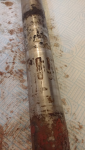
Galvanic corrrosion of stainless steel fitting?

That was what I was thinking but it seems the OP has now provided more information that may indicate electrolytic corrosion.

ColinR: is there an electrical connection between the corroded strip and the transducer? Although seawater can conduct electricity it cannot be considered as a cable or solid metal part. It seems to me from your description that bare wires in the bilge are unlikely to lead to a problem externally, but if there is a positive connection it just could be.
+1 for that. There would need to be a "Solid" electrical connection between the transducer wires and the SS strip for electrolytic action. I think that the time scales quoted are co-incidental. However as said previously on site fault finding is needed. I would dismiss nothing until absolutely sure.
 
I've no specialist knowledge here but I understood that anything above 0.01 milliamp was enough to set up electrolytic corrosion. In exploring this aspect for my lithium build I found a photo of an aluminium cased cell that was seriously compromised by stray current leaking along a seawater-soaked painted wood surface.
 
Last edited:
Whatever the source of it, the stemhead strip has been turned into a sacrificial anode with an impressed current. Little else will cause stainless steel to behave like that in seawater.
 
Sorry I should have explained that the photos show the un damaged stainless steel strip above the waterline, the corroded strip is below the water line. I struggled a bit to reduce the image resolution so I could post them, and forgot to give a proper explanation. The boat owner has been prompted by this thread to think about an issue he had with the depth sounder not working for the past couple of years. On investigation recently he found that the transducer cable which goes through the bilges, had its insulation stripped bare (mouse?) for about 15cm in the bilge, back to bare wires. This has since been fixed, but could have let to a leakage of current into the bilge over the same period that the corrosion occurred. Could this be the cause?
That was what I was thinking but it seems the OP has now provided more information that may indicate electrolytic corrosion.
+1 for that. There would need to be a "Solid" electrical connection between the transducer wires and the SS strip for electrolytic action. I think that the time scales quoted are co-incidental. However as said previously on site fault finding is needed. I would dismiss nothing until absolutely sure.
I've no specialist knowledge here but I understood that anything above 0.01 milliamp was enough to set up electrolytic corrosion. In exploring this aspect for my lithium build I found a photo of an aluminium cased cell that was seriously compromised by stray current leaking along a seawater-soaked surface.
Whatever the source of it, the stemhead strip has been turned into a sacrificial anode with an impressed current. Little else will cause stainless steel to behave like that in seawater.

It would need someone with a good understanding of electronics to look at the circuit schematic for the echo sounder to say whether or not DC leakage from a damaged transducer cable into the bilge water was possible.
The only echo sounder I have the circuit for is the old Seafarer 3, Interestingly the power on/off switch appears to be in the negative so when switched off the whole circuit, including the outer sheath of the transducer cable, will be at +12volt so long as power is supplied to it.

I disagree that a solid connection to the stem head fitting will be necessary , I believe that a puddle of seawater will be sufficient provided it is in contact with one or more of the fastening screws but there will be a similar amount of corrosion of the exposed transducer cable.

However I think I would put the idea that the cause was the mouse damaged cable onto the back burner for now and check for 12 volts between the stem head fitting and battery negative using a digital voltmeter, or multimeter, and some long leads. Do this while the boat is out of the water and mouse free. Check with all the isolating and panel switches in their normal positions when moored and with them in their normal sailing positions.
If 12 volts is found some serious fault detection will be necessary.
If nothing found then maybe, just maybe, the mouse was the cause.

BTW
It was roast pork with all the trimmings and a glass of wine followed by rhubarb crumble for lunch club yesterday. Plus some good company. All without having to do any cooking or washing up myself.
 
Last edited:
A friend has a stemhead fitting that has a stainless steel strip extending down the stem, well under the waterline. This has stayed in good condition for 30 odd years, but has become eroded with what looks like galvanic corrosion over the last couple of seasons, including the screws into the GRP. Nothing seems to have changed on board. There is a hull anode at the stern that seems to be working, one on the prop shaft that he said has to be changed mid season because it erodes quite fast. One seacock seized due to age recently so he changed all of them as a precaution, and no degradation due to galvanic action was seen. The boat is plugged into shore power with the battery on charge during the season when in its berth. One thing that has changed is the neighbouring boats. I wondered if one of these might have a bad charging setup and be causing the problem? But how to diagnose the fault? Would a multi meter between the fitting and the engine block show anything? I was was going to suggest : do not plug into shore power when not in use; fit a small hull anode at the bow; bond the fitting in question to ground; cut it off short of the waterline. Any thoughts from someone who understands this better than I would be welcome. I’m going to visit the boat today so could glean more info. Thanks!
I worked at a stainless steel plant for many years so I got a bit of knowledge on the way. Stainless is only stainless because of a thin film of oxide on its surface and this need the air in flowing water to replenish. If stainless steel is in stagnant oxygen free water, for example screwed into wet wood or grp without sealant, then it will corrode big time. As an example I once had a Prout cat which had stainless fittings holding the rudders to the skegs. On the outside surface all was well but when I withdrew the 10mm 316 bolts that went through the skegs to hold the fittings, several sheared and others had holes in them for all the world like dutch cheese. Doesnt matter what grade of commonly available stainless, dont use it below the water line unless you can avoid a stagnant water film.
 
Indeed, it's not clear what practical purpose is served by the SS strip below the waterline; I'd be tempted to trim it back to well above the WL. The stray current still ought to be traced and the fault repaired though.
 
I worked at a stainless steel plant for many years so I got a bit of knowledge on the way. Stainless is only stainless because of a thin film of oxide on its surface and this need the air in flowing water to replenish. If stainless steel is in stagnant oxygen free water, for example screwed into wet wood or grp without sealant, then it will corrode big time. As an example I once had a Prout cat which had stainless fittings holding the rudders to the skegs. On the outside surface all was well but when I withdrew the 10mm 316 bolts that went through the skegs to hold the fittings, several sheared and others had holes in them for all the world like dutch cheese. Doesnt matter what grade of commonly available stainless, dont use it below the water line unless you can avoid a stagnant water film.
That was what I thought when looking at the photographs when I thought I was looking at the grp surface after removal of the strip. However it now seems that we are seeing the exterior surface of the strip. Crevice corrosion can be ruled out on an outward-facing surface.
 
it's not clear what practical purpose is served by the SS strip below the waterline; I'd be tempted to trim it back to well above the WL.

The purpose is protection of the GRP stem when moored up against a rock, close enough to step ashore. Quite useful in that situation. If the BO never intends to do this, he might like to consider your advice.
I have had the same make of boat for a long time (and have also been active in the class association) – the Vindö models all have this SS protective strip arrangement – and I have never seen or heard of any similar corrosion problems.
As others have already said, it is also my guess that this must be related to stray current of some type.
If it was my boat, the first thing I would check would be the wiring to the sb and port side lights. The lead comes up through the deck and enters the pulpit leg through an opening in in the foot. There can be sharp edges and inadequate cable protection at several spots here.
 
It would need someone with a good understanding of electronics to look at the circuit schematic for the echo sounder to say whether or not DC leakage from a damaged transducer cable into the bilge water was possible.
The only echo sounder I have the circuit for is the old Seafarer 3, Interestingly the power on/off switch appears to be in the negative so when switched off the whole circuit, including the outer sheath of the transducer cable, will be at +12volt so long as power is supplied to it.

I disagree that a solid connection to the stem head fitting will be necessary , I believe that a puddle of seawater will be sufficient provided it is in contact with one or more of the fastening screws but there will be a similar amount of corrosion of the exposed transducer cable.

However I think I would put the idea that the cause was the mouse damaged cable onto the back burner for now and check for 12 volts between the stem head fitting and battery negative using a digital voltmeter, or multimeter, and some long leads. Do this while the boat is out of the water and mouse free. Check with all the isolating and panel switches in their normal positions when moored and with them in their normal sailing positions.
If 12 volts is found some serious fault detection will be necessary.
If nothing found then maybe, just maybe, the mouse was the cause.

BTW
It was roast pork with all the trimmings and a glass of wine followed by rhubarb crumble for lunch club yesterday. Plus some good company. All without having to do any cooking or washing up myself.
I would also check battery + Ve to -ve on the fitting, including the strip. Just in case. It should be Zero in both cases. As said previously you can rule nothing out until proven!
Lunch sound good, Just been for a filling late morning and haven't had lunch today B***** starving!
Edit:- Don't know what echo sounder but would imagine transducer would only have X frequency pulses to and from the main unit. Should not have power when not working?
 
Last edited:
Epic corrosion on 1.5" mobo shaft.
This was inside the stern gland.
Similar damage inside the "P" bracket

I know this is off-topic but can I check what kind of seal this is? I found crevice corrosion when I had a Volvo seal - especially in any season when the boat didn't move much. I haven't had crevice corrosion since using an Elice Radice with the venting tube and I would guess / hope that this allows the possibility of oxygenation of the otherwise trapped water between the seal lips.
 
Last edited:
There's risk of any stern gear getting crevice corrosion if it's unused and in relatively still water, especially in a marina or harbour where oxygen levels are lower, that's the nature of cutless bearings.
 
thanks for all these helpful comments. It gives the owner plenty to investigate. I only had one quick visit to see the boat and the extent of the corrosion. While there we did a quick check with a multi meter, between the anchor chain which was in contact with the stemhead, and ground i.e. sticking the negative probe into the ground as the boat is ashore. This with shore power on. It produced a zero reading.
 
You need to go through the boat's circuits one by one, AC and DC, and check them against the boat ground; the ground outside is not of any use in this case.
 
You need to go through the boat's circuits one by one, AC and DC, and check them against the boat ground; the ground outside is not of any use in this case.
Re. the Op's post about using the multimeter between the anchor chain and Earth (Ground) What setting was it on Ohms or volts? What range and was it on AC or DC? Was the DC system shut down and isolated? There is no Galvanic isolator fitted, so can we assume that the shore power relies purely on the Protective Earth conductor (Earth wire) in the shore supply cable with no other earth connection? What is the resistance or lack of conductivity between each link of the anchor chain, I am assuming they had paid out some chain ? Whatever, the result they got is what would be expected.
Re. penfold's post.
I rather suspect that the OP and owner have a very limited knowledge of both corrosion and electrical testing. Perfectly understandable and I say that without in any way meaning to be critical. My understanding of corrosion is that it is "Rust" Perhaps they should engage the services of an expert in corrosion (Metallurgist) ? and determine the type of corrosion. Similar applies to the electrical set up and testing. Talk to a professional. Having said that I am well aware of the can of worms and vipers nests that could be opened down that route!
 
Top