Galvanic corrrosion of stainless steel fitting?

ColinR

Well-Known Member
Joined
23 Oct 2001
Messages
583
www.victoriashadow.co.uk
A friend has a stemhead fitting that has a stainless steel strip extending down the stem, well under the waterline. This has stayed in good condition for 30 odd years, but has become eroded with what looks like galvanic corrosion over the last couple of seasons, including the screws into the GRP. Nothing seems to have changed on board. There is a hull anode at the stern that seems to be working, one on the prop shaft that he said has to be changed mid season because it erodes quite fast. One seacock seized due to age recently so he changed all of them as a precaution, and no degradation due to galvanic action was seen. The boat is plugged into shore power with the battery on charge during the season when in its berth. One thing that has changed is the neighbouring boats. I wondered if one of these might have a bad charging setup and be causing the problem? But how to diagnose the fault? Would a multi meter between the fitting and the engine block show anything? I was was going to suggest : do not plug into shore power when not in use; fit a small hull anode at the bow; bond the fitting in question to ground; cut it off short of the waterline. Any thoughts from someone who understands this better than I would be welcome. I’m going to visit the boat today so could glean more info. Thanks!
 
Not sure why you think it is galvanic corrosion? What other metal is it in contact with?

Photos would be useful to help diagnose the cause.
Thanks Vyv, I haven’t seen it yet but the owner thinks it looks like that. He is a very experienced yachtie but is asking for a view on this. The SS is not in contact with anything except GRP hull and the water when she’s afloat, so nothing else has changed that I can think of. The fitting has been fine for all these years, and suddenly this has started to happen, so something must have changed. I will get some pics later. The boat is a Vindo, a lovely Swedish ketch.
 
Thanks Vyv, I haven’t seen it yet but the owner thinks it looks like that. He is a very experienced yachtie but is asking for a view on this. The SS is not in contact with anything except GRP hull and the water when she’s afloat, so nothing else has changed that I can think of. The fitting has been fine for all these years, and suddenly this has started to happen, so something must have changed. I will get some pics later. The boat is a Vindo, a lovely Swedish ketch.

Galvanic corrosion occurs when two "dissimilar" metals or alloys are electrically connected and both immersed in ( the same pool of) seawater.
If one is stainless steel and suffering from corrosion the other must be more cathodic. There are not many likely candidates!

Electrolysis perhaps ? if there is an electrical leakage via anchor and chain from a defective windlass .......... possible but seems unlikely.

Leakage from another boat via the shorepower earth connections , the electrical system and the anchor chain ... just a possibility ?????
If the shorepower is left plugged in, in use or not, a galvanic isolator must be fitted. May be it is and it has failed

But is the corrosion on the exposed surface or between the stainless steel and the GRP. If the latter its likely to be crevice corrosion. That or stress corrosion is also what is likely to be affecting the screws

Like Vyv I'd like to see a photo or two.
 
Last edited:
Galvanic corrosion occurs when two "dissimilar" metals or alloys are electrically connected and both immersed in ( the same pool of) seawater.
If one is stainless steel and suffering from corrosion the other must be more cathodic. There are not many likely candidates!

Electrolysis perhaps ? if there is an electrical leakage via anchor and chain from a defective windlass .......... possible but seems unlikely.

Leakage from another boat via the shorepower earth connections , the electrical system and the anchor chain ... just a possibility ?????
If the shorepower is left plugged in, in use or not, a galvanic isolator must be fitted. May be it is and it has failed

But is the corrosion on the exposed surface or between the stainless steel and the GRP. If the latter its likely to be crevice corrosion. That or stress corrosion is also what is likely to be affecting the screws

Like Vyv I'd like to see a photo or two.
VicS, Not wishing to be critical of your very useful post(s) However I think the references to Galvanic Isolators can be confusing. They are only required if the Shore power is connected to the dc. wiring and with a path to earth other than the protective conductor of the supply lead. If for example an extension lead is used for shore power with no connection to anything else they are not required. Hope that hasn't confused the matter further. Regarding the OP's post. Another one that is almost impossible to give a definitive answer to with out seeing and investigating first hand.
 
If the shorepower is left plugged in, in use or not, a galvanic isolator must be fitted. May be it is and it has failed

This is not correct.

A GI is only required when the shore power Earth is connected to the boats anode bonding circuit.

If there is no such connection a GI is a waste of time and money.

Whilst it is a current requirement to have the connection, older boats were not required to have such a connection. There are countless boats out there with no such connection, no GI and no problem.
 
VicS, Not wishing to be critical of your very useful post(s) However I think the references to Galvanic Isolators can be confusing. They are only required if the Shore power is connected to the dc. wiring and with a path to earth other than the protective conductor of the supply lead. If for example an extension lead is used for shore power with no connection to anything else they are not required. Hope that hasn't confused the matter further. Regarding the OP's post. Another one that is almost impossible to give a definitive answer to with out seeing and investigating first hand.
That's true;

If there is no connection then it probably rules out anything to do with near by boats.

Gota go . Wrinklies lunch club today.
 
They are only required if the Shore power is connected to the dc. wiring and with a path to earth other than the protective conductor of the supply lead.

Perhaps a little picky of me, but that's not 100% accurate (although i get what you're saying and totally agree).

The connection to DC negative (or not) isn't the issue, it's the connection to the anode bonding circuit that matters. Some confusion was caused here due to the wording in an older ISO, regarding the requirement to provide an alternative path for the PE by connecting it to the DC negative. This was incorrect in some cases, the DC negative may be isolated. So, the requirement is for the PE to be connected to the water, in which case a GI (or isolation transformer) should be fitted.
 
The SS is not in contact with anything except GRP hull and the water when she’s afloat, so nothing else has changed that I can think of. The fitting has been fine for all these years, and suddenly this has started to happen, so something must have changed.
If the stainless strip is original (and thus similar to my Vindö 32), the strip will be part of the stemhead fitting and therefore in metallic contact with the standing rigging, aluminium spars, lifelines and pulpits... in fact most metal objects on deck and above.
If so, there is potential for current leaks from many spots where wire isolation might have failed, for instance navigation light wiring.
 
Last edited:
If the stainless strip is original (and thus similar to my Vindö 32), the strip will be part of the stemhead fitting and therefore in metallic contact with the standing rigging, aluminium spars, lifelines and pulpits... in fact most metal objects on deck and above.
If so, there is potential for current leaks from many spots where wire isolation might have failed, for instance navigation light wiring.
Just to add to the cauldron and give it a stir! For Electrolysis to take place there must be a source of electrical current, as suggested by other posts. For Galvanic action to take place two dissimilar metals must be in electrical contact. If the conditions are right. If two dissimilar metals are in reasonably close proximity. And if the conductivity of the water is right, i.e. low enough resistance, then that will, possibly, provide the electrical circuit. The conductivity can vary due to many reasons, salinity, detritus etc. So could be caused by other boats very close by. Or even a pile for a mooring or pontoon. These are only possibilities, expressed relatively simply. They do however add to the can of worms that constitutes these types of corrosion. To provide a definitive answer remotely, on line is a bit like finding the Holy grail! It really needs a lot of investigation on site by someone with a good understanding of the subject and hopefully the cause may be found. Sorry to be bit negative.
All of the above could be utter rubbish and it could be something else!!
 
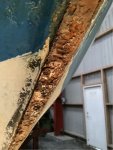
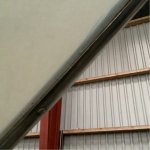
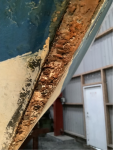
Thanks all for this interesting input. I had a look today, photos attached. There is no galvanic isolator. the corrosion in the stem fitting has taken place over the last couple of years, but I was wrong in that the shaft anode which used to erode a lot during a season, appears to have no erosion after this season afloat, it looks like new. There are no hull anode, just a couple of small ones bonded to the rudders bearings. They have eroded somewhat. 377A56AE-07EF-4CE8-A178-F543A39BA93F.jpeg97A6D2A6-8255-4738-A23E-0001F5DFDDF4.jpeg
 
Based on this photograph
1669222234419.png I would investigate the possibility of electrical leakage from a faulty, or incorrectly wired, piece of equipment on board.

Re the non corroding shaft anode . I would investigate the reason for that as a separate issue.

I would also investigate the possible need for a galvanic isolator. If there is any circuit between the shorepower earth and any underwater components fit one or don't leave the shorepower plugged in but remember it will only protect against current from very low voltage sources such as dissimilar metals. It wont stop current from the vessels DC system
 
Thanks all for this interesting input. I had a look today, photos attached. There is no galvanic isolator. the corrosion in the stem fitting has taken place over the last couple of years, but I was wrong in that the shaft anode which used to erode a lot during a season, appears to have no erosion after this season afloat, it looks like new. There are no hull anode, just a couple of small ones bonded to the rudders bearings. They have eroded somewhat. View attachment 146625View attachment 146626
I am not quite sure what you have shown us here. Is the upper photo the grp after removal of the strip?
 
I am not quite sure what you have shown us here. Is the upper photo the grp after removal of the strip?
The OP will have to confirm, but to me it is obvious that the first photo shows the severely corroded stainless strip at around water line level (blue boot stripe), the second shows the same strip, undamaged, further up towards the stem head.
 
I am not quite sure what you have shown us here. Is the upper photo the grp after removal of the strip?

I assume that because we were talking about corrosion of a stainless steel item the photo was of that item but looking at it again........ you could well be right

If so a bad case of crevice corrosion ?
 
Sorry I should have explained that the photos show the un damaged stainless steel strip above the waterline, the corroded strip is below the water line. I struggled a bit to reduce the image resolution so I could post them, and forgot to give a proper explanation. The boat owner has been prompted by this thread to think about an issue he had with the depth sounder not working for the past couple of years. On investigation recently he found that the transducer cable which goes through the bilges, had its insulation stripped bare (mouse?) for about 15cm in the bilge, back to bare wires. This has since been fixed, but could have let to a leakage of current into the bilge over the same period that the corrosion occurred. Could this be the cause?
 
I assume that because we were talking about corrosion of a stainless steel item the photo was of that item but looking at it again........ you could well be right

If so a bad case of crevice corrosion ?
That was what I was thinking but it seems the OP has now provided more information that may indicate electrolytic corrosion.

ColinR: is there an electrical connection between the corroded strip and the transducer? Although seawater can conduct electricity it cannot be considered as a cable or solid metal part. It seems to me from your description that bare wires in the bilge are unlikely to lead to a problem externally, but if there is a positive connection it just could be.
 
Top