Fuse between solar panels and MPPT controller?

My panels are not grounded as the panel framed are aluminium and mounted on a stainless steel frame mainly to prevent corrosion.

I have a circuit breakers between the regulators and each battery bank and each battery bank has a main 600 Amp fuse to protect the battery cables/bus bars.

Circuit breaker rated for the wire from regulator to the main battery bus bar.
 
I've a further question but afraid to ask (not!) - seems I started a bit of a bun fight here!

What I do take from posting on these forums is to be careful who's answers you trust, and to cross reference with other sources..... you'll learn something from the the good, bad and ugly responses.

(y)

Q: Do the panels need to be grounded?

No.
Q: Should the +/- cables from the controller (via a breaker) go direct to the battery terminals? Or can they go to the central negative bus and the positive pre-main (ANL) fuse going to the house batteries? (as shown in this diagram from Victron)
https://www.victronenergy.com/uploa...charger-12-50-1-inverter-375W-MPPT-100-30.pdf

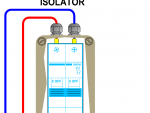
You can connect directly to the batteries, to the battery terminal of the isolator or anywhere in between that is convenient. You must not connect them after the isolator switch, as turning the switch off can damage the controller. Wherever you connect them, you fit the fuse/breaker at that point.

You will, of course, have noted that Victron do not show a fuse/breaker between the controller and the panels :)
 
This has already been discussed and the conclusion is its only an isolator breaker and not an overload breaker.
Yes, I mentioned it had been discussed in this thread. I was simply correcting Paul's statement as he said Victron didn't put a breaker in and there clearly is one in there.
 
Yes, I mentioned it had been discussed in this thread. I was simply correcting Paul's statement as he said Victron didn't put a breaker in and there clearly is one in there.


Paul said fuse/breaker and I am sure Paul meant an overload breaker which is what a fuse is in fact .

As was discussed Vectron have an isolator/breaker which is very different to a circuit breaker of a Residual current Device (breaker) as you can switch it off

An isolator/breaker is simply a switch and has no current protection capability.

You seem to be confused by the different terminology which can be confusing to the uninitiated.
 
Yes, I mentioned it had been discussed in this thread. I was simply correcting Paul's statement as he said Victron didn't put a breaker in and there clearly is one in there.

My statement didn't need any correcting. I said "fuse/breaker" which indicates a device for circuit protection, the device in the Victron schematic is an isolator, so the solar array can be isolated from the controller for maintenance purposes, it's important to isolate the controller from the panels before disconnecting the panels batteries, for instance.
 
Last edited:
My statement didn't need any correcting. I said "fuse/breaker" which indicates a device for circuit protection, the device in the Victron schematic is an isolator, so the solar array can be isolated from the controller for maintenance purposes, it's important to isolate the controller from the panels before disconnecting the panels, for instance.

Why ?

Does'nt the act of disconnecting the panels isolate the controller from them?
 
Victron are indicating a circuit breaker rather than a simple switch in their schematic. The symbol for a circuit breaker is shown on the diagram.

However, it can be difficult to find a find a switch rated for voltage produced by many modern solar panels. Circuit breakers are sometimes used as a sensible solution to this problem, despite not necessarily needing the circuit protection ability.

I think they are fundamentally suggesting that a means of easily disconnecting the solar panel input is needed. It is important with many systems to turn off solar panel output in a set order, usually the connection between the panels and the controller needs to be broken before disconnecting the battery. This can be dangerous in some systems, as the solar panel voltages can be in the lethal range, so a means a disconnecting without touching the wires is essential.

The issue of whether circuit protection is needed on the solar panel side of the controller is more complex and system dependent.
 
Victron are indicating a circuit breaker rather than a simple switch in their schematic. The symbol for a circuit breaker is shown on the diagram.

However, it can be difficult to find a find a switch rated for voltage produced by many modern solar panels. Circuit breakers are sometimes used as a sensible solution to this problem, despite not necessarily needing the circuit protection ability.

I think they are fundamentally suggesting that a means of easily disconnecting the solar panel input is needed. It is important with many systems to turn off solar panel output in a set order, usually the connection between the panels and the controller needs to be broken before disconnecting the battery. This can be dangerous in some systems, as the solar panel voltages can be in the lethal range, so a means a disconnecting without touching the wires is essential.

The issue of whether circuit protection is needed on the solar panel side of the controller is more complex and system dependent.

The picture does show some kind of symbol which I cannot see in detail

These are the recognized symbols are below

ec3741efe2749e0e3f03c7b019c33c96.jpg


I would much prefer to have a proper circuit diagram to see really what they mean.

I really don't see why here needs to be any current overload in a high impedance device and I don't see why there even needs an isolator.

There has been several posts saying its dangerous without ( there is danger of fire) but I cannot father out how and what real damage disconnecting wires can make

Its said electric shock even with 4 panels in series may be with a open circuit of something like 80+ volts DC mine max will be 20 volts

My setup has 6 x 80 watt panels via 2 regulator that feed my domestic batteries through my main isolator switch.

I also have 2 x 80 watt panels via 2 regulators direct to the battery's to jut keep trickle the batteries while we are away. We have a much higher solar intensity than the UK or even the med.

Do be careful of suppliers of over specifying requirements to increase their revenue.

Some ask Vectron why is there a overload and/or isolator between the solar panel and the regulator and why do they show a different type of circuit beaker which they is labeled a thermal device. Yet the one between panel and regulator just says isolator/breaker

The only time I would put a protection overload is if I don't have a regulator on a very small solar panel. That protection would be at the battery not the solar panel. This would be due to the very low internal impedance of the battery. You also need reverse diodes to prevent the discharge of the battery at night.
 
Last edited by a moderator:
The picture does show some kind of symbol which I cannot see in detail

I have enlarged the symbol below:
0D78CC0B-1F05-4255-83AF-99869EB84741.png

Its said electric shock even with 4 panels in series may be with a open circuit of something like 80+ volts DC mine max will be 20 volts

If you have a single “12v” panel or multiple “12v” panels in parallel there is no risk of dangerous voltages. However, as little as three “12v” panels in series will produce voltages on the input side of the solar controller at around 65v which is potentially lethal. It will at least give you a decent shock in the wrong circumstances. For high power solar panels even a single panel is likely to be capable of producing these voltages. A means of disconnecting the solar panel output without physically pulling out wires is sensible precaution, especially in a saltwater environment.
 
Last edited:
I think they are fundamentally suggesting that a means of easily disconnecting the solar panel input is needed.

That's my view too. They call the device an "isolator" for one thing, for another, if it's a system that needs fusing, that device would not fulfil the requirements if it was an overload device.
 
This topic comes up frequently.

In very simple terms if you have three or more panels the combined current of two or more panels can in some fault conditions and some wiring configurations be enough to overheat the internal wires embedded within a solar panel. A fuse between the battery and the controller will not protect against this fault, indeed there is no need for a battery connection at all, the excess current can be produced by the other solar panels in the array.

As the OP only has two solar panels in his array the above scenario will not occur so fusing on the solar panel side of the controller is not required in this case, but it is required for some installations.


That's interesting

With a 3 or more panels in series the current through can only be the maximum the one panel can produce. If a panel goes short circuit its the voltage that will drop and the current will be depending of that produced by only one of the panels (all panels n series must be the same power capacity.

If the panels are in parallel and yo get a short in the internal wiring of one of the panels the short will be zero resistance by definition so will not really produce any heat. If there is a partial short circuit the panel could would produce some voltage but lower then the others. This voltage will then reduce the possible current flowing and will have little heating effect.

The exact conditions of the fault will be needed to do proper analysis and possible heating effect.

We need to know the resistance of any partial short and the maximum current and voltage that can be produced.

Yes there is a possibility but like any fault you have the to consider the probability of it accruing in real life and the probability of if causing a dangerous condition.

Also consider the current carrying capacity of a cable no only depends on the size (resistivity of the wire) but the material of the insulation, the ambient temperature and any enclosure (conduit/trunking) the wire is enclosed in if any. This is all about the melting point of the wire insulation and the heat transfer rate from the heated wire.

Duty cycle could also be a factor in some conditions
 
My statement didn't need any correcting. I said "fuse/breaker" which indicates a device for circuit protection, the device in the Victron schematic is an isolator, so the solar array can be isolated from the controller for maintenance purposes, it's important to isolate the controller from the panels before disconnecting the panels batteries, for instance.
You mean the device labelled breaker? ?
 
That's interesting
With a 3 or more panels in series the current through can only be the maximum the one panel can produce. If a panel goes short circuit its the voltage that will drop and the current will be depending of that produced by only one of the panels (all panels n series must be the same power capacity.
If the panels are in parallel and yo get a short in the internal wiring of one of the panels the short will be zero resistance by definition so will not really produce any heat. If there is a partial short circuit the panel could would produce some voltage but lower then the others. This voltage will then reduce the possible current flowing and will have little heating effect.
The exact conditions of the fault will be needed to do proper analysis and possible heating effect.
We need to know the resistance of any partial short and the maximum current and voltage that can be produced.Yes there is a possibility but like any fault you have the to consider the probability of it accruing in real life and the probability of if causing a dangerous condition.
Also consider the current carrying capacity of a cable no only depends on the size (resistivity of the wire) but the material of the insulation, the ambient temperature and any enclosure (conduit/trunking) the wire is enclosed in if any. This is all about the melting point of the wire insulation and the heat transfer rate from the heated wire.
Duty cycle could also be a factor in some conditions

Roger, I agree of most of what you are saying, but various regulation authorities have already analysed the risk and fuses on the solar panel side of the controller are mandatory in some circumstances.

I would also suggest that a particular wire size can only conduct a maximum current without overheating. The internal wires used in solar panels are kept as small as possible to minimise shading. It can typically only conduct around twice the rated current output of the individual solar panel. The exact amount can usually be found in the specifications. If this current is exceeded, and it can be exceeded in a fault condition by two or more connected solar panels it will overheat. Overheated wires are not a good thing. Fuses or circuit breakers should be installed to eliminate the possibility.

This is all explained in the link I provided in post # 56.

It is true that with only two panels the OP does not require this protection, but this thread and many others seem to imply the fusing on the solar panel of the controller is never required. This is wrong and dangerous advice. I suspect many contributors do not mean to imply this and are responding to OP’s specific requirements of only two panels. I think we should make it clear that in some circumstances circuit protection is required on the solar panel side of the controller.
 
It's worth noting that some of the Victron schematics are no more than general guidance. They do not include fuses etc for every eventuality.

A nice little quote from Victron "Electrical system knowledge is needed for safely installing systems. a Manual for product x cannot learn you this. "
 
Top