Daydream believer
Well-Known Member
Batten tension should be just enough to remove any wrinkles & apply a slight tension to the cloth.Batten tension could be looked at.
Battens are not there to make a sail shape. Over tensioning is wrong

Batten tension should be just enough to remove any wrinkles & apply a slight tension to the cloth.Batten tension could be looked at.

Missing the point there I think.A) There is no fixed object at top of mast
B) A hydraulic backstay ram has far more power than anybody using a small halyard winch

The other option with an elderly cruising boat of dubious build quality in the first place is that the boat bends somewhere in the middleMissing the point there I think.
The more you grind on a main halyard, the more downwards load you are putting into the sheave at the top of the mast, that's the fixed point. In effect the luff of your sail and your halyard inside the mast are acting as a 2:1 tackle on the mast. So whatever tension you've ground into your halyard at the winch, you've exerted twice (excluding any friction losses) as much downward force on the top of the mast. That's compression. What the compression force does depends on a lot of things, but it's doing something. It's more than possible that in a stiff, overbuilt, cruising mast the effect is close to zero.
The backstay is doing something a little different, and again the exact effect of the backstay on your mast depends on a lot of factors, but the primary thing the backstay does when you wind it on is reduce the distance between the transom and the masthead. On masthead rigged, very stiff, straight, masts, this basically just rakes them aft. On spindly fractional rigs with pre bend and swept back spreaders this bends the mast.


In effect the luff of your sail and your halyard inside the mast are acting as a 2:1 tackle on the mast.
Yes. But consider the force on the sheave at the top. What multiple of the halyard force is acting on the sheave?No it isn't. You pull the halyard in 1m, the sail rises 1m.
Ok, I understand. Yes, twice the force on the mast, not the sail. Failure to read.Yes. But consider the force on the sheave at the top. What multiple of the halyard force is acting on the sheave?
The owner of an early 3/4 tonner called Dingo told me that when it was launched the designer came aboard & had them loosen all rigging. He then strung a taught line inside the boat from bow to stern.The other option with an elderly cruising boat of dubious build quality in the first place is that the boat bends somewhere in the middle
Er, not quite. The standing part of the halyard is not compressing the mast. Or at least only the top foot or so to the headboard. It’s a part of the reason for the arrangement. The compressive load is 1.5 x the halyard tension, plus the losses, surely.Ok, I understand. Yes, twice the force on the mast, not the sail. Failure to read.
Thrice the force on Dragonfly masts with 2:1 halyards.

Have you considered the Barton Boomstrut?It is a heavy fully battened sail - plus a very heavy boom with no topping lift. Previous boat had a gas strut in the solid kicker but with this (non Selden) mast and boom it is apparently not easy to retrofit a gas strut. (Makes tricky to open slot enough in winds below about 7kt TWS, but fortunately not racing and traveller well up helps).
Thanks. Our boom is too big and heavy for that. Had a Selden with gas strut on last boat but different mast make.Have you considered the Barton Boomstrut?

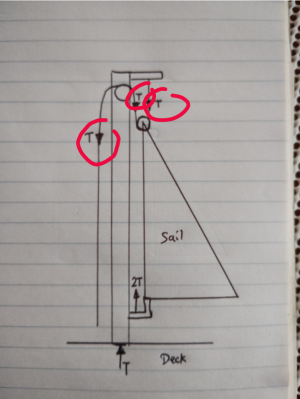
Here's my understanding with a diagram of the forces on the mast where T is the tension of the rope. Assuming no friction from the pulleys or batten cars. The mast is in 3T compression between the gooseneck and the halyard sheave. The sail is in 2T tension. This ignores the 90° turn the halyard does at the bottom of the mast. Of course the pulleys and cars do have friction and the main sheet complicates things in real life.Er, not quite. The standing part of the halyard is not compressing the mast. Or at least only the top foot or so to the headboard. It’s a part of the reason for the arrangement. The compressive load is 1.5 x the halyard tension, plus the losses, surely
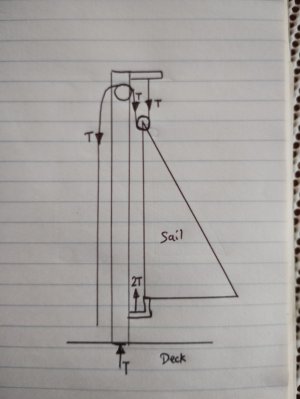
The arrows are the vertical forces exerted on the mast by the rope and the sail. At the top of the mast they all point downwards because a rope can only pull, not push.Your arrow is the wrong way between sail sheave and halyard sheave in the mast.
You have included the T exerted on the upper pulley where the halyard goes over the top. But where have you allowed for the T that is pulling on the piece extending from the crane. There are 2 Ts up there but you have only taken one downThe arrows are the forces exerted on the mast by the rope. At the top of the mast they all point downwards because a rope can only pull, not push.
Eh? There are 3 T's at the top of the mast in my diagram. Don't know why you can't see them. The mast is in compression of 3T, not 2T, because there are 3 T's pointing downwards. I have shown the forces acting on the mast.You have included the T exerted on the upper pulley where the halyard goes over the top. But where have you allowed for the T that is pulling on the piece extending from the crane. There are 2 Ts up there but you have only taken one down
However you put it the weight on the head of that sail is 2 T which is transferred down the mast not 1 T that you show
It might only take 1 T to pull it up but it still means 2 T up there
That’s what I thought, but confused myself with Angus’s diagram and lost confidence in my theoryHaving a 2:1 halyard (as I do) is about both reducing the load at the clutch, but also reducing mast compression.
If you have a halyard lock, then just pull down on the tack, then obviously the compression is just equal to the amount you pull down.
If you have a conventional halyard, then your main luff and halyard effectively make a 2:1 tackle on the top of the mast, and the compression on the mast is twice the halyard load.
If you have a 2:1 halyard as per Angus' diagram, then for a given luff tension the halyard load is 1/2. However, there are now 3 times that halved load acting on the masthead, so the compression load is 1.5 x the luff tension.
If you went to a 4:1 halyard, the halyard load would be 1/4 of the luff tension, but there would now be 5 times that load acting on the masthead. So you'd have mast compression of 1.25 x luff tension.

Cunningham is a very useful control, but even as an extremely performance minded sailor, I did not specify one on my cruising main.
Flatteners are very much "old tech" but it does sort of depend on the cut of the sail. When they were in fashion the idea was to have a really full sail, that did not flatten fully in the foot when at the black band, but be able to get it flat and inside the black band when you cranked it on.