Fulex Jamming

Mikenda

Well-Known Member
Joined
4 Jan 2004
Messages
216
Visit site
I have a Furlex 200, recently it has jammed three times when furling. The furling line jams either above or below the plastic flaps inside the drum (that are designed to help the rope furl smoothly). Furlex calls these plastic flaps "line guard". I know it is important to keep some tension on the furling line for a smooth furl, and always do. When the furling line jams above or below the flap, the drum won't turn and you are stuck with a half furled sail.
Any experience or advice appreciated.
 
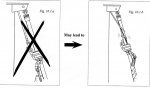
All I can suggest is that you check the angle of the lead-in which should be at right-angles to the centre of the drum.

Another possibility is that your furling is too thick and builds up on the drum so that it pops over the top or bottom of the line guard.
 
I have a Furlex 200, recently it has jammed three times when furling. The furling line jams either above or below the plastic flaps inside the drum (that are designed to help the rope furl smoothly). Furlex calls these plastic flaps "line guard". I know it is important to keep some tension on the furling line for a smooth furl, and always do. When the furling line jams above or below the flap, the drum won't turn and you are stuck with a half furled sail.
Any experience or advice appreciated.

If you have the last pulley before the furler fixed to the stanchion they have a tendency to slide upwards un-noticed. This causes the line to ride up & can cause a line to jump over the plastic part
The other point to notice is that the line goes through the stainless steel line guard & not outside it. The sail will still furl but not always - as you may have found- It could easily have been re threadled at some time & only recently jammed
 
You have my empathy. Exactly same happened to me, and it became more prevalent - as once the flap has been distorted, it is more prone to further fouling. Like you, it happened sometimes on top, and sometimes at the bottom of the flap. And yes, the lead of the rope was perfect. And there was not too much rope on the drum (used standard furlex rope).
I eventually removed the flaps, by drilling out the rivets. No problem now. I note that other brands of furlers don't have those flaps.
 
Same thing has happens to me several times each season and has caused a few near epics. On one memorable night I was single handing and had the genoa jammed out in a force 6. It took a good hour to get it sorted. It never happened on my Hood or Plastimo reefing gear. I have checked the installation several times and it conforms to the Selden diagrams in all respects. I always keep some tension on when unfurling and am using the Selden supplied line. I also noticed it seemed to be the flexible line guard which was causing the problem. I can actually get a finger between the flexible line guard and drum. There also seems to be excessive clearance between the drum and upper and lower flanges of the line guard housing. I don't understand how it happens if there is always some tension on the line. It's a poorly designed item. Is it something to do with the free turn feature on the drum. Could this allow the drum to rotate and result in a small piece of slack line becoming jammed. On re reading the instructions they mention that the flexible line guard has low friction aluminium edge protectors. Maybe these are missing.
 
Last edited:
I assisted a guy with a really nice Nic 32 in Ardglass this August.

His forestay lower fitting had unscrewed itself. He was lucky he was sailing downwind or he might have lost the rig.

The Furlex was an early model. The bearing balls had broken or worn the side of the lower track and fallen out where they jammed against the screw together lower fitting.

He put the furling line on a winch and as he furled the genoa the fitting unscrewed, separating the forestay.

Not an uncommon problem with the early Furlex-I experienced the same with my Gibsea.

As I had some experience of having one in bits and back together again, between us we managed to fake it up so it worked good enough to get him home.

Good thing he was good at going up the mast!

Woth checking all the balls are in place-if they are not, they could be the cause of the stiffness.

Good Luck!
 
In my case its not stiffness. Its a relatively new system and has done this since it was installed. Every time I find a small loop jammed under the flexible line guard.
 
In my case its not stiffness. Its a relatively new system and has done this since it was installed. Every time I find a small loop jammed under the flexible line guard.

Mine does this at times. I think that it is because there is to much rope on the drum and also due to alignment and allowing the sail to unfurl to quicklyas previously mentioned. If the drum looks full you could try to remove some of the inner core of the furling line back to where you are likely to handle it. The line should still have enough strength - well mine has so far!
 
Only 3 turns left when the sail is out so I don't think there is too much line on the drum. One thing is suspect happens though is that at the start of the furling process the high tension on the line cuts into the stack of line which is already on the drum and probably pushes it to one side and possibly causes the loop which then gets tangled. The only way to avoid this as far as I can see is to have as much tension on the line when unfurling as the anticipated furling load. This would necessitate using a winch on the sheet when unfurling which would be impracticable. As far as I can see the design is not very good if the line can get under the flexible line guard so easily. The line guard housing is currently centered relative to the drum but there does not seem to be any way to adjust the clearance. I just had another look and its actually worse than I thought the flexible line guide is not full height except for the aft 50mm or so on each side. Not sure if this is wear or as designed. The step where the height changes is acting like a hook and will catch any loose coils. Have attached a picture taken through the gap between drum and guide.
 

Attachments

  • IMAG0703.jpg
    IMAG0703.jpg
    89.2 KB · Views: 17
Last edited:
Only 3 turns left when the sail is out so I don't think there is too much line on the drum. One thing is suspect happens though is that at the start of the furling process the high tension on the line cuts into the stack of line which is already on the drum and probably pushes it to one side and possibly causes the loop which then gets tangled. The only way to avoid this as far as I can see is to have as much tension on the line when unfurling as the anticipated furling load. This would necessitate using a winch on the sheet when unfurling which would be impracticable. As far as I can see there is either a part missing or the design is not very good if the line can get under the flexible line guard so easily. The line guard housing is currently centered relative to the drum but there does not seem to be any way to adjust the clearance.

Have you got the correct angle set up?Furlex047.jpg
 
In my case its not stiffness. Its a relatively new system and has done this since it was installed. Every time I find a small loop jammed under the flexible line guard.

Please dont think I am being patronising, but are you keeping tension on the line as you furl the sail?

In my experience this is very important.

When I pull out our jib First Mate-who is helming-lets the furling line run through her hands with a bit of friction so as to get a tight wrap of the line on the drum.

Before we did this we experienced similar line wraps and loops.
 
I pay the line out with a turn round a winch to maintain tension in the same way as I used to do with the Hood and Plastimo system which never jammed. I'll dismantle the line guard next week to find out why it looks different to the one shown on the Selden drawing.
 
I just examined the flexible line guard which appears to be in as new condition and undamaged. After some experimentation the failure mechanism appears to be.
, as suspected, that when pulling on the furling line the inside coils on the drum are compressed. This sometimes throws out a small loop which can fall under the large gap at the front of the flexible line guide. As soon as the drum rotates the loop also rotates and catches on the step at the step on the aft edge of the line guide. I am at a loss to understand why the design has such a big gap between the flexible line guide and the sides of the drum at the forward end and why there is a step at the aft end. I would have thought the gap between the guide and drum ought to be much less than the rope diameter. Even if the furling line had a huge amount of tension on it when furling there are bound to be occasions when a loop forms due to random distribution of coils on the drum and the high initial load on the furling line.
 
I just examined the flexible line guard which appears to be in as new condition and undamaged. After some experimentation the failure mechanism appears to be.
, as suspected, that when pulling on the furling line the inside coils on the drum are compressed. This sometimes throws out a small loop which can fall under the large gap at the front of the flexible line guide. As soon as the drum rotates the loop also rotates and catches on the step at the step on the aft edge of the line guide. I am at a loss to understand why the design has such a big gap between the flexible line guide and the sides of the drum at the forward end and why there is a step at the aft end. I would have thought the gap between the guide and drum ought to be much less than the rope diameter. Even if the furling line had a huge amount of tension on it when furling there are bound to be occasions when a loop forms due to random distribution of coils on the drum and the high initial load on the furling line.

If the inner coils are being compressed enough to produce loops, then the furling line is not loaded enough when it is being wound on the drum.

Unless fairly strong tension is applied your problem is likely to occur every time you use the jib.

My two 'pennyworth anyway............................
 
Just had a very prompt reply from Selden. They acknowledge the problem and recommend removing the flaps if they are causing a problem with a particular application. As Venus1 has already done. They have deleted them from their latest model.
 
Last edited:
Just had a very prompt reply from Selden. They acknowledge the problem and recommend removing the flaps if they are causing a problem with a particular application. As Venus1 has already done. They have deleted them from their latest model.

Flaps or not-it appears your coils on the drum are too loose-how will removing them address this?

Not critisism, just interested.
 
The main point is that there is a big gap and step on the flexible line guide which acts as a hook and can catch even a very small loop. In addition the flexible line guide is sprung against the coil so that it is rubbing against it all the time and can catch even a small irregularity. The tension on the furling line when unfurling the sail would have to be at least as high as the load necessary to say furl a fully out genoa in a force 6 to stop small loops forming when applying the furling load to a fully wound line drum. With a load this high you would have to winch out the sail which would put a lot of load on the system. Removing the flexible line guide would mean that the system would be much more tolerant to small loops forming. I have quite a large genoa and tend to leave reefing late as the boat is very stiff. I sometimes need both hands to get the first few turns on so the problem I have been having may not affect other people. It has been a fairly consistent problem for me though. You will see the problem if you look closely at the drum when it is full of line and tug on the furling line. I hope this helps the OP and anyone else who has had this problem.
 
Top