Fuel transfer at sea ?

+1 for the jiggle syphon, I timed mine emptying a pint glass in 6 seconds, including the jiggle.

It's quick, clean (minimal drips on removal) but most importantly, simple.

But then I doubt I'll ever fill up at sea more then a handful of times during my life.
 
Last edited:
I think you need to tackle the root cause which is to increase the size of tank(s).
My Mirage 28 was fitted with a 20gal tank which meant I could motor for a couple of days continuously. Admittedly I never had to but it was a reasurance. The downside is of course the large amount of fuel stored overwinter which could develop bugs. A reasonable endurance would be about 12 -18hrs I would say.
+1 for the jiggle syphon, I timed mine emptying a pint glass in 6 seconds, including the jiggle.

It's quick, clean (minimal drips on removal) but most importantly, simple.

But then I doubt I'll ever fill up at sea more then a handful of times during my life.
 
I have a smallish diesel fuel tank (27l) and a selection of funnels/filters all neatly tied to the tank. It's a system which works well when alongside, but I'm wondering what is best practice when refuelling at sea. Spare fuel is in a couple of 10l plastic cans, with a 25l steel jerry can option.

The donk consumes 3l/hr at 3000 rpm, and about 1.4l/hr at 2000 rpm. Even with a full tank, that's a range of 9 hours at decent revs , giving a range of 45 miles before a top-up is needed

OPTIONS

1 Pouring into funnel

2 Plain plastic oral suction/syphon

3 Jiggle syphon

4 Electric transfer pump

5 Manual transfer pump

5 Air compression transfer pump


1, 2, 3 all require the can to be above the fuel tank, and there is no really secure nook or cranny I can tie the can to if solo. Even with a buddy and lots of absorbent blue paper roll, there's a (demonstrated) risk of some fuel spillage or overfilling.

4, 5, 6 would mean I could secure the can on the cockpit deck while operating the elec, manual, or air pump. Also I can keep an eye on the level in the fuel filler tell tale.

At the moment I am favouring the air pump route, for which I need a spare can cap with an air IN tube, and a fuel OUT tube. Easy enough to make up and store on board, and a manual air pump would be independent of any power requirement . fuses, switch, etc.


Alternative suggestions, and comments please on achieving a clean and quick RAS :)
Crossing Biscay, sloppy sea with 2 mtr swell, the filler is on the top of the sugar scoop. I roped the 5 gall bidon to the pushpit, I have a simple piece of pipe with a stick tie wrapped to one end. The stick end goes in the bidon, the stick is to keep the end of the pipe at the bottom of the bidon. The other end of the pipe goes in the filler hole and is jammed in. Then a small piece of small pipe is put alongside the stick end pipe in the bidon and a piece of rag is used to seal the bidon and pipes opening. A quick puff of air by mouth in to the short piece gets the siphon running. The stick is used to chase the last bit of diesel at the bottom of the bidon. A simple piece of kit, most important, easy to clean and store. Nothing worse than a complicated bit of kit dribbling diesel when its put away.
Stu
 
Crossing Biscay, sloppy sea with 2 mtr swell, the filler is on the top of the sugar scoop. I roped the 5 gall bidon to the pushpit, I have a simple piece of pipe with a stick tie wrapped to one end. The stick end goes in the bidon, the stick is to keep the end of the pipe at the bottom of the bidon. The other end of the pipe goes in the filler hole and is jammed in. Then a small piece of small pipe is put alongside the stick end pipe in the bidon and a piece of rag is used to seal the bidon and pipes opening. A quick puff of air by mouth in to the short piece gets the siphon running. The stick is used to chase the last bit of diesel at the bottom of the bidon. A simple piece of kit, most important, easy to clean and store. Nothing worse than a complicated bit of kit dribbling diesel when its put away.
Stu

Sounds like a very good idea. Also available as a product:
https://www.waterlinedesign.eu/products/1690-siphon-pump-blow-start
 
Why is anyone with a 9 hour range wanting to refuel at sea?
I can see a few different needs.
One is a flat calm channel crossing or similar.
The other is some sort of rough weather when best progress must be made.

In flat water, most things will work, but in rough weather, I don't fancy anything that relies on open containers, siphons, funnels etc.

A partial solution on one of my boats, a second filler cap directly on top of the tank. So the tank can be dipped, sampled etc, and filled from the shelter of the locker where the tank is. Maybe less chance of the sea getting in, but obviously you have to think about where any spills are going.
The closest I got was pouring in a couple of 5l cans (normal halfords type of thing) just to be sure I wasn't going to run out while entering harbour and mooring up.

We often fill from cans, it's less hassle than taking the boat to the fuel pontoon. A couple of 10 litre cans with a spout. With care it's a couple of squares of kitchen roll and one disposable glove.
 
Why is anyone with a 9 hour range wanting to refuel at sea.

Back in the 80s we had a wauquiez gladiateur, 33' with VP md11c. Fuel tank approx 17 gallons so we reckoned on 25 hours safe continual running from full. Normally fine, and we carried further 12 gallons in plastic cans, buried as low as possible in a cockpit locker.

Couple of times we sailed to France from home port in N Ireland, trekking from strangford to Scillies in one go. Coming back the second time, about an hour out from Scillies we entered a fog bank and saw practically nothing until about 10 miles south of strangford lough. Scary experience, with no radar and only Deccan and rdf nav, but that's another story. Winds were light and we had to end up motoring all the way, almost 48 hours.

We had a simple system which others have already described, using a small submersible pump and length of hose. Filler in the cockpit beside the tiller. We wanted a system which would be cause minimal hassle while underway, did not require lifting and manoeuvring heavy cans while underway. Fuel cans stayed in the locker and the pump did the work. Small submersible pumps are so cheap now, would only have jiggle type as back up.
 
I have an old car pump. A length of hose is fitted to one end and the other a hose which is permanently connected to the return line to the fuel tank. There is a filter fitted after the pump. Thus when I need to top up the main tank I drop the other end into a fuel can in the storage locker, flick a switch and watch the leve rise and turn off. It works for me,I never fuel through the deck fitting.
 
Surprised no one has suggested heaving to, which would make the process easier....... there, fixed that :)

Heaving to implies that the OP is sailing, so would have less need to top up his tank. Or is your suggestion that he should put the sails up, stop motoring, heave to, top up the tank, unheave to, take the sails down then resume motoring?:confused:
 
Heaving to implies that the OP is sailing, so would have less need to top up his tank. Or is your suggestion that he should put the sails up, stop motoring, heave to, top up the tank, unheave to, take the sails down then resume motoring?:confused:

Maybe that's a little unfair. When we had a boat with a small tank we would top it up before nightfall if it was low - even if sailing well at that moment. We'd be hoping for another calm before dusk but if that didn't happen then we would do it under sail
 
Heaving to implies that the OP is sailing, so would have less need to top up his tank. Or is your suggestion that he should put the sails up, stop motoring, heave to, top up the tank, unheave to, take the sails down then resume motoring?:confused:

Sigh, Did you really just write that?
Perhaps I did mean if the OP is sailing, or motorsailing, or perhaps my comment was stupid, as you imply.
 
General reply to assorted suggestions and questions.

Resumé: Tank capacity 27l, 3l/hr at 3000 rpm and 5kts = 45miles. That's a third of the way across from Roscoff to Plymouth.

Even with two crew I have managed to spill diesel using a good funnel system and lots of paper roll in calm sailing weather. That may be incompetence or system failure, but I do not like the idea of manoeuvering a 25l steel container above the coaming, and pouring into a funnel, or using a syphon system. The control of start/flow/stop is imprecise and risky.

That seems to leave the jerry can needing to be secured in the cockpit, and an electric, manual, or air pressure pump to transfer up to the fuel filler. Though there is a 12v socket in the cockpit, I am not happy to rely on 12v being available as part of the worst-case planning.

There's a cheapo manual pump on ebay

http://www.ebay.co.uk/itm/Hand-Siph...618091?hash=item25e00b2a6b:g:Ad0AAOSw6NhZuTOe

which claims to pump fuel or air, so could be set up as per Cap Clueless' excellent photo in post#16. Estimating the dimensions at 25 mm diameter and length of 250mm from the picture and the advert, I come up with a delivery of 125cc per stroke: that's 200 strokes to empty a 25l can of diesel, so it looks like about 8 minutes to transfer, plus some prep and tidy up time. In the context of sitting on a sailing boat in the middle of the Channel, that's acceptable.

I am going to order the ebay pump, and as I regularly transfer diesel to an assortment of farm vehicles, will do some testing re transfer times and take some pics. There's always the question of failure of the pump seals, so I shall also look at those.

Thanks again for your help and suggestions :)
 
General reply to assorted suggestions and questions.

Resumé: Tank capacity 27l, 3l/hr at 3000 rpm and 5kts = 45miles. That's a third of the way across from Roscoff to Plymouth.

Even with two crew I have managed to spill diesel using a good funnel system and lots of paper roll in calm sailing weather. That may be incompetence or system failure, but I do not like the idea of manoeuvering a 25l steel container above the coaming, and pouring into a funnel, or using a syphon system. The control of start/flow/stop is imprecise and risky.

That seems to leave the jerry can needing to be secured in the cockpit, and an electric, manual, or air pressure pump to transfer up to the fuel filler. Though there is a 12v socket in the cockpit, I am not happy to rely on 12v being available as part of the worst-case planning.

There's a cheapo manual pump on ebay

http://www.ebay.co.uk/itm/Hand-Siph...618091?hash=item25e00b2a6b:g:Ad0AAOSw6NhZuTOe

which claims to pump fuel or air, so could be set up as per Cap Clueless' excellent photo in post#16. Estimating the dimensions at 25 mm diameter and length of 250mm from the picture and the advert, I come up with a delivery of 125cc per stroke: that's 200 strokes to empty a 25l can of diesel, so it looks like about 8 minutes to transfer, plus some prep and tidy up time. In the context of sitting on a sailing boat in the middle of the Channel, that's acceptable.

I am going to order the ebay pump, and as I regularly transfer diesel to an assortment of farm vehicles, will do some testing re transfer times and take some pics. There's always the question of failure of the pump seals, so I shall also look at those.

Thanks again for your help and suggestions :)


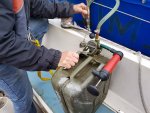
That link is to the same type of pump that I used in my set up.
In my first attemps I tried using it to pump diesel, but it was very messy, as fuel seemed to come out everywhere.

In my second attempt only air goes through the pump into the top of the can.
The outlet pipe which comes up from the bottom of the can, through the special cap, has a 15mm domestic plumbing type ball valve on its outer end.

The ball valve has a few inches of 15mm copper water pipe connected to each end. The shorter one allows connection to the hose. The longer one with a suitable bend makes a perfect spout.
I also made a new longer handle for the valve, to make it easier to use while being thrown about.

It's not perfect yet, as the only valve holding the air pressure in the can is the pumps clack. In practice a few good strokes starts fuel flowing but it needs someone continuing to pump slowly to keep up with losses of air. A decent clack in the air supply pipe would solve this.

It would have been much simpler to use a 12v submersible pump but non of the ones I've seen will fit through a standard "jerry can" neck. I've tried syphon pumps and Jiggle pumps, but they are useless unless the can is elevated.

The air pressure system will happily lift fuel from the can on the cockpit floor up to the deck filler some 3 feet higher.
In the picture the can is on the seat, but at sea I would normally leave it on the floor.

John
 

Attachments

  • Refueling.jpg
    Refueling.jpg
    96.5 KB · Views: 1
Top