Fuel tank leak

I'll take my Land Rover over a French boat thank you very much :mad:

:p

What I would check is the return line for over pressure and squirting from a connection. 60 litres is about an hours run time which as far as I can tell is around your usual fare.
I thought that but the connections are dry to the touch. But everything will be rechecked by myself today and tomorrow.
It’s the timing of the diesel discovery. For example when there was just a cupful of diesel in the bilge, the boat smelled like it. But with thirty litres it really stinks. And that stink happened after I nipped up the return hose and it was dry to the touch.
Plus, when it was in the water I ran the engine (upto high revs) with me in the engine room and I’m sure I would have seen it squirting at high pressure. I was looking for it
 
further if I got that right, boat on the hard, engine not turned on, and still new diesel comes up in the bilge...
That is the situation. All power is off. I’m going in a few minutes to see if there is even more. If there isn’t it could mean that it was just diesel setting in the bilge or the level of oil is now below the hole. So nothing is truly diagnostic unless I find an actual hole. If I can’t find a leak then I’m back to square one
 
But with thirty litres it really stinks. And that stink happened after I nipped up the return hose and it was dry to the touch.

Ah, the manly aroma of unburnt diesel in the bilge. Good luck with that. It took several gallons of a bubblegum smelling bilge cleaner for my family to get back on and I only lost a couple litres down there when the racor seal failed.
 
Ah, the manly aroma of unburnt diesel in the bilge. Good luck with that. It took several gallons of a bubblegum smelling bilge cleaner for my family to get back on and I only lost a couple litres down there when the racor seal failed.
Full of good news today aren’t we?‍♂️
Just came from the boat (will post photos later). Another one litre after two days. All evidence is pointing to the tank. A major job if there ever was. Tomorrow we’ll go talk to the Beneteau shop and get their opinion (I’m actually very nervous, it could cost anything...).
Impossible to see the bottom or sides or the other face of the tank. It’s right up against a bulkhead that’s covered in sound deadening foam. To get access it in order to drill from the other side will require removing loads of trim and having nerves of steel. And for what? Is it simpler to just take the tank out without actually finding the source ? And what’s the technique, engine out? And the logistics of getting the boat to their yard. And the cost. And do we upgrade the tank?
Lots to keep we awake tonight
 
How easy or difficult is it going to be to remove the tank?

Engine out will be my guess. Will they do it insitu? I don’t think so. Because of the design of the boat it will take lifting with a very long reach. I don’t think our yard will have it. So how do I get the boat to them in winter? Nightmare
 
Engine out will be my guess. Will they do it insitu? I don’t think so. Because of the design of the boat it will take lifting with a very long reach. I don’t think our yard will have it. So how do I get the boat to them in winter? Nightmare
It's a boat and everything is always installed in such a way as to maximise grief when something goes wrong. I had a leaky tank years ago and it was a pain. I did find the leak eventually, pinhole near a bottom corner but adjacent fibreglass sealed it most of the time until it grew larger. It was an engine out job but at least I could design a better replacement (decent sump etc.)

I wouldn't be surprised if it was punctured by a screw through a bulkhead as already suggested. Impossible to be 100% certain but I think you are correct about a leaky tank. Good luck and I hope it turns out to be an easier fix than you expect.
 
I would steady up a bit and not think about removing the tank until you have the source of the leak ----- stain the fuel in the tank with UV dye this company sells the dye and the detector

Engine Oil and Fuel Leak Detection Dye - [RA-RLD4]

Alternatively if you can completely drain the system down there is a means of locating leaks using a smoke generating machine which you might be able to hire from a garage or buy off ebay there are machines that are specific to the task,

third method is to introduce helium into the fuel tank and use a helium detector to sniff out the leak, Helium is used for this purpose in engineering because its a small molecule that finds leaks easily.

my best bet is on UV dye!! good luck!!
 
Last edited:
Full of good news today aren’t we

Hey, just telling it like it is. Once you have a bit of oil in the bilge it's a begga to get out. You can clean the engine bay until you happy to eat off of it. Next bit of water you get and a nice thick film of it floats down in a bed of dust and fluff on top like you never bothered to clean it. I'll spend two days on the hard scrubbing my bay and no sooner go to sea than find a film of it again and have to throw down a spill kit. Eventually you get it clean and then next season accidentally drop an oil filter changing it or something equally stupid and get to weep tears of frustration again. At least oil doesnt stink like diesel. Try having a sweet meat buffet and some wine in the fog of fumes that is diesel bilge. It's nasty man! Just nasty. Go to sea in it and you'll be down to strawberry jam sandwiches and told in no uncertain terms you no longer cut a romantic figure etc etc. as your better half is doubled over the side in misery.
In the mean time you will go to bed tonight thinking about the next litre or 10 you'll face in the bilge and wish you had a Land Rover ? ?
 
I would steady up a bit and not think about removing the tank until you have the source of the leak ----- stain the fuel in the tank with UV dye this company sells the dye and the detector

Engine Oil and Fuel Leak Detection Dye - [RA-RLD4]

Alternatively if you can completely drain the system down there is a means of locating leaks using a smoke generating machine which you might be able to hire from a garage or buy off ebay there are machines that are specific to the task,

third method is to introduce helium into the fuel tank and use a helium detector to sniff out the leak, Helium is used for this purpose in engineering because its a small molecule that finds leaks easily.

my best bet is on UV dye!! good luck!!
Thanks for that. That will keep me occupied during my sleepless nights?
 
On the upside, engine out and fuel tank out is a great opportunity for a spring clean and fresh paint all round. Look like @MartynG and feel really good about your nice new shiny bilges and sparkly clean freshly painted engine. Silver clouds and all.
 
On the upside, engine out and fuel tank out is a great opportunity for a spring clean and fresh paint all round. Look like @MartynG and feel really good about your nice new shiny bilges and sparkly clean freshly painted engine. Silver clouds and all.
My bilge is (was) clean and my engine looks new
There is no upside
 
I posted this link on Lucas Gan thread with his leaking tank. This seems the way to go for a boat tank that you have to remove engine and or superstructure. If you look on their website they have a step by step for inserting a bladder into an existing tank. You look to have enough room.http://atlinc.com/marine.html
 
3E977FCD-A23B-490A-B978-396C4FECE2CE.jpeg
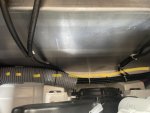
Is the yellow highlighted strip wet ?
Talc it today after drying . Report back in 2/3 days .

Mark on a pic the exact location of the last 2 L .

I can see your oil drain pump in one pic , but save guessing
 
That looks like a VERY difficult job if the tank needs to come out. Engine out isn't trivial and it looks as if the tank sits on or close to the hull behind a raised GRP frame. There might be room to lift it over the frame and slide it aft under the engine access hatch. However, it doesn't look like there would be any room to turn it for removal.

It isn't unusual for these frames to have a hole on one side and liquid then drains through and appears in the bilge from limber holes in other frames. That's exactly what happens on my boat.

It does look as if everything exits the tank from the top as you'd expect and therefore no reason for any leak when engine is off. I'm seeing engine feed (with shut-off valve), return, generator feed and sensor wires.

It seems that you are looking for a pretty slow leak of approx. 1ml every 3 minutes, based on your last figures. I assume you have run a dry tissue over the three hoses and they are all dry for their full length. You should be able to find the leak on engine or generator with a dry tissue. I'd expect around 2-5 drips every minute somewhere. If the base of the engine and generator are bone dry that would make a tank leak more likely. I've found kitchen roll very useful in tracking down some leaks (wedged, wrapped , tied or taped in place). You can then try dye or Helium if the tank seems to be the only thing left. Only problem with dye is that it will appear quickly from a tank leak but eventually work through to a leak elsewhere and not really help discount a tank leak. I think you'd need to monitor frequently and note time taken for the dye to appear.

All guesswork from the pictures but I hope you follow the logic. Feel free to pick holes in it as that might produce additional information.

One final thought. The feed pipe has a valve and I'd be surprised if that leaked. I can't imagine the return line goes to a dip pipe and that means it can't syphon from the tank. The generator feed pipe would really be the only one of the three that's likely to allow fuel to syphon out of the tank.
 
Last edited:
I do not like the raw tank ( even though it’s shaped ) just siting on the inside of the hull .
It should be strong enough to sit on mounts like your engine bearers and suitably “ insulated “ considering Al tank standards and held down with a couple of adjustable straps .

I am after seeing these pics reverting back to hull flex / poor blocking / after your last lift …….Adverse forces passed on to the tank .
If it was mounted as I describes in para 1 ^^ any hull flexing would not be directly passed on to the tank .There would a little give through the seperate bearers , mounts and straps to accommodate inevitable hull flexing .

IF the yellow line gets wet with fuel .
We need to establish its that .
 
View attachment 126284
Is the yellow highlighted strip wet ?
Talc it today after drying . Report back in 2/3 days .

Mark on a pic the exact location of the last 2 L .

I can see your oil drain pump in one pic , but save guessing
In actual fact the bottom of the tank is vee shaped. And the center is the lowest point. We cleaned before and it didn’t look like it’s had fuel on it but I have put some white powder and will check it in two days time.
The whole fuel tank should be on a liner, in which case that is the only place it could flow through. But here’s the problem....it would fill the bilge under the engine first, and that can hold at least a litre or more. But it’s dry (it used to fill now it doesn’t).
There is a possibility that the fiberglass, gel coated liner has a drain hole in it or there’s a gap behind it and the fuel is going straight to the hull.
No matter how I look at it logically, there is always a mystery. And until I can see under and behind the tank, I can’t be certain
 
I posted this link on Lucas Gan thread with his leaking tank. This seems the way to go for a boat tank that you have to remove engine and or superstructure. If you look on their website they have a step by step for inserting a bladder into an existing tank. You look to have enough room.http://atlinc.com/marine.html

Very interesting, I will study this
 
Top