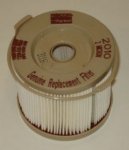
Fuel filters - why are there two?

>Every time the subject of fuel filters comes up, KellysEye claims that it's very important they have a bypass valve. Then somebody asks him what the valve is for, and he never answers.


Sorry it's oil filters not fuel filters.
Thanks for owning up to your mistake - I assumed that you'd misread the topic.
 
No idea... :) I'm not Racor, I don't make em!!

Maybe the disc is frangible, set to fracture at a certain deltaP? The instructions don't say how it works or is used.

Just showing that some fuel filters do have a bypass feature.
 
No idea... :) I'm not Racor, I don't make em!!

Maybe the disc is frangible, set to fracture at a certain deltaP? The instructions don't say how it works or is used.

Just showing that some fuel filters do have a bypass feature.

I was thinking that Racor is one of the best filters on the market.
But this do not make sens.

Bypass on a fuelfilter?
explain this to me!please:confused:
racor.jpg

where is it?
 
Last edited:
The engine mounted one is supplied as standard to protect the injection pump and injectors. A second one is (usually) fitted by the installer. I've removed the element from the engine mounted one as it would be almost impossible to change it at sea. The remaining (primary) filter is easily accessible and is fine enough to protect the engine. If I had room, I would fit a coarse filter upstream of it in an accessible position, but I don't (have room).
Also the engine mounted (secondary) filter is a proprietary Volvo Penta and quite expensive.

This a most unwise thing to do. It will certainly void the warranty on any injection components. The tolerances on injection components are very fine and stuff that will waltz through the primary filter will damage and may even cause a seizure in the injection components.

You would be wise to replace it and make modifications to be able to change it. N.B. I have seen engines that have run 5000 hours with out changing the secondary filter.
 
dont forget the lift pump will need checking most have a simple gauze element and no matter how clean your tank is, what you put into it may not be.
If for example you were to leave your fuel line empty over time, if their copper or there's any metal fittings, corrosion may occur due to the eletrolitic action of the different materials. Best practis is to flush the system through after layup with clean fuel to purge any thing out. I'm always selling new jets for zenith and solex carbs because the jets have corroded.
An aglomerator is a wonderful thing all the water and rust / sediment which is heavier than the fuel sinks to the bottom back in the early 1900's carburetters used to have them fitted at the fuel inlet point of the carb. I think I still have a few early bronze carbs which have them as a standard fitting and part of the carb. Zenith's used to sell seperate ones their very small and rare these days but I have one some where in the pile
 
It takes a lot of filter elements to pay for injection equipment
If halve the rubbish written in this thread ended up in any fuel system you would be in bleeding trouble
 
dont forget the lift pump will need checking most have a simple gauze element and no matter how clean your tank is, what you put into it may not be.
If for example you were to leave your fuel line empty over time, if their copper or there's any metal fittings, corrosion may occur due to the eletrolitic action of the different materials. Best practis is to flush the system through after layup with clean fuel to purge any thing out. I'm always selling new jets for zenith and solex carbs because the jets have corroded.
An aglomerator is a wonderful thing all the water and rust / sediment which is heavier than the fuel sinks to the bottom back in the early 1900's carburetters used to have them fitted at the fuel inlet point of the carb. I think I still have a few early bronze carbs which have them as a standard fitting and part of the carb. Zenith's used to sell seperate ones their very small and rare these days but I have one some where in the pile
On my MD22 the lift pump is on top of the engine and sucks thru the primary filter so it sucks clean fuel
S
 
Im not worried about warranties my engine is forty years old! I have listened to forum wisdom though and will put a new element in. If it blocks, I'm stuffed and will have to sail my way out of trouble.
 
I was thinking that Racor is one of the best filters on the market.
But this do not make sens.

Bypass on a fuelfilter?
explain this to me!please:confused:
View attachment 47474

where is it?

The bypass is usually a knock out disk which you can remove as a last ditch save your life action when the primary filter is totally blocked.basically removing the element from the system you can then proceed on your secondary filter only.
only to be used in emergency once you've depleted your supply of spares
I think Leaving the filter in situ rather than just removing it helps the turbine feature of the racor filter remove some of the contaminates
 
Im not worried about warranties my engine is forty years old! I have listened to forum wisdom though and will put a new element in. If it blocks, I'm stuffed and will have to sail my way out of trouble.

Why not move the filter to a more accessible spot. Fabricate a bracket for it and repipe. It is only low pressure circa 7 psi so easy to do.

I would regard being able to change filters as a safety item.
 
The secondary is part of the engine afaik. The primary is nicely gettatable hence my earlier plan to take the element out of the secondary.
The pressure is negligible as there is no lift pump and the tank level is about 300mm above the secondary filter.
 
Last edited:
The secondary is part of the engine afaik. The primary is nicely gettatable hence my earlier plan to take the element out of the secondary.
The pressure is negligible as there is no lift pump and the tank level is about 300mm above the secondary filter.

It's rarely the secondary that gets blocked anyway. I guess to take the secondary out of the system you're going to have to butcher a filter to remove the filter element then fit it to the engine. Could you add a new secondary somewhere else (i.e a suitable spin on filter)?
 
The bypass is usually a knock out disk which you can remove as a last ditch save your life action when the primary filter is totally blocked.basically removing the element from the system you can then proceed on your secondary filter only.
only to be used in emergency once you've depleted your supply of spares
I think Leaving the filter in situ rather than just removing it helps the turbine feature of the racor filter remove some of the contaminates

:encouragement:
 
Re access to the engine-mounted filter; when I bought my boat it had been recently re-engine with VP D1-20. When the time came to do my first oil/filter change I discovered that access to the filters on the starboard side of the engine was difficult to impossible. My solution was to make a square cut-out in the fore-and-aft panel separating the head from the engine space. This was sized to suit a commercially available hatch.
 
lpdsn, I could effectively take the secondary out of the system by removing the element but some contributors to this thread say that would be suicidal.

I think lpdsn was suggesting that you might disable the engine filter and instead fit a remote alternative to it somewhere more accessible, not get rid of secondary filtration altogether.

Am I losing my wits or has no-one made the obvious point about the OP's question?: as well as often including a water seperator, the primary filter is coarser than the engine filter. At least, that's been the case on the engines with which I've been the most familiar. As well as offering two-stage filtering, to some extent the preference for a coarser primary filter is mandated by the lower pressure of fuel in that part of the system: there may not be sufficient pressure for a fine filter to deliver sufficient fuel for the engine.

A Parker/Racor technical document has this to say:
Racor’s 2 micron filter medium should only be used in final or secondary filters where the fuel is first filtered by a primary filter. The primary filter for a 2 micron final filter should use a 10 micron medium.
The exception in using a 2 micron filter in place of a primary filter is to obtain high-efficiency water separation, and is usually used in marine applications where the fuel supply may be cleaner but also may contain water more often. If the installation can allow the use of a filter large enough, then a 2 micron filter can serve in a system as the only filter in that system.
 
I think lpdsn was suggesting that you might disable the engine filter and instead fit a remote alternative to it somewhere more accessible, not get rid of secondary filtration altogether.

Am I losing my wits or has no-one made the obvious point about the OP's question?: as well as often including a water seperator, the primary filter is coarser than the engine filter. At least, that's been the case on the engines with which I've been the most familiar. As well as offering two-stage filtering, to some extent the preference for a coarser primary filter is mandated by the lower pressure of fuel in that part of the system: there may not be sufficient pressure for a fine filter to deliver sufficient fuel for the engine.

A Parker/Racor technical document has this to say:
Racor’s 2 micron filter medium should only be used in final or secondary filters where the fuel is first filtered by a primary filter. The primary filter for a 2 micron final filter should use a 10 micron medium.
The exception in using a 2 micron filter in place of a primary filter is to obtain high-efficiency water separation, and is usually used in marine applications where the fuel supply may be cleaner but also may contain water more often. If the installation can allow the use of a filter large enough, then a 2 micron filter can serve in a system as the only filter in that system.

I was wondering about that too. The element in my primary filters (2 parallel Racors) is 30 micron, which is what my Yanmar dealer supplies. Never had a problem with dirty secondary filters.
 
Top