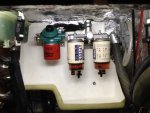
Fuel filter / seperator location

FirstAway

Well-Known Member
Joined
4 Apr 2004
Messages
107
Location
Durham
Visit site
In my Hanse 350 the primary diesel filter / seperator is located underneath the bunk in the starboard cabin, right next to the diesel tank. This is awkward to get to at the best of times, but I think would be very difficult to drain if it had to be done in a rough sea.
I would like to improve the access by relocating it into the engine bay, which would entail raising it about 20 or 30 cm.
Can anybody foresee any problems with this setup?
Grateful for your thoughts.

Bob
 
I have done this. I also fitted a primer bulb so that I could do the filter change and prime the system all from the same point. Be aware, though, that if your filter is above the fuel level in the tank there will be negative fuel pressure in the filter, so any leaks will not be obvious.
 
Thanks Neil, yes I agree the primer bulb is a great idea and will incorporate that.
Currrrently unless the tank is full, the filter is above the fuel level anyway, so I guess I am already living with that.

Bob
 
In my Hanse 350 the primary diesel filter / seperator is located underneath the bunk in the starboard cabin, right next to the diesel tank. This is awkward to get to at the best of times, but I think would be very difficult to drain if it had to be done in a rough sea.
I would like to improve the access by relocating it into the engine bay, which would entail raising it about 20 or 30 cm.
Can anybody foresee any problems with this setup?
Grateful for your thoughts.
Move it to an easily accessible location in the front of the engine compartment. Guess what we did last winter. :D
 
Move it to an easily accessible location in the front of the engine compartment. Guess what we did last winter. :D

I moved my unit to the engine room because the old system had over the years soaked the ply backing pad and cabin sole with diesel. The engine room area is in effect the same arrangement except behind the access panel. If the engine has an enclosed sump it can help catch any spills. Also I had space in my engine compartment.

Other adjustments that can be made at the moving time: install a large drip pan device under the filters to make spills easy to contain. Some on here have made GRP trays that hang off the rear mounting bolts, make sure the bowls are heat resistant, not all older models were, the bulb has been mentioned, fit a vacuum gauge and if possible mount the vacuum gauge remotely using suitable extension hose (kits available form ASAP). Also a good time to consider upgrading to twin filters and having isolation valves so that a change out can happen with the engine running.
 
Another vote for this very useful modification :)

Note that in many cases you can also move the filter that comes attached to the engine - it's mounted there for installation convenience, not because it has to be to work. Leave it plumbed the same but with slightly longer hoses and you can put it on the bulkhead with the main filter(s).

A quick changeover valve (ours has been needed twice now after bad fills, once urgently in the mouth of Portsmouth Harbour) can give peace of mind - manufactured ones can be quite pricey but they can also be made cheaply from individual valves and lengths of tube for a slight increase in bulk.

A vacuum gauge tee-d into the line between the lift pump and the off-engine filters will indicate when they are starting to block so that the engine starting to splutter isn't the first you know of it. These are not expensive.

A drip tray of some kind under the filters will make it quicker and easier to change them - mine is designed to hold a plastic jug into which the old filter and its contents can be dropped:
 

Attachments

  • fuel-filters.jpg
    fuel-filters.jpg
    110.4 KB · Views: 2
Top