Fuel filter question

misterjenkins

Well-Known Member
Joined
14 Dec 2015
Messages
75
Visit site
Our boat Kite has a beta 20, with a Lucas type primary filter.

Yesterday we had the engine cut out on us, with next to no wind. It was clearly fuel starved, so replaced the filters, still nothing. After a lot of investigation, we discovered a blockage in the head of the filter housing, which I couldn't shift as no way to poke anything through the bit where the blockage was. It needed to be blown through with an air line, so as more tide than wind where we were, we ended up getting a tow.

Clearly the cause of this is some nasty fuel bug, but the fact that I could get a blockage in the filter head that couldn't be cleared without an air line (due to the arrangement of tubes within the filter head) feels like a design flaw.

So, my question: is this a known weakness of Lucas filters? Would something else be less prone to a similar issues?

(I understand that the root cause of this is improper treatment of the fuel. I've been using a bottle of treatment I 'inherited' which clearly has had no effect. I'm upgrading my fuel treatment also)
 
I've never heard of a blockage in the cast head of the CAV-type filter, and indeed diesel bug residue is usually a bit black and gelatinous, so it'll gradually block the filter but I wouldn't expect it to block the passages in the filter head.

It would be worth checking whether there's a metal mesh filter on the bottom of your fuel pick-up pipe in the tank. These can get clogged by diesel bug too.
 
@Sandy - the filter itself looked clean. I replaced it at the start of the year and the last one also came out clean, which is why I didn't think I had a problem.
 
clearly you have fuel bugs lurking in the water bottom of your tank........ if there is enough water the bugs will form a raft of debris floating on the water under the fuel.................... at sea this could break up and come through with the fuel and yes it will block the filter head...its is not a symptom of bad design more symptom of how much fuel bugs you have..,get to work drain the water, clean the tank then dose with biocide... dosing with biocide now will kill the bugs but you have to physically remove the bodies!!! Perhaps the legacy biocide was working but you have not been doing the other jobs.......its all a matter of house keeping.
 
@freebe thanks, yes. I understand both the cause and the treatment. My question was whether other filter designs would be less prone to a blockage in the head without ever showing significant residue in the filters?
 
@freebe thanks, yes. I understand both the cause and the treatment. My question was whether other filter designs would be less prone to a blockage in the head without ever showing significant residue in the filters?

I don't think so, they all have fairly small passages.
 
@freebe thanks, yes. I understand both the cause and the treatment. My question was whether other filter designs would be less prone to a blockage in the head without ever showing significant residue in the filters?
the passages in the filter head are approximately the same diameter as the inside of your fuel lines its just that they turn sharp corners to send the fuel in the required direction, most filters will be the same unless. you step up a few sizes to larger filters then the ports will be bigger diameter to cope with larger fuel flows this could do no harm but it will cost, you will have a Christmas tree of plumbing parts to step and step down each side of the filter and its bit sledge hammer to crack your biological walnut..,
 
  • Like
Reactions: pvb
Coming at the problem from a different direction, if you could see inside the tank you wouldn't have to guess what state the fuel is in, whether the fuel treatment is working or whether the filter or lines might get blocked, in whatever part of the system that might happen.

FLB-1 Inspection Hatch | Tek-Tanks
 
@Catalina36 we have an inspection hatch, and as part of solving this issue we drained the tank, opened it up and cleaned it. There was brown residue on the walls of the tank. So definitely bug in there.

Further investigation shows that the filter head was connected so that fuel flowed down through the central channel of the filter and back up through the filter itself. This seems wrong to me, but the filter head doesn't allow flow in the other direction.e Very confused by that.
 
A good few years ago, after a bumpy trip, my fuel filter blocked a few yards short of No 4 buoy in the entrance to Portsmouth Harbour. After a fairly traumatic entry into the harbour under sail, ably assisted by a Britanny Ferry coming the other way, I went to a car breaker and got a matching pair of spin-on filters. A few bits of plumbing from ASAP and a couple of hours work later and I had twin filters in parallel, with the ability to switch between them in seconds. It's a system I would strongly recommend. Of course, since I've had the ability to change to a new filter quickly and easily, I've not had any need to. I run on one filter, with the other primed and ready to go. Annual maintenance is limited to swapping over to keep the taps working. I changed filters after 10 years because the old ones were getting rusty.
 
Further investigation shows that the filter head was connected so that fuel flowed down through the central channel of the filter and back up through the filter itself. This seems wrong to me, but the filter head doesn't allow flow in the other direction.e Very confused by that.

That's incorrect for a CAV-type filter. The fuel should flow through the filter first, then go up the central channel to the engine. There are usually arrows cast into the filter head to show which are the in and out connections.
 
Standard CAV configuration, it does allow the potential for the heavier crud caught by the filter to fall and be visible in the glass bowl below.

It isn't. The fuel should flow through the filter first, as this tends to agglomerate any minute drops of water into larger drops which will fall to the bottom of the bowl.
 
The name of the game is really to keep the tank clean enough that the filter can cope with all the crud that can possibly reach it.
 
A good few years ago, after a bumpy trip, my fuel filter blocked a few yards short of No 4 buoy in the entrance to Portsmouth Harbour. After a fairly traumatic entry into the harbour under sail, ably assisted by a Britanny Ferry coming the other way, I went to a car breaker and got a matching pair of spin-on filters. A few bits of plumbing from ASAP and a couple of hours work later and I had twin filters in parallel, with the ability to switch between them in seconds. It's a system I would strongly recommend. Of course, since I've had the ability to change to a new filter quickly and easily, I've not had any need to. I run on one filter, with the other primed and ready to go. Annual maintenance is limited to swapping over to keep the taps working. I changed filters after 10 years because the old ones were getting rusty.

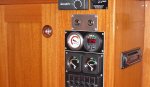
My old HR had twin primary filters, with taps so you could select one or the other, or both. I also fitted a vacuum gauge on the main switch panel, which gives lots of warning if a filter is starting to clog up.

vacuum.jpg
 
@pvb that's what I thought, flow in the top and back up the centre, but the arrows indicate the reverse. The filter head also has a manual integrated priming pump that has a one way valve, only allowing flow in what we both assume to be the wrong direction ?
 
Top