
Fridge Thermostat

Norman_E

Well-Known Member
Joined
15 Mar 2005
Messages
25,017
Location
East Sussex.
Visit site
My fridge has two compressors. The Johnson Controls thermostat in the photo controls the water cooled mains compressor that drives the big cooling plate in the fridge, not the 12 volt one with the Danfoss controller shown in the photo. The fridge works well except that with a digital thermometer at the bottom of the fridge it goes down to minus 1 C before the compressor switches off, and up to plus 6 C before it comes back on.

I cannot find any instructions or diagram of the works of the thermostat, but would like to reduce the temperature difference between open and closed. Does anyone know how? Changing the thermostat would be a right royal pain, probably involving considerable surgery on the boat to get the old one out and a new one in as its routed inaccessibly beneath the fridge.
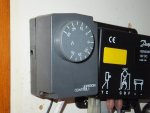
tn_DSCF3511.jpg
 
Some mechanical thermostats have a differential adjustment facility, which can reduce the range of temperature between switch off and switch on. You'd need to take the cover off and have a look.
 
The fridge works well except that with a digital thermometer at the bottom of the fridge it goes down to minus 1 C before the compressor switches off, and up to plus 6 C before it comes back on.

A fridge should be around 5C. So yours is working from a health food point. I would have thought if you try to reduce the range your battery load will increase as the compressor cycles more than necessary. Only my opinion.

Most fridges that use a mechanical thermostat have the thermostat installed in side the fridge to have better control over the temperature range. If it is mounted out side the thermostat works to a point but is also subjected to ambient temperature on the mechanism of the thermostat.
 
Last edited:
The 'stat probe needs to be on the cooling plate/evaporator.

You may find a screw or two that you can adjust, one will adjust the temperature and the other the temp' differential. Be aware though that if you set the difference too small the compressor may not like starting under the pressure.
 
The 'stat probe needs to be on the cooling plate/evaporator.

You may find a screw or two that you can adjust, one will adjust the temperature and the other the temp' differential. Be aware though that if you set the difference too small the compressor may not like starting under the pressure.

Forgive me if I'm missing something but... Is the cooling plate the thing that cools the fridge? If so, wont the temperature of this be much lower than the temperature than most of the rest of the fridge? and, if so, wont the compressor shut off long before the fridge reaches the target temperature?
 
Forgive me if I'm missing something but... Is the cooling plate the thing that cools the fridge? If so, wont the temperature of this be much lower than the temperature than most of the rest of the fridge? and, if so, wont the compressor shut off long before the fridge reaches the target temperature?

The thermostat sensor should normally be attached to the cooling plate.
 
The end of the probe is close to, but not touching the cooling plate. The issue is that the compressor will run for hours on end, then shut off for several more hours, often as much as 12 hours off before it restarts. I will open up the thermostat to have a look later.
 
The end of the probe is close to, but not touching the cooling plate. The issue is that the compressor will run for hours on end, then shut off for several more hours, often as much as 12 hours off before it restarts. I will open up the thermostat to have a look later.

Do you have an ordinary cooling plate, or an accumulator?
 
Forgive me if I'm missing something but... Is the cooling plate the thing that cools the fridge? If so, wont the temperature of this be much lower than the temperature than most of the rest of the fridge? and, if so, wont the compressor shut off long before the fridge reaches the target temperature?

Yes, it will obviously be cooler. You set the stat to turn off at x degrees cabinet temp, the plate will be cooler, but that doesn't matter.
 
Last edited:
Forgive me if I'm missing something but... Is the cooling plate the thing that cools the fridge? If so, wont the temperature of this be much lower than the temperature than most of the rest of the fridge? and, if so, wont the compressor shut off long before the fridge reaches the target temperature?
Yes. The stat probe should never be affixed to the plate, it is controlling the space temperature and the plate has to be a few degrees cooler when the compressor is on or there will be no heat transfer.

The point about a time delay between cycles is to allow the hi and lo sides to equalise pressure otherwise the start up loading on the compressor could be excessive, and could shorten its life.
 
Accumulator plates (sometimes called holding plates) contain a volume of a eutectic mixture which effectively gives a store of coldness which is released over a period. This can reduce the cycling of the fridge compressor dramatically.

I was thinking you were referring to the other type of accumulator.
 
Both Waeco and Isotherm say that the thermostat sensor should be attached to the cooling plate.

And Penguin/Frigoboat.
Just installed a Penguin system. The instructions are very explicit that the thermostat sensor should be attached to the evaporator plate: "The tip of the capillary should be in touch with the evaporator surface for at least 7.5mm". They even supply a liitle keeper designed to accomplish just that. Can't say what's required for a holding plate.

Some of the nomenclature used in this thread seems a bit confused. There's holding plates/accumulator plates; and evaporator plates. The former are quite thick and, as said, 'store' coldness, much like a domestic storage heater in reverse; the latter are quite thin, often bent into 'L' 'U' or hollow box shapes, and ribbed. They (or rather the compressor they're attached to) cycle on an off.
 
Top