Fridge aesthetic outer layer finish?

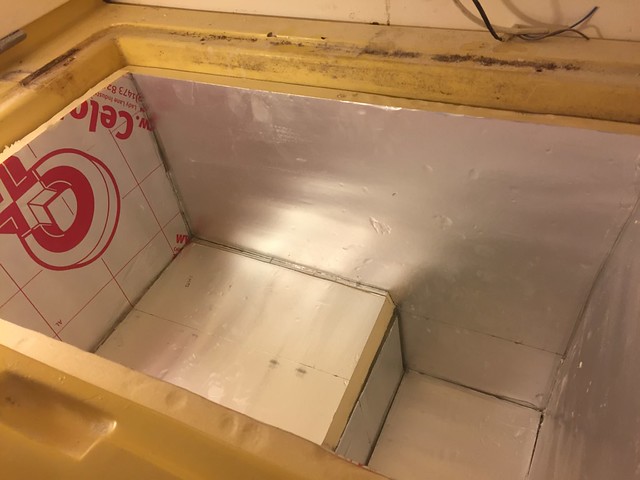
Update, went to boat and started dremelling part of the inner of the cool box to make more space and found that it was already insulated with 40mm of foam... Result!

So rather than go more complicated I added another 25mm of internal insulation, filled some of the gaps lets by the builders with expanding foam and glassed it all in.

Pretty happy with the results, will see what it's like when dry and painted.
 
50mm sorry, builders merchant stuff. might be 80mm. Not thought about putting 5 inches (125mm) in...
Had considered something like acrylic as the final layer, access is ok - not the best - kind of tucked under an overhang, but certainly something I can work at.

In Australia they would say the minimum is four inches insulation and preferably five inches. The inside of the box must be glass smooth using "flowcoat" as the OP said. (I think I used two pot epoxy). Lucky I have a refrigeration tradie who has installed fridge/freezers on boats in Darwin (tropical) helping me. He looked at what I am doing and was critical on several aspects: one was that I would never be able to clean it properly.
 
In Australia they would say the minimum is four inches insulation and preferably five inches. The inside of the box must be glass smooth using "flowcoat" as the OP said. (I think I used two pot epoxy). Lucky I have a refrigeration tradie who has installed fridge/freezers on boats in Darwin (tropical) helping me. He looked at what I am doing and was critical on several aspects: one was that I would never be able to clean it properly.

I worked in marine refrigeration and it was always 100mm that the refrigeration companies specify in their requirements however it just isn't physically possible on an average yacht. The cabinets that are supplied as built in refrigeration units have sometimes as little as 30mm insulation yet they work perfectly well. I would just recommend get as much in as you can and if you cant make sure the fridge cooling plate is slightly oversize so it will definitely cool it.
 
In Australia they would say the minimum is four inches insulation and preferably five inches. The inside of the box must be glass smooth using "flowcoat" as the OP said. (I think I used two pot epoxy). Lucky I have a refrigeration tradie who has installed fridge/freezers on boats in Darwin (tropical) helping me. He looked at what I am doing and was critical on several aspects: one was that I would never be able to clean it properly.

Another point is that I saw Berthon boatyard make some really good sheets of material to build fridges. it was celotex style insulation and they stuck melamine plastic to it with epoxy. they could then cut it with chamfers on the corners and seal the inside edges with sealant for a really smooth finish and good insulation as well. They constructed a lovely cabinet in an old wooden yacht and we fitted the refrigeration system. It worked like a treat and looked like a bought in unit.
 
I worked in marine refrigeration and it was always 100mm that the refrigeration companies specify in their requirements however it just isn't physically possible on an average yacht. … I would just recommend get as much in as you can and if you cant make sure the fridge cooling plate is slightly oversize so it will definitely cool it.
You can also gain quite a bit by fitting a keel-cooled fridge system.

From the pdf I linked in post #3:

VjAtOnl.jpg

More info: http://www.penguinfrigo.co.uk/fitting-a-keelcooler/
 
I've just had a 1.2m x 1.2m aerogel spacethem blanket delivered for me to play with with view to building a fridge.
Amazing stuff, I believe this 10mm thick is the eqiv to 50mm of celotex.
Feels warm as soon as you touch it.

Will need another 5 sheets when I go ahead which isn't cheap but its supposed to be the business.
 
How much will the aerogel cost?

If it's affordable then it really is the best stuff:

qRFGthG.png

(sorry if this table has come out too large, I think I need new glasses)
 
Owen
The refrigeration tradie who inspected my fridge/freezer said the most common mistake on yachts/boats in Darwin was that the insulation extended out to the hull. He said when the sea-water temperature was around 32 C the units could not handle it as the heat was transmitted through the foam. He said there must be an air space and it must be ventilated.

I thought of keeling cooling but apparently because of the sea-water temperature there would be no advantage.
 
Last edited:
Owen
The refrigeration tradie who inspected my fridge/freezer said the most common mistake on yachts/boats in Darwin was that the insulation extended out to the hull. He said when the sea-water temperature was around 32 C the units could not handle it as the heat was transmitted through the foam. He said there must be an air space and it must be ventilated.

I thought of keeling cooling but apparently because of the sea-water temperature there would be no advantage.

I worked in Mallorca when I was working on fridges a lot and I have to say I have never seen this problem as generally if the sea temperature was that high the air temperature was higher so the air gap would be no use however an air gap is almost always there anyway because the cabinets are usually insulated before fitting in the boat. I have seen many many fridges on all kinds of yacht and superyacht and the average thickness of insulation I have encountered was around 50mm.
Keel cooling is good and is certainly more efficient however There are problems associated with them such as corrosion and damage. The worst case scenario I have seen is a keel cooler leaking sea water into the refrigerant circuit which meant complete replacement of the fridge unit. This is unusual but can happen. It is also a case of having to cut another hole in the boat and they dont work terribly well while the boat is on the hard in warm climates. I have fitted water cooled tube in tube condensers in the past with a 12v pump running at 6V to lower the current and prolong the life. this works very well and overall the current draw is reduced a lot.
 
as generally if the sea temperature was that high the air temperature was higher

Of course if there is a cool breeze the temperature could be (say) 24 C but the sea water temperature would remain relatively constant at 32 C.

On a super-yacht with constantly running generators insulation would not be such a consideration.

Waeco installation instructions emphasize the importance of air circulation around the compressor and from memory suggest that it be installed in no less than 100 cu ft compartment.

I have a "U" shaped condenser in my 6 cu ft freezer. How do I stop frozen food rolling about in a rough sea and destroying the condenser? I have made a f/g "U" shaped cowling fitted inside the "U" condenser with a number of one inch holes to allow circulation of cold air. Do you think this is the way to go?
 
Talking of evaporator plate shapes, whats the advantage of the O shaped ones against the flat plate? Is it purely space?
ccf803290fedf3f002c0915f0bf22558.jpg


-vs-

d909c6dd143c363f60ac47ee982797d7.jpg
 
Bit of an update, whilst installing the calorifier the last couple of days I continued the fridge install, sanded down the lumps in my glassfibre work, and painted another layer of epxoy over the top. This has created a reasonably nice finish to which I added paint. Needs another couple coats yet, but very promising given the budget and timescale.

Its probably not as good as something thats been flowcoated but I have reached the level of my capability with this. Next step is to install the Waeco Cold Machine compressor and D plate.

IMG_0128 by Owen Lees, on Flickr
 
Last edited:
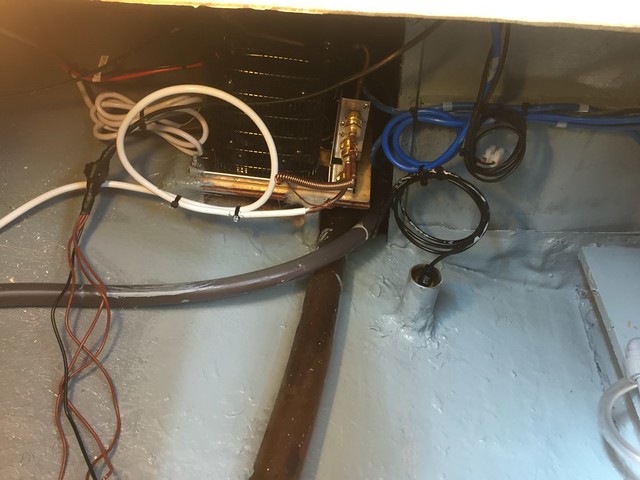
I finished the fridge install, and wow.... lowest setting was as cold as a cold place!
The compressor shut off after a short period and came on in cycles, I haven't timed it - but it didn't feel like it was always powering up, I would imagine that when full it will be more efficient after reaching temp.
I refilled the 30mm hole for the coolant hoses with foam and a backing plate as per the diagrams and then touched up the paint where I'd whoopsied with the drill.

Just like to say thanks again for the help & assistance gained from YBW since last August, I would never dreamt I could have attempted this if it wasn't for you.

Untitled by Owen Lees, on Flickr
 
At the risk of hijacking - on my recent fitting of the same kit, I affixed the Celotex on the outside of the fridge box - should I be worried about water ingress? Celotex IS closed cell after all.

xCB9Obi.png


The above is clearly a work in progress shot :) I need to take some finished effort. When we used it over the weekend on our first trip, with an imperfect seal on the lid (cock up thats in my garage for rectifying) the compressor ran for about one and a half, maybe two minutes every half an hour on setting one. Is that about right?

Good effort on yours!
 
The advice on here was to go inside OR out, I cant see it being an issue personally and does make the job nicer - I was planning on doing it externally until I realised that getting at 50% of the fridge would require me to visit a magician and be sawn in half...

Yes - that's about what I got, the cool box went right down in temp very quickly - then the compressor cut in for a minute or so and then off again.
 
The advice on here was to go inside OR out, I cant see it being an issue personally and does make the job nicer - I was planning on doing it externally until I realised that getting at 50% of the fridge would require me to visit a magician and be sawn in half...

Yes - that's about what I got, the cool box went right down in temp very quickly - then the compressor cut in for a minute or so and then off again.

You've done a great job there it should be good for years. The one on my boat has been in since new ( I can tell because the compressor was obsolete when I started in refrigeration 15 years ago!) so if yours does that well it shouldn't owe you a lot.
 
Top