French Canals & Draught

Seah0rse

Well-Known Member
Joined
30 Jun 2009
Messages
170
Location
Me UK boat Albufeira
Visit site
Hi all

I am in the process of researching a trip to the Med (Port Louis) via the main French Canals starting at Le Harvre and then via Paris.

Having trawled through a large number of many interesting posts on French Canals it seems that my Yacht is on the very limit of maximum draught in some places. She is a long fin keel drawing 1.8m in salt water and, while the Canal waters might not be described as 'fresh' water, I wonder if there is a difference in bouyancy considering it's make up which might mean I draw say 1.9m.

If this is so, any views on transporting the main mast by road to compensate for the loss of bouyancy?

I also wonder what the Peniches draw and if it would be practical to follow them through the shallower parts.

Thanks

Seah0rse
 
Canals draught

We came up the canal system from Port St Louis last year and with a draft of just over 1.7m we had to choose our route very carefully. Have a look at the blog for more details . We did do a bit of "ploughing" with the keel but nothing serious. A gangplank was essential because there were times when we could not get the boat into the bank. It is impossible to get any long term guarantee of depths in the canals, there are so many variables. You may get a response from Grehan to your post if so, he is the man to talk to.
Re mast shipment, it does make life easier. We shipped ours from Navy Service near PSL to Calais via a very good German guy and the cost from memory was around 650 Euros for a 45ft pole. De-masting in Calais is easy and the re-mast guys at Navy Service are excellent.
PM me if you need any addresses.
 
If you mean, does the level in the canals vary much . . . yes it does, depending on the year, the season and whether it's rained much recently. All of which factors determine whether the canal is fed with enough to keep its level at the basic 'prescribed' one. There is a difference in buoyancy between fresh (floats a bit lower) and salt water - what this amounts to I've no idea and I've never noticed much of a difference me'sen. You might well need to swallow the cost of losing the mast for the trip, might help a bit, weight (draft) wise. You will get the added convenience of not worrying about that fragile 'lance' sticking out fore and aft. Samwise's recommendation - http://www.masttransport.de
You might end up following a peniche, but you couldn't plan around such.

As Samwise has indicated, lots of (updated) and detailed info on the Grehan website; and of course, PM me for anything specific.
 
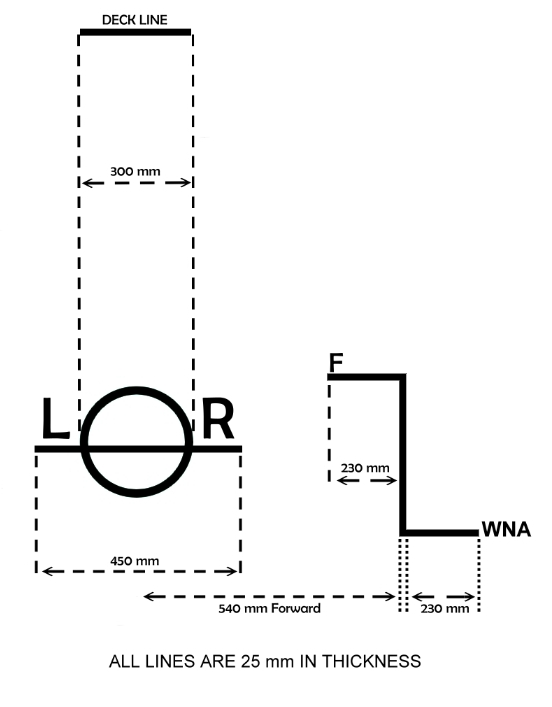
You mean you haven't marked your plimsol lines?

Load_line_sailing.jpg


* TF – Tropical Fresh Water
* F – Fresh Water
* T – Tropical Seawater
* S – Summer Temperate Seawater
* W – Winter Temperate Seawater
* WNA – Winter North Atlantic

The Summer load line is the primary load line and it is from this mark that all other marks are derived. The position of the summer load line is calculated from the Load Line Rules and depends on many factors such as length of ship, type of ship, type and number of superstructures, amount of sheer, bow height and so on. The horizontal line through the circle of the Plimsoll mark is at the same level as the summer load line.

The Winter load line is one forty-eighth of the summer load draft below the summer load line.

The Tropical load line is one forty-eighth of the summer load draft above the summer load line.
The Fresh Water load line is an amount equal to
cf56131676d727b30562f5eb94207974.png
centimetres above the summer load line where
f5d889f32d6794e1bc2ed394e9688c76.png
is the displacement in metric tonnes at the summer load draft and T is the metric tonnes per centimetre immersion at that draft.
In any case where
f5d889f32d6794e1bc2ed394e9688c76.png
cannot be ascertained the fresh water load line is at the same level as the tropical load line.
The position of the Tropical Fresh load line relative to the tropical load line is found in the same way as the fresh water load line is to the summer load line.
The Winter North Atlantic load line is used by vessels not exceeding 100 metres in length when in certain areas of the North Atlantic Ocean during the winter period. When assigned it is 50 millimetres below the winter mark

Fresh water is considered to have a density of 1000 kg/m³ and sea water 1025 kg/m³. Fresh water marks make allowance for the fact that the ship will float deeper in fresh water than salt water. A ship loaded to her Fresh Water mark in fresh water will float at her Summer Mark once she has passed into sea water. Similarly if loaded to her Tropical Fresh water mark she will float at her Tropical Mark once she passes in to sea water.
 
Last edited:
Last week I was in Beziers and paid a visit to the nine locks at Faugeres. I asked specifically the question of minimum depth (I am 1.9m) and was quoted 1.6m as being the maximum draft you could get away with.
 
I am hopefully coming the other way this winter. I am going to put the mast on a trailer ( 10m long sailplane trailer ) and drive it across France myself. Now if you wanted to contribute to the cost fuel on the run down France I could put your mast on for the down trip and bring mine back on the up trip.
 
Hi all

I am in the process of researching a trip to the Med (Port Louis) via the main French Canals starting at Le Harvre and then via Paris.

Having trawled through a large number of many interesting posts on French Canals it seems that my Yacht is on the very limit of maximum draught in some places. She is a long fin keel drawing 1.8m in salt water and, while the Canal waters might not be described as 'fresh' water, I wonder if there is a difference in bouyancy considering it's make up which might mean I draw say 1.9m.

If this is so, any views on transporting the main mast by road to compensate for the loss of bouyancy?

I also wonder what the Peniches draw and if it would be practical to follow them through the shallower parts.

Thanks

Seah0rse

The main published maximums for the canals from the English Channel to The Med are:

Draught 1.4 metres
Beam 5 metres
Air Draught 2.4 Metres

At 1.9 metres draught you are going to have a problem I am afraid. I can believe that at about 1.7 you may get away with it with a little "ploughing" but 1.9 is pushing your luck IMHO
 
I can say that given your draft you can rule out the Canal de Bourgogne as it was only 1.20m in places last year and I doubt it's improved since. As for following a peniche I think you'll find they're either too slow on the canals ~2 knots hotel barges or a real challenge to keep up with on the rivers at 7-8 knots through the water, 12-13 knots over the ground.
 
draught on French Canals!

Hi All, Guinness is not normally available at the locks!

More seriously, I passed through Rouen/Paris/Marne/Saone/Rhone in 2003 May as I remember.
I never had to stop moving due to silt, draught was a bulb keel of 1.8m .No noticeable increase in draught due to fresh water, does affect narrow beamed wineglass style yachts more.
Planks long most useful as stated.Travel during lock keepers hours is smoother, they moped along the bank to prepare locks in non -automatic sections.Marne canalised sections found shallowest, but raw water filter when opened was clean. Needed a water pump overhaul upon reaching Med. sand in water of Seine scored it badly.

Best of luck in your transit. VNF.fr will post you a list of stoppages "chaumages" which are the planned stoppages, not the emergency ones!You can read this in advance to avoid taking the wrong route. In the case of 1.8m draught there is only one way, as described above.I took the mast on deck two trestles with room to duck under. Must be very steady if demasting in Le Havre, as before Seine can be entered one takes to sea again and then goes up the Seine.I found I had to circle once or twice to kill off the tendancy of the trestles to collapse.This allowd me time to frantically tighten everything up. You have been warned. Some de-rig in Honfleur, comments perhaps from Grehan on this?
Good Sailing and boating to all!
 
The staircase - at Foncerannes/Fonserannes, near Beziers - is on the Canal du Midi and 1.6m (quoted by the VNF) would actually often be a problem.
However, as people have pointed out, the route from the Channel to the Med does not (necessarily) involve using the Midi.
If you look at
http://www.tagweb.co.uk/grehan/-vnf-guide.html#map
you'll see that the determining factor is 'getting past' Paris by one route or another.
Essentially, the northern Marne route or the southern Loire/Centre route. Both are book quoted at 1.8m depth, although someone with that draft might well be ploughing at times. At some times of the year / local conditions they might not get through, other times they would (as PaulClan did).
I haven't a clue where those 'through route' figures quoted by boatmike come from, or which route they apply to . . .

But you can certainly rule out the Bourgogne and the Nivernais!
 
The staircase - at Foncerannes/Fonserannes, near Beziers - is on the Canal du Midi and 1.6m (quoted by the VNF) would actually often be a problem.
However, as people have pointed out, the route from the Channel to the Med does not (necessarily) involve using the Midi.
If you look at
http://www.tagweb.co.uk/grehan/-vnf-guide.html#map
you'll see that the determining factor is 'getting past' Paris by one route or another.
Essentially, the northern Marne route or the southern Loire/Centre route. Both are book quoted at 1.8m depth, although someone with that draft might well be ploughing at times. At some times of the year / local conditions they might not get through, other times they would (as PaulClan did).
I haven't a clue where those 'through route' figures quoted by boatmike come from, or which route they apply to . . .

But you can certainly rule out the Bourgogne and the Nivernais!

In fact he did specifically say Starting at Le Havre and passing through Paris. Any discussion of the Midi is therefore irrelevant.
Where do my numbers come from?

1. From Inland Waterways of France By David Edwards-May, but these are admittedly for the smaller waterways. If you stick to the "Freycinet" canals this increases to
Draught 1.8m
Air draught 3.5m
Beam Still 5 metres

Incidentally the max draught quoted for the Midi (central section) is only 1.6 metres so thats no good anyway.
If you ask VNF they will give you current minimum depths for the present, which can be considerably less than this sometimes and sometimes, after heavy rain a lot more making the air draught critical for some...
Also reading Derek Bowskills excellent "The Channel to the Med" he says openly that these figures are "at best" and take no account of silted sides of canals that you are often forced to navigate to avoid Peniches on these routes.... Hence the talk of Ploughing!!!
 
In fact he did specifically say Starting at Le Havre and passing through Paris. Any discussion of the Midi is therefore irrelevant.
Exactly. Except if you were thinking about exiting at Agde, which is not such a daft idea if you're heading towards Spain, Gib and parts West. In fact, a pretty good one.
If you stick to the "Freycinet" canals this increases to
Draught 1.8m
Air draught 3.5m
Beam Still 5 metres
Correct, as book values.
Incidentally the max draught quoted for the Midi (central section) is only 1.6 metres so thats no good anyway.
The whole Midi, not just the central section, whatever that might be - you mean the centre line of the canal width, maybe?. And that is also somewhat optimistic.
If you ask VNF they will give you current minimum depths for the present
This is a difficult idea. People in the office may not know the localised situation 'on the water' and will tend to quote that 'the VNF expects the minimum depth to be . . and then the book value. It's pretty impossible to contact local eclusiers who might know, but many of them are students and don't know one end of a rope from the other anyway. :) [from direct personal experience]
 
Last edited:
we had a most amusing experience coming up the Rhone with our Hustler 25.5 fitted with an 8 hp diesel.
the current was pretty stong and I reckoned we were only doing about half a knot over the ground.I decided we would ask if this was normal for August or should we wait for the flow to diminish.

I forget the town at which we stopped but I trotted off to the river authourities to enquire if this was normal.

having arived at an impressive reception I asked the young lady the question,to which she replied I don't know but I will ask.and promptly shot off.

"please follow me ,I will take you to somebody who can answer the question"
well blow me down she showed me into a room full of the river engineers having a monthly meeting.
I asked the question
slide rules,calculators flashed out like rapiers,huge argurement,meters per sec,litres per hour and christ knows what else
after 10 minutes it was decided it was normal.
after I met a fellow in a yacht with a 6hp engine
 
A room full of hydrological engineers - impressive! I wonder if there is collective noun - a Gush, perhaps :)
In fact, information about Rhone currents is easily and accurately available on the Rhone Authority website. And the current information is also current! - updated automatically from sensors in the river.
http://www.inforhone.fr/inforhone/FR/Commun/carte.aspx?chapitre=hydrologie
The only snag is that the information is in cu.m / sec and that the force of this flow is naturally modified by river sections that are wider or narrower, deeper or shallower than at the measuring point.
 
Hi all
I am in the process of researching a trip to the Med (Port Louis) via the main French Canals starting at Le Harvre and then via Paris.
If this is so, any views on transporting the main mast by road to compensate for the loss of bouyancy?
I also wonder what the Peniches draw and if it would be practical to follow them through the shallower parts.

Provided you stick to the main routes you will have no problems apart from perhaps running aground in soft mud once or twice and sometimes not being able to get very close to the canal bank to 'park up'. Normally you will always be able to put your bows in close enough to get off and make fast the lines even if the stern is sticking out.....

You can get your mast transported and or stored by a French haulage company - have a quick look at my web site - the lorry option..... cost around £2000...

Peniches are sometimes overloaded and push mud but I really shouldn't follow them - you will find sufficient water in mid channel for 99% of the time and if you really do get very stuck the lock keepers controling that section can raise the level a bit but you almost certainly will not need that service.

regards

Michael
 
A room full of hydrological engineers - impressive! I wonder if there is collective noun - a Gush, perhaps :)
In fact, information about Rhone currents is easily and accurately available on the Rhone Authority website. And the current information is also current! - updated automatically from sensors in the river.
http://www.inforhone.fr/inforhone/FR/Commun/carte.aspx?chapitre=hydrologie
The only snag is that the information is in cu.m / sec and that the force of this flow is naturally modified by river sections that are wider or narrower, deeper or shallower than at the measuring point.

provided one has a computer,which I certainly did not carry
 
Top