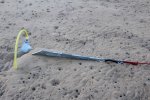
Fortress hook in an Emergency

Suggest you re-read post#12 so that you understand the point that Jonathan is making in relation to sizes of anchors and why an oversize anchor is not necessarily a "good thing".
Why should Jonathan's opinion be any better than my own experience? Maybe if you're in the habit of anchoring in places where changing tidal current is a main player, it might be vital that no part of your anchor is left protruding. I don't, so it isn't.
 
It should be noted that Fortress anchor sizing tables are only for 30 knots of wind.

From the Fortress website:
“Boat anchor size recommendations are for boats of average windage and proportions in 30 knots of wind, average bottom conditions, and moderate protection from open seas. Remember that the loads in 42 knots of wind are twice as much as in 30 knots.”

The concept that a smaller anchor will have the same, or even higher ultimate holding capacity than a larger model of identical design and construction is fundamentally wrong.
 
Last edited:
Why should Jonathan's opinion be any better than my own experience? Maybe if you're in the habit of anchoring in places where changing tidal current is a main player, it might be vital that no part of your anchor is left protruding. I don't, so it isn't.
It is not his opinion, but demonstrated fact. Size as determined by weight is not the key factor in ultimate holding power of the anchor and it is demonstrably true that some anchor designs have higher holding power than other designs of similar or greater size. It is equally true (as demonstrated by the photos in post#12) that there is a point at which the holding power of a smaller anchor is equal to a larger anchor of the same type. This is because ultimate holding power of the same design of anchor is a function of the load applied to the anchor and this load is a function of the boat's ability to apply that load. So for a given boat and conditions there is no benefit from having a larger anchor if you cannot apply the load to achieve its higher ultimate holding power. This is exactly what he is demonstrating by applying equal loads in the same substrate to 2 different sizes of the same design anchor.

So your statement is just your belief and not supported by the physics. You might believe that a bigger anchor is "better" but unless you have carried out the same experiment with two different sizes of the same anchor in the same conditions (as Jonathan has) it is only your personal opinion and therefore open to challenge.
 
The concept that a smaller anchor will have the same, or even higher ultimate holding capacity than a larger model of identical design and construction is fundamentally wrong.

That is not what Jonathan is saying. He is demonstrating that for a given load the holding power is essentially the same. However if a greater load is applied the larger anchor will achieve higher holding power. The key lesson is that holding power is a function of the load a given boat in given conditions can apply. Therefore if the boat cannot apply sufficient load to achieve the higher holding power there is no advantage in having a larger anchor (of the same design).

This is surely at the heart of the "New Generation" anchor movement. Better design of anchors (flukes, geometry, materials etc) provide higher holding power for a given size/weight This is exactly what all the tests concentrate on and clearly demonstrate this is the case.

So for my boat at 31' and 5.5 tonnes an old style (CQR?) would recommend 35lbs/16kgs, whereas a Delta (next step up in holding power afainst size) would be 10kgs and if you look at the data more advanced designs could be even smaller (defined by weight) based on ultimate holding power.
 
Hi all

I have carried a fortress anchor on three boats now primarily as a kedge however the anchor is sized as a bower. I have often wondered if the fortress could be relied apon to replace the primary if it was lost?

I know a lot of people generally carry two anchors and I guess a lot include a danforth or fortress.

Look forward to hearing your thoughts.


i have been old user of different anchors , almost all of them !!! hehehehehe
i ONLY use fortress as auxiliar or emergency
i was one of the first to try them in 1990 i think ...
i DONT like as main anchor as lightweight is more a mess than a benefit from my point of view
the lack of weight (if you have a windlass) is not helpful. Haters come and hate me.
in hard complex bottoms i DONT like at all.
i put my life on DELTA or CQR instead .
 
It is not his opinion, but demonstrated fact. Size as determined by weight is not the key factor in ultimate holding power of the anchor and it is demonstrably true that some anchor designs have higher holding power than other designs of similar or greater size.

True, but for given anchor design and construction material the larger anchor will always have a higher ultimate holding power than the smaller anchor.

This is because ultimate holding power of the same design of anchor is a function of the load applied to the anchor and this load is a function of the boat's ability to apply that load.

Not true. The ultimate holding power of an anchor is fundemental property of the anchor, the substrate an other factors.
 
That is not what Jonathan is saying. He is demonstrating that for a given load the holding power is essentially the same.
The ultimate holding power is not the same.

As the anchor size is increased (for the same design and construction material) the ultimate holding power also Increases. This is not only common sense, but has been demonstrated in numerous practical anchor tests.
 
I'm sure that small anchors will be fine for a lunch hook in benign conditions. Having been anchored in anything up to 74 knots, I prefer something that I can trust with my life. It's painfully obvious that a larger anchor of a particular design will have a greater potential hold than a small one. Otherwise, whatever size the boat, everyone would have dinky wee anchors. Aye right!
 
There is no suggestion that the ultimate hold of a large anchor is not greater than that of a small anchor of the same design.

Hold is a function of the tension in the rode (that is how hold is measured) and the hold developed is a function of the vessel (and wind). The Ultimate hold of a FX 23 is huge, in fact the ultimate hold os a FX 16 is huge and if you ever set a FX 16 to its ultimate hold your problem would be retrieval - simply because it would be set so deeply.

Taking a Rocna - of 15kg - its ultimate hold in nice clean sand is around 2,000kg - it is very unlikely anyone with a 15kg Rocna has ever set it to its ultimate hold. Use a 30kg Rocna under the same conditions as the 15kg Rocna and the 30kg Rocna will stand proud and not be so deeply set (but set side by side they will have the same hold if they are set to the same tension (that is how hold is measured). There is nothing magic that allows a bigger anchor to develop more hold than a smaller one - its about the tension in the rode. There is a wealth of data demonstrating that shallow set anchors (in this thesis same design and set to the same tension but bigger) are more susceptible to yawing and chop compared to deep set smaller anchors

Yawing and Anchor Holding - Practical Sailor

Part of the background to the article is that the shank when buried acts as a vertical fluke and resists yawing. In a larger anchor not so deeply buried the shank does not offer this advantage. Assuming same design, same seabed, same tension then both anchors's hold is a function of the fluke, how big it is and how deeply set. The bigger anchor will be more shallow set - if they both have the same hold. Now veer the tension and the large anchor has that same hold but the smaller anchor has more hold provided by the resistance of the shank to lateral movment. Under normal straight line pull the shank offers no benefit (except it holds chain to fluke :). ).

It is my opinion, yes an opinion, that in the absence of veering and chop if you increase tension a modern anchor will simply dive more deeply (having watched thousands of anchors being tested - this is more than opinion). As soon as you add veering and chop to the equation then the outcomes change.

As background to the idea that chop is a major function in anchor dragging. I have sat and watched a line of yachts all roughly anchored parallel to a beach. When a front comes through at a roughly fixed wind speed none of the anchors moved - yet the wind was blowing 30 knots onshore. The wind speed did not change much but as the seas built one by one yachts dragged. Yes - the forecast was a 'bit' out - which is why we were all exposed and the front was more sustained than expected. We did not drag but we did move - the cat was hobby horsing too much to be comfortable. If you read accounts of storms on anchorages - yachts do not drag initially - they stay safe and sound. Dragging develops with time and one thing that also develops with time is the roughness of the water (as the chop builds).

The idea of the shank being a vertical fluke is elegant (and has been tested, see above) and protects the fluke/yacht from dragging due to yawing but that longer lever arm, longer and higher, increases the opportunity for de-stableising the hold of the fluke of the larger anchor - noting that both flukes are offering the same hold - in the set direction.

Hold is measured in the set, the tension, direction and is a measure of fluke effectiveness - completely ignoring the role the shank might play in a change of tension direction.

In my photos I use a Fortress, because I have 3 different sizes of Fortress. I would use an Excel, Spade, Rocna, Viking to illustrate the same point - except I don't have different sizes of these anchors. I thus must use Fortress and allow you to decide if extrapolation to other anchors is valid - I think it is valid.

I don't have a Danforth - but in most tests a Fortress and Danforth of the same size develop roughly the same hold - its not weight that is important - its design. We have been using an aluminium Spade and an aluminium Excel which both replace the same physically sized version of Spade and Excel made from steel. 8kg aluminium compared to 15 kg steel - we cannot tell the performance difference between aluminium and steel - and we have been using, testing and comparing for 15 years. Its not weight - its design. We have a Viking and Mantus of the same roughly physical dimensions - the Viking is a better design (there are subtle differences - the Viking has twice the hold of the Mantus - its design (and the Viking weighs 10kg to the Mantus 15kgs).


None of these anchors are perfect - which is why we carry 2 x Fortress and a Spade and Excel. Like Vyv we too anchor in a 'V' or fork because we find it reduces vesting (nothing to do with doubting the performance of a single anchor). We have all met owners who have lost their only anchor - it does happen (so we have spares and ALL are sized to become the main bower anchor - we don't carry small 'kedge' anchors - ours a ll light enough (being aluminium) to be handled by hand from the bow or from the dinghy.

I dug through more pictures here is a partially set Mantus - plenty of chain here! It could be a Rocna, Spade or Excel. It has set with a slight list (not unusual for any anchor) but note how the protrusion supporting the roll bar stands proud. Many of us anchor in locations with a tidal effect (in seems difficult to escape tides if you anchor in the sea :) - but just imagine what might happen if the tide turned, or the wind changed and your chain got under that flange. Maybe better to have a slightly smaller (or better) and anchor that you could have set more deeply in the first place?

IMG_7508.jpeg

I don't make this stuff up. Same anchor, different occasion, different rode, same location.

Image 2b.jpeg


And to reduce ideas that I am picking on Mantus - this, below, has been our primarily, equally shared with Spade, anchor or bower anchor. Our Anchor Right Excel. Also set with a list - its what happens. Again what happens in a change of tide or wind?

If you are going to power set - use strong power and maximise the depth of burial. If you anchor is oversized - these illustrations illustrate some of the issues, the linked article describes the advantages of burying the anchor as deeply as possible.
IMG_9752.jpeg

Normally the anchor slowly self rights - I have set these anchors (before the tide has receded) with a sheet winch (except for the Excel which was set using the windlass before the tide receded) but not power set..


But 'we' digress - for the OP if you use a Fortress it will be ideal in sand and mud but a major weakness occurs in weed or pebbles. For weed and pebbles you need different anchor or sufficient clarity to be able to drop the Fortress into a weed free area. Fortress can be dismantled but even assembled (which would be my recommendation) they can be stored flat (packed against a locker wall or tied to the transom/lifelines). They are light enough to be thrown (if small enough) or deployed safely from a dinghy (they become a handful once you get bigger than the FX 23). They do come up on ebay as people here have sourced there - just keep your eyes open). You can use them as a primary - given the restriction Is mention.

Take care, stay safe

Jonathan
 
Good to know that "There is no suggestion that the ultimate hold of a large anchor is not greater than that of a small anchor of the same design". (Note the double negative).
That's precisely why I, sailing in an area where we don't get excited about being anchored in 30 knots of wind, use anchors which are probably bigger than the sizes recommended by the anchor makers.
 
Good to know that "There is no suggestion that the ultimate hold of a large anchor is not greater than that of a small anchor of the same design". (Note the double negative).
That's precisely why I, sailing in an area where we don't get excited about being anchored in 30 knots of wind, use anchors which are probably bigger than the sizes recommended by the anchor makers.

Your experiences are certainly something we could all learn from. It would be invaluable and educational if you could possibly define your yacht, rode and anchor(s) (size and design).

Jonathan
 
I was using a smallish fortress for lunch stops, but I have noticed that once weed gets caught between the flukes and the shaft it starts to drag. This can happen in pretty benign conditions so it's been relegated to the kedge.
 
Your experiences are certainly something we could all learn from. It would be invaluable and educational if you could possibly define your yacht, rode and anchor(s) (size and design).

Jonathan

Here we go:
36ft deck saloon ketch.
64m of 10mm chain on 20kg genuine Bruce. (Normal everyday anchor).
Fortress FX23 with 5m of 11mm chain, and a choice of 50m of climbing rope or 65m of three strand 20mm nylon.
20 kg fabricated fisherman type anchor with slightly enlarged flukes.
Another identical climbing rope, and masses of other assorted lines and warps.
A light Danforth, primarily for the dinghy.
 
Here we go:
36ft deck saloon ketch.
64m of 10mm chain on 20kg genuine Bruce. (Normal everyday anchor).
Fortress FX23 with 5m of 11mm chain, and a choice of 50m of climbing rope or 65m of three strand 20mm nylon.
20 kg fabricated fisherman type anchor with slightly enlarged flukes.
Another identical climbing rope, and masses of other assorted lines and warps.
A light Danforth, primarily for the dinghy.

Thanks Norman,

I'm guessing high windage and heavy displacement with the ability to deploy a riding sail and quell veering. As your cruising ground is the Western Islands - you might suffer stronger winds but you will derive shelter from any swell or chop.

Hardly excessive :) - except for the 10mm chain (which I would have opted for 8mm and a longer length - but then we have well in excess of 10m tides 'up north).

I recall you leave the yacht, sometimes for extended periods, and deploy a Bahamian moor - as you have nothing else this is presumably with the Fortress and Bruce (effectively relying on the Fortress under certain conditions as a primary or bower anchor (which like Vyv) answers the OP's question).

If only others provided this sort of detail of their ground tackle.

Jonathan
 
I think I have decided on just keeping it to the 13lb Mantus seems to work really well with the 10m chain and 50m warp and in the aft locker the fortress 3m chain and plenty of long mooring mines to add on when needed. I have added a large bow shackle to the end of the fortress chain to make it easier for tying on lines.

The reason for the thread is because i was toying with the idea of keeping the 4kg lewmar delta on board which was the anchor i previously used as a bower before I found the Mantus second hand for a bargin of £40. This was from previous advice from Neeves of looking out on the second hand market for a modern gen anchor which came up trumps.

I think i will keep the Delta in the garage as a spare for any losses.
 
I'd keep looking for a credible new generation anchor. Not all new generation anchors are equal. If on a budget I'd be looking at a Kobra - some very happy owners on YBW

An Inquiry into Anchor Angles - Practical Sailor

This independent work showing the impact of fluke angle. Note the difference in hold between a fluke at 17 degrees (Mantus) and 30 degrees, Bugel, Fortress, Knox - in fact virtually all other anchors.


IMG_8682.jpg


Your Mantus has a similar hold to a similarly weighted Delta - I've measured it.

If you have any losses it would be really convenient to have the spares on the boat - not much use in the garage. We lost our primary and all the rode once (clutch slipped, retaining shackle for bitter end failed) - and having a spare rode, grapnel and anchor meant we could anchor and then retrieve the primary.

Jonathan
 
Here we go:
36ft deck saloon ketch.
64m of 10mm chain on 20kg genuine Bruce. (Normal everyday anchor).
Fortress FX23 with 5m of 11mm chain, and a choice of 50m of climbing rope or 65m of three strand 20mm nylon.
20 kg fabricated fisherman type anchor with slightly enlarged flukes.
Another identical climbing rope, and masses of other assorted lines and warps.
A light Danforth, primarily for the dinghy.

I don't have a spread sheet for a genuine Bruce and taking the easy option I looked at Lewmar's Claw spread sheet.

They suggest a 20kg Claw would be correct for a 35'-45' yacht using 10mm chain. I suspect your yacht is heavier than a common AWB so erring slightly on the side of caution I'm puzzled as to why you think your ground tackle would be considered overly large.

If I look at Lewmar's recommendation for their Delta, say 15kg, our catamaran fits perfectly at 35'-50' (with 8mm chain - as opposed to our HT 6mm chain and snubbers).

It seems we both meet with Lewmar's approval :)

What is interesting that though you are disparaging about our lightweight tackle - focussing not on steel anchors but aluminium versions - you are happy to rely yourself on use of a Fortress as a 'primary' in your Bahamian moor. We too have relied on a FX 23, in a fork ('V') with either our aluminium Spade or aluminium Excel and though our windage is higher I'll lay money down that you are slightly heavier than us. It seems you are critical - yet our practices and yachts are not that much different - and your ground tackle is hardly 'monster' and not so dissimilar to ours.

If you want to consider joining the ranks of going oversize with monster ground tackle - consider use of a 50kg anchor on a 50' yacht - where Lewmar might recommend a 20kg Delta, 30kg Claw and I think Rocna suggest a 33kg model. Norman you are quite normal, join the club :)

Take care, stay safe

Jonathan
 
I'd keep looking for a credible new generation anchor. Not all new generation anchors are equal. If on a budget I'd be looking at a Kobra - some very happy owners on YBW

An Inquiry into Anchor Angles - Practical Sailor

This independent work showing the impact of fluke angle. Note the difference in hold between a fluke at 17 degrees (Mantus) and 30 degrees, Bugel, Fortress, Knox - in fact virtually all other anchors.


View attachment 134390


Your Mantus has a similar hold to a similarly weighted Delta - I've measured it.

If you have any losses it would be really convenient to have the spares on the boat - not much use in the garage. We lost our primary and all the rode once (clutch slipped, retaining shackle for bitter end failed) - and having a spare rode, grapnel and anchor meant we could anchor and then retrieve the primary.

Jonathan


Choosing an anchor seems to be a minefield what ever you choose always seems to have a downfall, In fact I did look at getting a 6kg Kobra however was put off by the collapsible shack which looked flimsy and unreliable.

I think carrying the addition of the 4kg Delta would see the fortress dismantled down into a bag to be kept into a small locker. Being on a small coastal cruiser (Drascombe Coaster) means storage for spare anchors and lots of warp is difficult but as I regularly anchor I might need to consider this.

I notice that on SV panope the Mantus M1 sits quite high on his list of anchors
 
Top