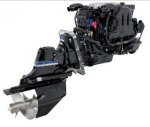
Ford Zetec p/ Merc. Alpha 1:

rustybarge

Well-Known Member
Joined
9 Aug 2012
Messages
3,665
Visit site
I would like to buy a brand new Suzuki 90 hp lean burn (155 kg) for my Power Catamaran, but the £9500 list price puts me off. You can buy a brand new car like the fabulous Dacia Sandara £5500.

So instead I'm going for an inboard with sterndrive, fitted into the large aluminium engine pod.

After careful consideration I've selected the petrol Ford Zetec 1.6se engine:
http://westfield-world.com/enginespecs_car.html
Engine (cc): - 1596cc
Basic Power: - 100 bhp
Weight: - 81kgs
Height: - 61cms
Length: - 47cms
Block: - Alloy
Head: - Alloy
Valves: - 16 Valves, Twin Cam
2nd Hand: - £350 (approx)
Ease of fit: - Easy to fit as these are quite small engines
Overall: - Small, light & compact Twin-cam with good achievable power range.
View attachment 29727

I've searched on old forum posts, opinion is The Mercruiser Alpha 1 gen 2 is better than the Volvo stern drives, and cheaper too. Weight 40 kg.
View attachment 29728

Total weight for 100 hp Zetec/ alpha1 = 121 kg. (impressive! )

I haven't got a clue about sterndrives, please advise:

Is there a water heat exchanger in the sterndrive; does the engine take cooling water from the drive, raw or fresh water?
Is the steering hydraulic or cable?
Does the engine need a flywheel?
How does the strendrive connect to the engine? What mods are needed?

Please advise on what other major hitches there maybe with my plans.
 
Good luck with the project RB, perhaps look at the Sierra/Sternpower range of knock-off copies of the Mercruiser sterndrive, myself and others I boat with have bought Sierra/Sternpower parts in the past from the States with good results at bargain prices.
 
I would like to buy a brand new Suzuki 90 hp lean burn (155 kg) for my Power Catamaran, but the £9500 list price puts me off. You can buy a brand new car like the fabulous Dacia Sandara £5500.

So instead I'm going for an inboard with sterndrive, fitted into the large aluminium engine pod.

After careful consideration I've selected the petrol Ford Zetec 1.6se engine:
http://westfield-world.com/enginespecs_car.html
Engine (cc): - 1596cc
Basic Power: - 100 bhp
Weight: - 81kgs
Height: - 61cms
Length: - 47cms
Block: - Alloy
Head: - Alloy
Valves: - 16 Valves, Twin Cam
2nd Hand: - £350 (approx)
Ease of fit: - Easy to fit as these are quite small engines
Overall: - Small, light & compact Twin-cam with good achievable power range.
View attachment 29727

I've searched on old forum posts, opinion is The Mercruiser Alpha 1 gen 2 is better than the Volvo stern drives, and cheaper too. Weight 40 kg.
View attachment 29728

Total weight for 100 hp Zetec/ alpha1 = 121 kg. (impressive! )

I haven't got a clue about sterndrives, please advise:

Is there a water heat exchanger in the sterndrive; does the engine take cooling water from the drive, raw or fresh water?
Is the steering hydraulic or cable?
Does the engine need a flywheel?
How does the strendrive connect to the engine? What mods are needed?

Please advise on what other major hitches there maybe with my plans.

Water is pumped from surroundings via an integral waterpump in the lower gearcase and taken to the engine/exchanger via a hose that exits through the transom shield.

Steering is either via teleflex push pull cable or can be hydraulic.

The drive is connected to the engine via a splined coupler plate that the driveshaft locates into.

The engine will need a flywheel. How else will the starter engage for one thing?
 
Rusty, I admire your ambition. You will have to marinise the engine before you do anything. Sorry if this sounds patronising, as it is not meant to be, but do you know how to do this? You might want to talk to Lancing Marine, as they marinise Ford engines. You will also need to calculate the size of heat exchanger. The Alfa drive will supply raw water to the heat exchanger. You will need to work out where the anodes should go to protect the engine. You will need to sort out the fuel system too.
Alternatively, you could look at an engine already marinise, like the Isuzu Merc diesel?
 
Good luck with the project RB, perhaps look at the Sierra/Sternpower range of knock-off copies of the Mercruiser sterndrive, myself and others I boat with have bought Sierra/Sternpower parts in the past from the States with good results at bargain prices.

Thanks very much for that tip Andy, I'll try and find out if there's a uk importer.
 
Water is pumped from surroundings via an integral waterpump in the lower gearcase and taken to the engine/exchanger via a hose that exits through the transom shield.

Steering is either via teleflex push pull cable or can be hydraulic.

The drive is connected to the engine via a splined coupler plate that the driveshaft locates into.

The engine will need a flywheel. How else will the starter engage for one thing?

Whoops, forgot about the starter ring gear......

What happens to the exhaust?
 
Rusty, I admire your ambition. You will have to marinise the engine before you do anything. Sorry if this sounds patronising, as it is not meant to be, but do you know how to do this? You might want to talk to Lancing Marine, as they marinise Ford engines. You will also need to calculate the size of heat exchanger. The Alfa drive will supply raw water to the heat exchanger. You will need to work out where the anodes should go to protect the engine. You will need to sort out the fuel system too.
Alternatively, you could look at an engine already marinise, like the Isuzu Merc diesel?

I have a converted Lancing marine Ford transit diesel in my present boat! Excellent company. They supplied the marinised engine g/b and the prop. Shaft, and I fabricated the Skeg etc and fitted myself.

I would love to fit the Ford cross flow engine, I owned a Cortina m2 and a Moggy both with crossflows, but it weighs 40 kg more, and is only a two valve engine so is a lot less economical than the zetec.

I'm very restricted on weight, 180 kg the max allowable on the pod, so it has to be petrol.
 
Last edited:
Hi Rustybarge
Intrigued, In which hull are you going to fit engine although you refer to a pod. A friend has a similar boat but twin shaftdrive.

It's a Cheetah 7.6 catarmaran.
Max. Hp is supposed to be 2 times 60 hp, or a single 90 hp on one pod! ( this is an Irish boat, think rally enthusiast)

View attachment 29736
 
Last edited:
Good luck with the project RB, perhaps look at the Sierra/Sternpower range of knock-off copies of the Mercruiser sterndrive, myself and others I boat with have bought Sierra/Sternpower parts in the past from the States with good results at bargain prices.

Hi Andy,

I'm unable to locate a Sierra sterndrive agent in the UK, do you have a link to the American manufacturer or company you buy off in the states?

Thanks.
 
Hi Andy,

I'm unable to locate a Sierra sterndrive agent in the UK, do you have a link to the American manufacturer or company you buy off in the states?

Thanks.


I used the wrong name originally (stern power?, I think that was a failed company from the 80's?), it's Sterndrive Engineering, this product works fine.

http://www.sterndrive.cc/
 
Last edited:
Whoops, forgot about the starter ring gear......

What happens to the exhaust?


Exhaust goes down a alloy horn into the transom shield where it comes out of two low backpressure ports on the underside of the transom shield. Higher RPM means higher gas flow so then the exhaust also comes out of the prop hub. It is a wet exhaust and the manifold dumps its water down the horn too. This cools the rubber anti backwash flaps and stops them from melting.

Happily it appears that your exhaust manifold is on the correct side for the straight 4 exhaust horn.
 
Exhaust goes down a alloy horn into the transom shield where it comes out of two low backpressure ports on the underside of the transom shield. Higher RPM means higher gas flow so then the exhaust also comes out of the prop hub. It is a wet exhaust and the manifold dumps its water down the horn too. This cools the rubber anti backwash flaps and stops them from melting.

Happily it appears that your exhaust manifold is on the correct side for the straight 4 exhaust horn.

Thanks very much for that info.

I've been looking at the price of new Zetec 1.6 engines, and ready to go with ecu and loom with new longitudinal sump for about £1 k. Incredible value! The Sei fake Merc sterndrive is about $1200, but there's shipping and duty and vat on top of that. Maybe the genuine Merc item is better value at £1500 plus vat, as you know what you're getting. I'll will also need to buy an old unit the get the transom cradle etc.

Lancing marine don't do marinisarion kit for the Zetec, but have one for the ford pinto so I may be able to adapt it to fit.

Am I correct in presuming that water from the heat exchanger is sprayed into the exhaust to cool it, but that the exhaust pipe does not actually pass through the heat exchanger water box, but just underneath it? In other words can I route the exhaust pipe separately from the heat exchanger, or do I need the manifold version in the photo at the bottom of the page.


I noticed on the Merc site that's a counter rotating sterndrive model, so I have to check to make sure the Zetec rotates the same way as the American engine. I'm pretty certain it does.

Project looks possible. When you consider that if you buy a new high tech outboard, and what's it worth in 5 years time.( Basically scrap). At least with a Zetec it's easy and cheap to replace it.
 
Last edited:
Mines raw water cooled but I believe the 4 cylinder with freshwater cooling dumps the water from the exchanger into the manifold, then the manifold dumps it down the exhaust via a water injection elbow.

Mine goes through the block, out of the water pump into the manifold then down the exhaust.
 
Mines raw water cooled but I believe the 4 cylinder with freshwater cooling dumps the water from the exchanger into the manifold, then the manifold dumps it down the exhaust via a water injection elbow.

Mine goes through the block, out of the water pump into the manifold then down the exhaust.


It's simples! ASAP- supplies have come up with the answer. Other un- named companies said I'd have to get a manifold casting specially made costing £****

Separately cool the engine fresh water in its own heat exchanger, like this one: £400
View attachment 29840

Then cool the exhaust system with its own water injection system like this connector: £100
View attachment 29841

The cooled exhaust water is then fed into the stern drive unit and out the prop. Hub, I think?

Costs:

New Zetec with longitudinal sump and Ecu £1200
New Merc, Alpha 2 stern drive £2000
Transom shield casing. £1500
Assorted pipe work, bellows etc. £ 250
Heat exchangers. £ 500
Yikes..........call it £5500. It's amazing how small numbers add up so quickly!
 
Last edited:
Many who did the calculation ended up going for a purpose made solution from either Volvo or Merc.

As you see a car engine needs marinizing (including alternator, starter, fuel system and a bunch of accessories like instrumentation, looms etc). For all to be happy (insurance) and the sake of resale value it should be CE marked as are the named brands.

After fitting the thing to the boat (custom made engine mounts?) you need to fit a coupler to the flywheel in order to connect the driveshaft from the sterndrive (which in it's turn runs in a gimble bearing inside the flywheel housing). The housing and steering connections connects to the inside of the transom plate (sterndrive make specific) where the sterndrive is fitted to the outside (with it's power trim & tilt).

Sea water enters the leg and is pumped, by a shaft driven impeller inside the sterndrive, towards the engine. The water is used either as primary coolant for the engine/manifold or for a heat exchanger. In both cases the 'used' water is blended into the exhaust and routed down to the transom, through this and out into the sterndrive to finally be sent out in the prop hub.

For this to all work, and for the engine to perform under the conditions in a closed compartment (hot air intake), a lot of things in marine engines have been tuned (eg. water jacket and channels in head and block). The load is different from car use (like running in 5th gear uphill all day) so ignition timing, camshafts, oil sump and ECU has been adapted for the use.

I won' t say a car engine can not be used, but many did the maths and found it better value to get a marine engine.

Offers are out there. A complete package might weigh about the same and not cost more than DIY.

An idea about the turnkey package
mercruiserpack.jpg
 
Last edited:
Many who did the calculation ended up going for a purpose made solution from either Volvo or Merc.

As you see a car engine needs marinizing (including alternator, starter, fuel system and a bunch of accessories like instrumentation, looms etc). For all to be happy (insurance) and the sake of resale value it should be CE marked as are the named brands.

After fitting the thing to the boat (custom made engine mounts?) you need to fit a coupler to the flywheel in order to connect the driveshaft from the sterndrive (which in it's turn runs in a gimble bearing inside the flywheel housing). The housing and steering connections connects to the inside of the transom plate (sterndrive make specific) where the sterndrive is fitted to the outside (with it's power trim & tilt).

Sea water enters the leg and is pumped, by a shaft driven impeller inside the sterndrive, towards the engine. The water is used either as primary coolant for the engine/manifold or for a heat exchanger. In both cases the 'used' water is blended into the exhaust and routed down to the transom, through this and out into the sterndrive to finally be sent out in the prop hub.

For this to all work, and for the engine to perform under the conditions in a closed compartment (hot air intake), a lot of things in marine engines have been tuned (eg. water jacket and channels in head and block). The load is different from car use (like running in 5th gear uphill all day) so ignition timing, camshafts, oil sump and ECU has been adapted for the use.

I won' t say a car engine can not be used, but many did the maths and found it better value to get a marine engine.

Offers are out there. A complete package might not cost more than DIY.

An idea about the turnkey package
mercruiser-8-2-sterndrive-3.jpg


Err.......I think you're right. It sounded like such a good idea, especially when I saw new Zetec engines advertised at £850.
I have always worked on the basis that in an open and competitive market, manufactures will make a fair margin for their products, and no more.

The project would work with second hand bits......but then you're buying someone else's problems.

It back to the drawing board!
 
If 'used' is somebody's removed package after an upgrade, then it could be just the perfect bargain.

Random ad:
..reconditioned 3 litre LX With Alpha 1 Leg. All gauges and control box included comes with power steering also. All Complete. Has new riser, new bellows , new alternator, new ht leads. Fully serviced Can see running

Asking £2995 for 135 hp.
 
If 'used' is somebody's removed package after an upgrade, then it could be just the perfect bargain.

Random ad:


Asking £2995 for 135 hp.


Just looking at the Suzuki lean burn 80 hp outboard. 0.6 ltr/ n.m at 15 kts is more than 7 mpg on a boat weighing 1.5 tons. That's very impressive fuel economy.

If those figures are true, then the lean burn technology is extraordinary.

Going on the basis that fuel can only get more expensive in the future,maybe I should take a very deep breath and get the cheque book out.

Sea%20Rover%2021D%20-%20DF80A%20(Lean%20Burn).pdf
 
My last outboard was a Suzuki 140. Loved it... so smooth, never missed a beat and easier than most on the fuel.

When other boats were idling nearby only my tell tale showed it was actually running.

A completely different solution though:

Outboards are specifically designed for the purpose, made of alloy (almost 100%). No flexible driveline (running in bellows) as the whole unit turns, easy access for repair and service and so forth. Fitting or replacing is so easy (even for thieves :(). Fresh Water cooing not an option (and not needed as it a) withstands seawater and b) drains itself to sea level when shut off).
 
Top