Flexible Stuffing Box maintenance

Many things are designed & made to make money, in this consumer world of ours, it doesnt make them better

Why do some people always have to be negative? Newer types of seal eliminate the less good features of old types and have gained almost universal acceptance. Would be surprising if they achieved that if they were not satisfactory.

Next thing you will be claiming is that everything from the past is automatically better. And that stuffing boxes were made for the good of the world with no intention by the makers of making any money.
 
Last edited:
That does assume that all inventions are better than the things they are trying to replace. Some are, others definitely not. Each solution tends to breed a new problem

No - it is only you that is trying to make this assumption. In this case new solutions have replaced old ones, which suggests that any new problems are less of an issue than old. Adoption of new designs (at least on new boats) is almost universal.
 
Unlike the type that has studs and nuts driving a yoke with tubular extension into the packing, just like in sailorman's photo, yours has a separate tube that is pressed in by the large nut, as in the drawing on my website. From your description it sounds like the tube has been driven all the way in and is now flush with the housing at the top of the threads. If you cannot grip it from outside you may need to separate the whole gland from the shaft and knock it all out from the stern end.

Can you post a photo of the installation with the gland nut removed?
 
Hi Vyv,

Thanks for responding to the original question. What you describe with the tube pushed all the way in would explain how it looks. I'll take photos of the inside of the gland when I'm at the boat this afternoon and will post them this evening.
 
I don't think Sailorman is blindly criticising modern seals, Tranona, just the general point that modern is necessarily better. After all, given a choice between a single malt and alcopop...

I think he is - but as his vocabulary is so limited to single words it is difficult to be sure what he thinks. Perhaps he could use sentences with subjects, verbs and objects to explain what he means then it removes any possibility of a misunderstanding.
 
Inside the gland, the entire width between the shaft and the gland itself does seem to be metallic or it could possibly be a very hard plastic - for sure there is no soft material that could be picked out.

I was absolutely convinced that the oil filter cover on my Citroen DS (a round plate on the bottom of the sump) had been assembled without the necessary O-ring, because I could poke a screwdriver into the slot and it hit something hard and metallic feeling. So I fitted an O-ring, refilled with oil ... and widdled the stuff everywhere. Further inspection showed that the old O-ring was so old, so compressed and so brittle that it felt just like metal. Vigorous work with a very small chisel got it out.

I suspect that your "very hard plastic" is "very hard packing material" ...
 
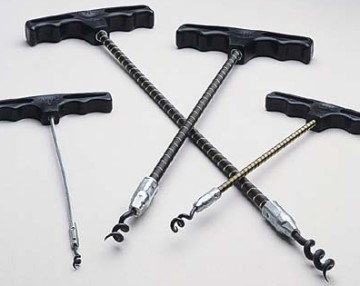
How does the "3 or 4 mm depth" compare with the length of the nut itself? I would suggest that you dig inside the nut at the inner face that presses against the main body of the gland. There is a 'special' tool for doing this and it looks like a corkscrew, however, you can still manage with a sharpened bit of steel wire... and a lot of fiddling.
packingchest.jpg

+1
 
I think he is - but as his vocabulary is so limited to single words it is difficult to be sure what he thinks. Perhaps he could use sentences with subjects, verbs and objects to explain what he means then it removes any possibility of a misunderstanding.
My dear chap what is there not to understand here [Many things are designed & made to make money, in this consumer world of ours, it doesnt make them better]..
Just because an item is made to fine tolerances with lip seals & O rings doesnt mean ir is better or more durable than a simple stuffing box that is repairable with a small box of tools.

Sail drives were adopted by the volume manufactures ( with the exception of Benetaeu ) due to the ease of installation, leaving the subsequent owners to pick up the tab for gaiter replacement every 7 > 10 years, a stuffing box rarely needs replacing & requires very little maintenance.
 
Last edited:
I can't offer any help to the OP I'm afraid, but to add to the thread drift: "...Is "Modern " better/
Yes. Otherwise they would never have been invented..." I would suggest that with shaft seals as with most things, it's a case of 'horses for courses'.
When we bought our present yacht it had a traditional stuffing box seal fitted and our intention was to replace it with a 'modern' seal; it was only after a conversation with our Surveyor during the final inspection that we changed (for the better, I still believe) our minds:
If your plans are for day weekend sailing, remaining close to the safety nets offered by the RNLI/SeaStart/TowBoatUSA, then I would agree that a 'modern' seal is the way to go; a bone dry bilge is always to be preferred. Should you be heading further afield, then a few drops of water into the bilge - especially a deep one like ours - is a small price to pay for a more durable/simple/repairable shaft-sealing system. A 'major' failure of a stuffing box seal might result in a litre or perhaps two per hour leaking into the bilge, something that can be accommodated whilst you travel to a suitable place to effect a repair and the engine will remain useable whilst doing so. The 'modern' seals which we've seen would all let in far more water than this after a major failure and whilst the majority have had some means of 'shutting down' such a leak, this generally requires that the seal unit is clamped to the prop-shaft effectively locking/fixing it in place and leaving the engine unusable, not a good situation if the nearest suitable place to effect a repair is hundreds, perhaps thousands of miles away.
As an aside, I assisted in the re-packing of a stuffing box (not ours) on a yacht which was afloat, anchored up a river in Suriname: Get the new Teflon ropes cut to length and ready, snorkel under the stern and pack around the cutlass bearing with plasticine, open the housing, remove and replace all but the last compressed/tired rope, re-clamp the housing, then remove the plasticene. This is not a method I would recommend to anyone, but it does (or in that instance anyway) work.
 
I don't think Sailorman is blindly criticising modern seals, Tranona, just the general point that modern is necessarily better. After all, given a choice between a single malt and alcopop...

In another thread Tranona has convinced me (to your horror) to consider replacing my stuffing box if/when I re-engine, so I'm not a complete Luddite in these matters. However, I cannot help feeling that if modern seals really were vastly better (as opposed to a bit better), then there would not be quite so many differing designs vying for our money ... I'd expect one to have won.

As far as I can see, the upsides of modern seals are
  • they don't leak and
  • they don't require regular maintenance
but the downsides are
  • they are more expensive than stuffing boxes and
  • a failure is more likely to be unforeseen and catastrophic
  • they need replaced every 5 - 10 years.
Fair?
 
However, I cannot help feeling that if modern seals really were vastly better (as opposed to a bit better), then there would not be quite so many differing designs vying for our money ... I'd expect one to have won.

Certainly this hypothesis is not the case with anchors. How many NG versions have emerged since the Spade kicked it all off? Without thinking for too long I can come up with ten, all quite similar but subtly different and with a range of prices. I think that the variation in shaft seals is considerably greater than it is with anchors, some types operating on quite different principles from others. Capitalism at work :)
 
In another thread Tranona has convinced me (to your horror) to consider replacing my stuffing box if/when I re-engine, so I'm not a complete Luddite in these matters. However, I cannot help feeling that if modern seals really were vastly better (as opposed to a bit better), then there would not be quite so many differing designs vying for our money ... I'd expect one to have won.

As far as I can see, the upsides of modern seals are
  • they don't leak and
  • they don't require regular maintenance
but the downsides are
  • they are more expensive than stuffing boxes and
  • a failure is more likely to be unforeseen and catastrophic
  • they need replaced every 5 - 10 years.
Fair?

Sorry if my sentiment wasn't clear, but the 'horror' was entirely ironic and intended to amuse you. Truly. Apologies if it caused offence.

I'm certainly no expert on stern glands, but have lived with several old types and a Radice. Certainly a lip-seal type arrangement has the potential to leak more catastropically than a well-maintained stuffing box (but if you'd taken apart the one on my boat when I bought her, which looked fine from the outside, you might think differently). But the bottom line surely is the frequency of examples of such catastrophe's happening. I daresay you've seen my post (#32) on 'the other thread', the response to which is keenly awaited (this time, with no irony): http://www.ybw.com/forums/showthrea...-gearbox-end&p=5515815&highlight=#post5515815
 
Certainly this hypothesis is not the case with anchors. How many NG versions have emerged since the Spade kicked it all off? Without thinking for too long I can come up with ten, all quite similar but subtly different and with a range of prices. I think that the variation in shaft seals is considerably greater than it is with anchors, some types operating on quite different principles from others. Capitalism at work :)

In the case of anchors I'd say that Spade / Bugel / Manson / Rocna are all variations on a theme, and a lot closer than lip vs surface seals. for example.
 
Top
