Flexible Solar panels - how do they perform?

one thing,,, whither you are wired in series or parallel does your battery bank have to be wired similarly , i have 4 hopefully uping to 6 batts ,,, 4 - 500 amp h

 
Actually, thinking about it further, I'm getting all the charge I need and more at the moment, so I'll just remove 2 of the panels and keep them as replacements for when the other two die.
 
Actually, thinking about it further, I'm getting all the charge I need and more at the moment, so I'll just remove 2 of the panels and keep them as replacements for when the other two die.
Some of the power produced by two of your panels is being wasted, or more correctly not harvested by your 15A limit, but this does not mean a 200w solar array will produce the same power as 400w array.

There will be times when your 400w array will produce less than 15A. If you take down two panels the output will be halved on these occasions.

So a 200w solar array may be enough, but it will produce less power than a 400w array that is limited by a 15A controller.
 
Some of the power produced by two of your panels is being wasted, or more correctly not harvested by your 15A limit, but this does not mean a 200w solar array will produce the same power as 400w array.

There will be times when your 400w array will produce less than 15A. If you take down two panels the output will be halved on these occasions.

So a 200w solar array may be enough, but it will produce less power than a 400w array that is limited by a 15A controller.
Yes, I can see that. It'll be interesting to see what the difference is.
 
one thing,,, whither you are wired in series or parallel does your battery bank have to be wired similarly , i have 4 hopefully uping to 6 batts ,,, 4 - 500 amp h

No. Assuming a 12v system, parallel panels typically produce a max voltage of about 20v, wired in series that becomes 40v going into the controller. But, no matter the input voltage, the output voltage will be suitable for your 12v batteries, so no changes to battery wiring. If you were to change your parallel 12v batteries they would become 24v, if two batteries, 36v if three etc, your electronics won't be very happy with you.
 
Our 50w roving panel staves off the rate of discharge at anchor - but that’s all. The challenge is finding space to mount fixed panels or stow roving ones on a 31’ boat.

Contemplating adding a 75w SunWare folding, flexible panel as a solution which avoids a gantry or ‘ gull wing’ mounts on the rails.

Anyone got experience of their efficiency and longevity? Is performance like for like with rigid or semi flexible panels - provided the flexible is treated with respect?

As you will know direct sunlight is necessary to give a reasonable output in terms of current and the optimum output is achieved at 90 degree angle to the sun. Shadows reduce the output significantly more than you would think by as much as 60%.

Obviously solar panel manufacturers quote the maximum output achievable under perfect conditions so taking into account all of the above you are probably not achieving a great deal more than replenishing battery drain so yes more panels in better location with good quality controller and panels should be the plan.

How do I know all this ? I have exactly the same issue!
 
We went through all the same reasoning when deciding to go for solar.

My initial thought was to go with flexible panels; They were to be mounted on our wheelhouse roof - they are much lighter weight, some flexible panels can be walked on, a consideration as pre - lazy jacks I needed access to furl sail.

In the end we chose glass panels, a total of 300w in 50w panels.

The first reason for this was to provide back ventilation to reduce loss of efficiency due to heating.

Secondly, I had read lots of negative reviews of flexible panels, especially the budget variety. The glass panels we chose are used for navigational aids.

Thirdly, as previously commented, shading is a serious and not to say, difficult to avoid situation on a sailboat. The shadow of a single stay or shroud can reduce output significantly. A standard 100w panel has 1 separation diode, creating two separate sectors. A shadow impacting one sector still leaves you with half a working panel. We have six 50w panels each with two separate fields. This reduces losses by shadowing considerably.

Forth, standard panels are much cheaper, likely longer lasting. The price for one of our panels was 35 Euro. Even if I stepped on one and broke it I wouldn't have slit my wrists.

We added an Epever 40A MMPT controller to the mix to give us the chance to expand if needed.

Three years in, as one poster said, it has been a revelation. Not once have we had to run the engine or our suitcase generator to charge the batteries, no matter how long we stay off-grid. We run our fridge 24/7 and all the other electrical bits and pieces as well as the auto pilot and the Webasto.

At first, I would tie the boom out of the way to prevent shading; I do not bother with that any more. We cruise from May to October in northern climes.
By 10 am the batteries are fully charged again on a sunny day, by 2pm when it is cloudy. We have 460A of battery capacity for the house.
 
I have had experience of using flexible ETFE pannels. In the UK with the panels flat on deck I have never got full output. Three years ago I started with a pair of 50W panels in series which gave a peak voltage of 40V. The best I ever got out of them was about 80W. I have a Victron MPPT 75/15 linked to a Raspbery Pi which acts Venus device which enable remote configuration and logging. The peak current from the panels was 2.6A at 30V giving 78W.

I then added a 110W panel and wired in in series with the two 50W panels which were wired in parallel . The max output originally was about 150W but it rarely exceeded 110W. I then changed it so that all three panels were in parallel and found this coped with partial shading better as the panels were deck mounted.

Last year I started having problems with the 50W panels. I believe that my mistake was fixing them with Velcro which gave an uneven support and has lead to the panels failing.

My boat is based on the South cost of the UK.

I suspect that if correctly configured the MPPT 75/15 may well be adequate for 400W if the pannels are configured so as to not overload the controller.

Victron have a useful tool called
MPPT Calculator Excel sheet
which you can download here.

Software - Victron Energy

If for example one has 8 55W pannels giving a theoretical may of 440W and configure them 4 banks of 2 in series the configuration is acceptable . However 6 in parallel is not as it exceeds the 15A limit of the controller. The limit applies to the input current from the panels.

Note the limit for the controller is the max PV short current see page 11 of the manual https://www.victronenergy.com/uploa...-10-75-15-100-15-100-20-EN-NL-FR-DE-ES-SE.pdf

Whilst you may occasionally harvest more with a larger controller I suspect that with 400W in the UK the 75/15 may be adequate.
 
Last edited:
If for example one has 8 55W pannels giving a theoretical may of 440W and configure them 4 banks of 2 in series the configuration is acceptable .
I think you must have selected 24v.

When I input this selection, as you would expect, the software suggests a 100/30 for a 12v system.

A 15A controller will self protect to limit the maximum current so will not become damaged by this configuration, but a significant amount of solar power cannot be utilised.

Victron recommend a maximum solar array size of 220w (@12v) for the 75/15.

However 6 in series is not as it exceeds the 15A limit of the controller. The limit applies to the input current from the panels.

Six in series exceeds the voltage limit. The controller has no self protection mechanism for excessive voltage (unlike current) and therefore would be permanently damaged with this configuration.
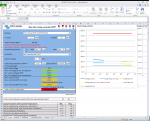
 
I think you must have selected 24v.

When I input this selection, as you would expect, the software suggests a 100/30 for a 12v system.

A 15A controller will self protect to limit the maximum current so will not become damaged by this configuration, but a significant amount of solar power cannot be utilised.

Victron recommend a maximum solar array size of 220w (@12v) for the 75/15.


Six in series exceeds the voltage limit. The controller has no self protection mechanism for excessive voltage (unlike current) and therefore would be permanently damaged with this configuration.
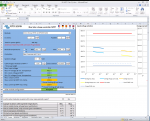
No I put in 12V. My point is that the underlying assumption that you get 50W from a 50W pannel laid flat with ocasional shading on a boat is flawed. Best my 110W flexible could get yesterday on the deck was just over 60W in Plymouth. I made a misstake typing the original now corrected 6 in paralled not series.

1591166607964.png1591166167496.png
 
I have had experience of using flexible ETFE pannels. In the UK with the panels flat on deck I have never got full output. Three years ago I started with a pair of 50W panels in series which gave a peak voltage of 40V. The best I ever got out of them was about 80W. I have a Victron MPPT 75/15 linked to a Raspbery Pi which acts Venus device which enable remote configuration and logging. The peak current from the panels was 2.6A at 30V giving 78W.

I then added a 110W panel and wired in in series with the two 50W panels which were wired in parallel . The max output originally was about 150W but it rarely exceeded 110W. I then changed it so that all three panels were in parallel and found this coped with partial shading better as the panels were deck mounted.

Last year I started having problems with the 50W panels. I believe that my mistake was fixing them with Velcro which gave an uneven support and has lead to the panels failing.

My boat is based on the South cost of the UK.

I suspect that if correctly configured the MPPT 75/15 may well be adequate for 400W if the pannels are configured so as to not overload the controller.

Victron have a useful tool called
MPPT Calculator Excel sheet
which you can download here.

Software - Victron Energy

If for example one has 8 55W pannels giving a theoretical may of 440W and configure them 4 banks of 2 in series the configuration is acceptable . However 6 in parallel is not as it exceeds the 15A limit of the controller. The limit applies to the input current from the panels.

Note the limit for the controller is the max PV short current see page 11 of the manual https://www.victronenergy.com/uploa...-10-75-15-100-15-100-20-EN-NL-FR-DE-ES-SE.pdf

Whilst you may occasionally harvest more with a larger controller I suspect that with 400W in the UK the 75/15 may be adequate.
I think the point being correctly made here is that although it works fine and won't break the unit, you won't get the full benefit from the panels. Now it might well be that in the UK, the panels are only pushing 70% of the maximum output anyway, and if this is the case, then of course the numbers actually add up, so it may be that this is what is happening with my setup.

Your latest post from the calculator shows an overcharge of 30%, which backs-up what I am saying. It is acceptable, but you might theoretically be able to get 30% more from the panels if they are working at 100%.
 
Flexible panels do sometimes develop faults. A good indication of the overall health of your solar system is that you should be seeing the full rated output of your panels, or very close to this in very good solar conditions. This is quite achievable in the UK with flat panels.
 
slightly OT, apologies, is there any reason one shouldn't be using panels designed for solar farms? I have 2X300W 1X2m glass polywhatever (iirc) panels instead of a bimini on the f/b, which have an open circuit V or 46 or 48max wired in series (so 92-96V max) on a 100V/30A Victron MPPT. All data tested on Victrons XLS file and passed with flying colours so should be fine. I see much better Amps compared to a friend with similar sized 28V (or thereabouts) panels especially in the morning where it matters most imho.
I also have the advantage of being able to use thin gauge cable to make the run from the hardtop to the e/r.
On the 3rd season now, still working...
V.
 
I have 260w of panels wired to a Victron 75/15 and on some days they get pretty close to the max output of 15a. The controller simply is not big enough to get the best from 400w.
 
slightly OT, apologies, is there any reason one shouldn't be using panels designed for solar farms? I have 2X300W 1X2m glass polywhatever (iirc) panels instead of a bimini on the f/b, which have an open circuit V or 46 or 48max wired in series (so 92-96V max) on a 100V/30A Victron MPPT. All data tested on Victrons XLS file and passed with flying colours so should be fine. I see much better Amps compared to a friend with similar sized 28V (or thereabouts) panels especially in the morning where it matters most imho.
I also have the advantage of being able to use thin gauge cable to make the run from the hardtop to the e/r.
On the 3rd season now, still working...
V.

I would have wired the panels in parallel rather than in series for several reasons:

1. 90v DC is above a potentially lethal voltage, so you need to be very careful with the wiring. You also need to watch component selection. Not many switches, circuit breakers etc are rated for this voltage.
2. Series connection produces poorer performance when one panel is shaded.
3. An open circuit voltage of 92-96v is very close to maximum for your controller. Most controller manufacturers (including I thought Victron) recommend that the PV open circuit voltage should be 10-15% below the maximum rating of the controller. This is because solar panels can produce voltages over the open circuit voltage in some conditions (such as when the panels are in low temperatures). Even a brief voltage over the maximum 100v rating will permanently damage the controller.
 
3. An open circuit voltage of 92-96v is very close to maximum for your controller. Most controller manufacturers (including I thought Victron) recommend that the PV open circuit voltage should be 10-15% below the maximum rating of the controller. This is because solar panels can produce voltages over the open circuit voltage in some conditions (such as when the panels are in low temperatures). Even a brief voltage over the maximum 100v rating will permanently damage the controller.

I just checked the 100/30 manual and it does state that the controller is OK for a:

“Maximum open circuit PV voltage: 100V.”
So they do have a little more voltage tolerance than most controllers.
However, they also set a limit of :

“Maximum: 144 cells.”

So check the number of cells in your panel is 72 or less for safe series connection.
 
Last edited:
Space is also at a premium on my little 23 footer. In the end I went for fairly inexpensive flexible panels from Sunstore. Initially I had a single 40 watt panel with a cheap PWM controller. I managed to find space for a second 40 watt panel and now have them connected in series with a Victron 75/10 MPPT controller.

The main reason I chose the panels was purely the size and flexibility were perfect for where I needed them. The oldest panel is now 3 years old and is regularly stepped on - no way to avoid it. The best I have seen as far as output so far this year is 71W peak out of nominal 80W - not bad considering they are both horizontal and always have at least the shadow of a rope or something across them. On average I’m getting about 260Wh a day from the pair for my 125Ah house battery and 26Ah starter.

They were relatively cheap and I regard them as semi-consumable, but I don’t think they’re doing too bad under the circumstances.
 
Top