Flexible drive question

sailorbaz

Well-Known Member
Joined
22 Apr 2002
Messages
296
Location
Bald Knob, Queensland, Australia
Visit site
sheared flex drive.jpgNew flex drive.jpgFlexible drive.jpg

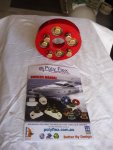
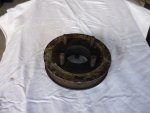
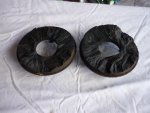
The old flexible drive in the photo has been between the prop shaft and gearbox of my 1GM10 since 1985. It consists of two steel plates bonded to the rubber with 4 studs welded on each side.
Recently while getting back on my mooring in very windy conditions, I got a rope round the prop which resulted in the rubber shearing. Fortunately I already had one mooring rope attached, so wasn't blown onto other boats.
The instructions for the new polymer one says max runout 3 thou. I can't pull the shaft flange close enough to measure it because of the zinc anode on the shaft.
Would it work if I bolt the new flex drive to the gearbox flange, pull the shaft flange close to it and rotating the flex drive, measure the gap all round?
Or is there a standard way of doing it?
I had a look at Vyv Cox's site but can't see one like mine.
TIA for any help.
Sailorbaz
 

That's R&D, which usually employs the 'magic red bolt' for alignment. The OP's is a Polyflex, which seems not to have one, although it may be possible to contrive a similar method of alignment checking.

The alternative, of course, is that if the old coupling was aligned, then so will the new one be. However, if it was stalled violently when it caught the rope, the engine may well have shifted sideways on its mounts. Don't ask how I know this...
 
Last edited:
Thanks for the replies.
The engine didn't stall when it happened. I hadn't realised it had happened until I did a service on the engine a week later!
I think the alignment is probably alright as I pushed the broken halves together before I removed them and they mated together OK, but I thought I should check the alignment anyway.
Sailorbaz
 
Would it work if I bolt the new flex drive to the gearbox flange, pull the shaft flange close to it and rotating the flex drive, measure the gap all round?
Or is there a standard way of doing it?

The short answer is yes.

The trick is not to pull the flange up too hard so you use some of the flexibility, though your coupling is anything like miy Bullflex, you won't do it by hand. You could even bolt the flange to the coupling as long as you leave a few mm slack on the bolts, which does simplify life.
 
Here's an update.
I've bolted the new coupling to the gearbox flange and pulled up the shaft flange to it. Although the two flanges are parallel there is a vertical misalignment of 9 mm. I think the system has been running with the old rubber flexible like this. It already had some surface cracks before it failed.
It looks like the PO installed like this as the engine mounts are already at the lowest setting - 92 mm above the bearers.
I could replace the engine mounts with Polyflex ones, which come in different heights but as the Yanmar ones are in good condition I'm thinking of removing the jack nut from all four and using s/s washers as shims to get the correct height.
Has anyone done this with Yanmar mounts?
It does say in the manual that the brackets on the engine should be as low as possible on the mounts.
Sailorbaz
 
I've bolted the new coupling to the gearbox flange and pulled up the shaft flange to it. Although the two flanges are parallel there is a vertical misalignment of 9 mm.

It would be worth rotating the shaft, 90 degrees at a time, to check that this vertical misalignment is uniform - ie that the shaft isn't bent.

Secondly, when trying to align the engine to the shaft, it's usual to check that the shaft is centred in the inboard end of the stern tube. Depending on your shaft seal, this may not be necessary.
 
Here's an update.
I've bolted the new coupling to the gearbox flange and pulled up the shaft flange to it. Although the two flanges are parallel there is a vertical misalignment of 9 mm. I think the system has been running with the old rubber flexible like this. It already had some surface cracks before it failed.
It looks like the PO installed like this as the engine mounts are already at the lowest setting - 92 mm above the bearers.
I could replace the engine mounts with Polyflex ones, which come in different heights but as the Yanmar ones are in good condition I'm thinking of removing the jack nut from all four and using s/s washers as shims to get the correct height.
Has anyone done this with Yanmar mounts?
It does say in the manual that the brackets on the engine should be as low as possible on the mounts.
Sailorbaz

yes the lower it sits the better
 
It would be worth rotating the shaft, 90 degrees at a time, to check that this vertical misalignment is uniform - ie that the shaft isn't bent.

Secondly, when trying to align the engine to the shaft, it's usual to check that the shaft is centred in the inboard end of the stern tube. Depending on your shaft seal, this may not be necessary.

Yes, I've checked that the shaft isn't bent and it is centred in the shaft tube. I was surprised that it could have been running with this misalignment for 30 years!
Sailorbaz
 
Top