Fizzy water - any ideas what's in my pipes?

Gregp74

New Member
Joined
1 Jan 2025
Messages
6
Visit site
Looking for advice on what might be in the water system on board our new (launched Oct last year) 41-ft yacht please.

When we leave the water in our pipes for more than a few hours, it's starts to have a specific odour, and fizzes as it comes out of the tap. If you run the water for a few minutes it subsides and the smell reduces, but it's really odd.

The (steel) tank is clean, and the water in it is fine. It's only when the water sits in the pipes between the tank and the taps, that it gets fizzy and starts to smell 'off'.

Can anyone help please?
 
Looking for advice on what might be in the water system on board our new (launched Oct last year) 41-ft yacht please.

When we leave the water in our pipes for more than a few hours, it's starts to have a specific odour, and fizzes as it comes out of the tap. If you run the water for a few minutes it subsides and the smell reduces, but it's really odd.

The (steel) tank is clean, and the water in it is fine. It's only when the water sits in the pipes between the tank and the taps, that it gets fizzy and starts to smell 'off'.

Can anyone help please?
Just to add - we've checked/cleaned the aerators in the taps, and all the pipes in the system look clean as well - also had a local maintenance company check it out, and they're stumped too, and have advised a (very expensive) water test.
 
I get the smell in my aft heads hot water tap and a small burst of air, but not fizzy.

Air in the system, introduced when the tap is switched off and some of the pressurised water drains back to the tank, or bleeds off when the tap is closed. The water with air sits in the pipes and festers away with bacteria that cause the smell and possibly fizz, which then gets displaced out when the system is used. This can happen with dirty pipes and no air in the system. What you think is clean, might not be.

The water pipes should be a food grade plastic specifically for drinking water use, which should help to prevent this.

I would recommend using bleach or a propriety branded water tank / pipe cleaner, replacing any water filters with new and flush through and soak the tank and pipes with the cleaning agent, then flush through again with bleach. Check all connections for air leaks. Clean again, or remove the aerators, as they can be a source of dirt build up.

Lots of YouTube videos on cleaning boats fresh water systems.

Also Practical Sailor article Keeping Water Clean and Fresh - Practical Sailor

I took deliver of a new boat way back in the 1980's and we found crisp (chips) packets, apple cores and lots of bits of dust and dirt in both the fuel tanks and water tanks. My point is it may not have been cleaned as good as you think, or expected. My experience was extreme.
 
As per others, clean the tank using some water tank cleaner and draw the water through all the system and leave to soak for around 12 to 24 hours. Empty tank and as you fill tank back up draw the fresh water through for a while.
If the water still fizzes replace all the plastic pipes including the filler one. If you have filters on the pipework that remove bacteria, etc remove the actual filter element before using chemicals and put put new elements back in or even try using the water without filters.
 
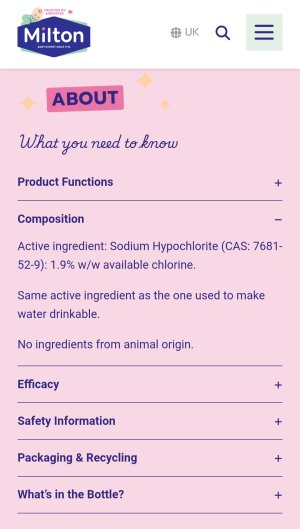
A reasonably clean water tank can be sterilised using Milton ( as used for babies feeding bottles etc)

Use at the rate of 30ml per 5 litres. Flush a little through the pipes then allow to stand for 15 minutes before draining and rinsing.

Milton is expensive therefore for a large tank use a non thickened domestic bleach at the rate of 20 ml per 5 litres and rinse more thoroughly.
 
A reasonably clean water tank can be sterilised using Milton ( as used for babies feeding bottles etc)

Use at the rate of 30ml per 5 litres. Flush a little through the pipes then allow to stand for 15 minutes before draining and rinsing.

Milton is expensive therefore for a large tank use a non thickened domestic bleach at the rate of 20 ml per 5 litres and rinse more thoroughly.
I'd skip the Milton fluid. It's active ingredient is sodium hypochlorite at a concentration of 1%. £5.30 a litre in Tesco.

Supermarket bleach is also sodium hypochlorite at 5% concentration for 87p a litre. Dilute the bleach 5 to 1 and you've got the same thing but at a thirtieth of the price (3%).

I believe the ideal sterilising concentration in your tank should be 50ppm so that's 1ml per litre of tank capacity of the 5% bleach.

Tank = 250 litres
50 ppm = 12.5ml
12.5ml x 20 (concentration of bleach) = 250ml per 250 litres of standard domestic bleach.

Please check my maths!
 
I'd skip the Milton fluid. It's active ingredient is sodium hypochlorite at a concentration of 1%. £5.30 a litre in Tesco.

Supermarket bleach is also sodium hypochlorite at 5% concentration for 87p a litre. Dilute the bleach 5 to 1 and you've got the same thing but at a thirtieth of the price (3%).

I believe the ideal sterilising concentration in your tank should be 50ppm so that's 1ml per litre of tank capacity of the 5% bleach.

Tank = 250 litres
50 ppm = 12.5ml
12.5ml x 20 (concentration of bleach) = 250ml per 250 litres of standard domestic bleach.

Please check my maths!
ITYWF Milton is actually 2% NaOCl

Your maths follows a a rather roundabout route but the answer of 250ml per 250 litres is correct to produce 50ppm

The dosage rates I quote originally came from a page on Milton's website aimed at campers and caravanners
 
There's nothing electrolytic going on in the system is there? I only wonder because of the term "fizzy"
 
Probably anaerobe(s) producing CO2, or sulfate reducers producing H2S as a smellier possibility, or perhaps both. You should kill them as discussed above.

However, their presence suggests there are probably organic residues in your pipes (though there is a slim possibility you've got bugs with the capacity to actually break down the plastic itself) which ideally you would physically remove by thorough scrubbing and flushing, or renewal, to avoid a recurrance.
 
Buy some pH paper and/or Litmus paper (they do different things ) and a cheap (Amazon) detector for ppm of contaminants?

All cheap.

Perhaps there is some electrolysis going on?

What are your pipes made of? Plastic, some type of metal?

Fizzing can be bubbles of air or OTHER gases.

As for sterilising, look at self brewing kits instead of bleach based products? Although Milton (which is weak bleach should be ok if used sensibly - or regular bleach diluted as WonkyWinch states) or purification tablets from a caravan shop (is that Amazon now?) and what do those tablets contain?

The fizzing: a mystery to solve. I would like to hear how you solve it if you have time.
 
Last edited:
As others have said, dose the tank with bleach for 24 hrs. Makes sure you run the taps to get some of the bleach solution into them. After 24hrs, empty the tank and refill. If it still has a bleach odour, drain again and refill. If you still have fizzy water, then there is possible something else going on.
I find that a super clean tank tend to have a more fizzy/aerated nature to it when any slime has been removed by dosing. We use a carbon filter so we get no smell and we drink from our tank
 
ITYWF Milton is actually 2% NaOCl

Your maths follows a a rather roundabout route but the answer of 250ml per 250 litres is correct to produce 50ppm

The dosage rates I quote originally came from a page on Milton's website aimed at campers and caravanners
I got my info from Wikipedia which has verified sources, however, straight from the horses mouth, it's 1.9% so it's thrown my cost comparison.

Bleach is now only 1/15th (c 6%) of the cost of Milton Fluid.

Screenshot_20251020_071537_Brave.jpg
 
Last edited:
Lab testing is expensive and not much use if you don’t know what you are looking for - you have to specify what you want to test for. There are water test strips which will give you a rough answer. Or a pet shop will do the basic tests for about £2.

It’s not likely the pipes could be that contaminated in a year. Who had the boat from new ? Might they have put some treatment in the tank which is still there ? People do strange things sometimes.
 
Hi all, thanks so much for the advice here.

To add a few more details - and perhaps deepen this mystery - I've done two rounds of Puriclean treatments, one at the recommended dose, and a second a few weeks later at a stronger dose (which took 5-6 flushes to remove any residual odours from it). Neither of these solved it, and within hours (left overnight), the smell is back.

I've had the boat from new (launched October 2024) and the pipes are medical grade plastic, and nothing else has been flushed through them. Having had the inspection hatch of the tank open repeatedly to try and solve this now, I can categorically say that the water in it is fresh/clean. So it's definitely the pipes/system where this is occurring.

I've bought some water testing strips from Amazon, so will give that a go next, and then try the bleach route as per suggestions here. Will report back...
 
I wouldn’t use bleach in a stainless steel tank as it may damage it. You have thoroughly cleaned the pipes so logically bleach is not needed.

I used to test samples for off odours. If you half fill a mug with the water, put cling film over it, wait for ten minutes or so then lift the film and smell the trapped air that should concentrate any smells. You might get a clearer idea of what it is. But do the smell test well away from the tap. It may be the smell is coming from bacteria in the drain as the water hits it. You can get a flexible thin brush to clean it.

It is possible that the fizzing is just air in the water - if it looks cloudy in a glass but clears from the bottom up over a couple of minutes.

My bathroom sink drain behaves exactly as you describe when it needs cleaning. Instant smell when the tap is turned on dissipating quickly. It doesn’t smell at all until the water hits it.

Otherwise it can only really be cross contamination but if the problem is fairly recent that seems unlikely.
 
Bleach is not always a go to; there is reason I suspect it is banned from school use.

Good news is you have plastic pipes; no electrolysis (probably)?

As said, do the bubbles dissipate in a glass after a few minutes ? if so , no problem existsts.

What have pH strips and litmus paper produced?

What has a meter that measures ppm ‘told’ you ( the meter costs a few quid on Amazon- I used it to measure my domestic supply)?
 
If the boat is less than a year old, is there any warranty you can claim upon? I realise that many humans and business people wish to do the least possible…

I have seen that the most successful companies are the ones that produce the best customer service ; it was a YouTube video - I will not post it. It was created by a rich man comparing vehicle hire companies; he concluded Enterprise beat Hertz and Avis etc simply because of better customer service.

Are you able to still talk talk to boat manufacturer?
 
Bleach is not always a go to; there is reason I suspect it is banned from school use.

Good news is you have plastic pipes; no electrolysis (probably)?

As said, do the bubbles dissipate in a glass after a few minutes ? if so , no problem existsts.

What have pH strips and litmus paper produced?

What has a meter that measures ppm ‘told’ you ( the meter costs a few quid on Amazon- I used it to measure my domestic supply)?
Beach is the water industry standard for cleaning potable water tanks. Chlorine is the base substance in traditional bleach. The treatment on commercial sized water tanks is called chlorination in the industry.
The chlorine is removed before the tank is put into service by draining and refilling. I normally do this twice if we have the time. Our 800 L tank can take a day to fill in some boatyards so I have only emptied and refilled on occasion. The carbon filter removes and residual chlorine taste.
 
Bleach is not always a go to; there is reason I suspect it is banned from school use.

Good news is you have plastic pipes; no electrolysis (probably)?

As said, do the bubbles dissipate in a glass after a few minutes ? if so , no problem existsts.

What have pH strips and litmus paper produced?

What has a meter that measures ppm ‘told’ you ( the meter costs a few quid on Amazon- I used it to measure my domestic supply)?
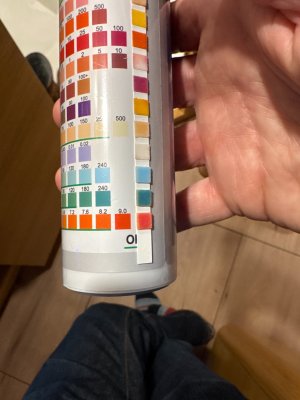
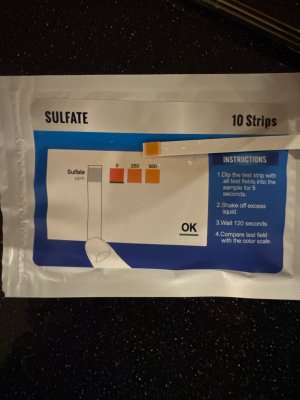
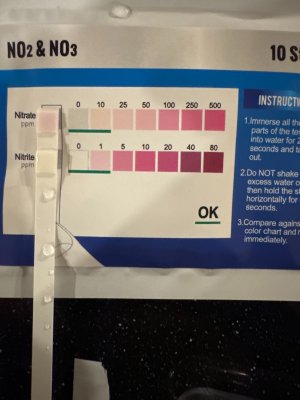
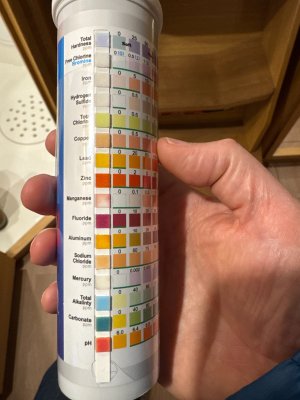
I took some test on the weekend, and got the following results. The bacteria test came up negative, which is a relief.

Alkalinity looks high

Carbonate 240 (above recommended amount)

Sulfate around 500 - high levels

PH - high (9)
 

Attachments

  • Water testing_1.jpeg
    Water testing_1.jpeg
    1.2 MB · Views: 9
  • Water testing_2.jpeg
    Water testing_2.jpeg
    1.1 MB · Views: 8
  • Water testing_3.jpeg
    Water testing_3.jpeg
    1.1 MB · Views: 7
  • Water testing.jpeg
    Water testing.jpeg
    1.4 MB · Views: 9
I took some test on the weekend, and got the following results. The bacteria test came up negative, which is a relief.

Alkalinity looks high

Carbonate 240 (above recommended amount)

Sulfate around 500 - high levels

PH - high (9)
Did you do one on the water you use to fill the tank as a comparison ?
 
Top