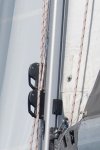
Fixing a clutch to my mast

Oscarpop

Well-Known Member
Joined
31 Jul 2011
Messages
1,053
Location
Kent
Visit site
Just picked up a spinlock clutch at the sbs , which I intended to rivet to the mast.

However looking at the clutch this is not going to be possible and it's going to need to be tapped and then screwed on.

Never done this before. I need to use m8 screws according to the fitting instructions. Not sure how easy this is, and how much the tapping bits are to buy. Any suggestions, or shall I just get the local sailmaker/shipwright to do it?
 
Taps bits are just a couple of quid.

They come in three types, first cut, second cut and plug. For a mast type alloy, just use a first cut.

Drill the hole (6.8mm or a little less), and mount the bit in a drill. A tap handle is the 'proper' tool, but a drill makes it a lot easier to get it square. Turn the chuck by hand only.

Keep firm pressure on it as you go in (you are helping it to cut the start of the thread - otherwise you run the risk of just making a hole). Do two turns and unwind one turn, repeat. A little oil is good.

If I've made it sound tricky - it isn't. Do a couple of practice holes in scrap and you will get the feel for it. It is easy.
 
Last edited:
Depends upon the loads being put on the clutch...

I am sure you can get extenders so that rivets can be fitted into deep spaces. You should also use a zinc? paste when putting stainless or insulator of some sort on a mast past to stop corrosion, alloy masts and S/S cause electrolysis as quick as.

I would go for rivets if you can find the technology...
 
Depends upon the loads being put on the clutch...

I am sure you can get extenders so that rivets can be fitted into deep spaces. You should also use a zinc? paste when putting stainless or insulator of some sort on a mast past to stop corrosion, alloy masts and S/S cause electrolysis as quick as.

I would go for rivets if you can find the technology...

The load on the fixing bolts for a clutch is (almost) only shear - no reason to make the install complicated.

I would use SS bolts, drill an tap as described in the post from boguing http://www.ybw.com/forums/showthread.php?373188-Fixing-a-clutch-to-my-mast&p=4373730#post4373730

Use Duralac or other suitable compound to insulate dissimilar metals.
 
How thick is the mast wall?
You need a reasonable thickness to get strength from a tapped thread.
I think 3 turns of thread is a minimum?
That's 4.5mm for M8.
It could be that thick low down, as there are often doublers inside.
If not I would consider rivnuts.
And/or look at the loads to see if M6 might do?
 
I've already got 2 identical spinlock xts clutches on the mast so I know there is enought thickness.

Thanks all, will give it a go
 
I've already got 2 identical spinlock xts clutches on the mast so I know there is enought thickness.

Thanks all, will give it a go

The existing ones may screw into a tapped plate inside the mast?
Any way, drill a small hole and you will find out.
Good luck in missing all the halyards and wires ... ;-)
 
You need a thick mast wall in order to effectively tap for 8mm screws.If your mast is anything like mine (3.5mm) I'd advise you to use Monel rivets instead of screws.
 
You need a thick mast wall in order to effectively tap for 8mm screws.If your mast is anything like mine (3.5mm) I'd advise you to use Monel rivets instead of screws.

I can't rivet them as there is no way I'd get the rivet into the clutch to secure it

It's a selden mast that is 16m high. I just checked the selden site and I should have at least 5mm thickness
 
Last edited:
The clutches on my mast are bolted onto a "stand-off"bracket, which in turn is riveted onto the mast. The clutches only have provision for two bolts, but the bracket has six or eight rivets. Seems a better way than tapping into the thin mast wall.
 
I can't rivet them as there is no way I'd get the rivet into the clutch to secure it

It's a selden mast that is 16m high. I just checked the selden site and I should have at least 5mm thickness

The clutches on my mast are bolted onto a "stand-off"bracket, which in turn is riveted onto the mast. The clutches only have provision for two bolts, but the bracket has six or eight rivets. Seems a better way than tapping into the thin mast wall.
If you have a 5mm mast wall then it should be ok to tap and screw but as said above a better solution is a base made of sheet stainless that is riveted to the mast.
 
image.jpg

As you can see, I have 2 clutches mounted on the mast without brackets.

They have been there 2 years and still haven't moved an inch. It's just the rivets vs tapping.

I would be surprised if southerly used backing plates, although I will e mail them on Monday
 
If you have a 5mm mast wall then it should be ok to tap and screw but as said above a better solution is a base made of sheet stainless that is riveted to the mast.
+1.
I instruct on Glenans 5.70s. They have a pair of halyard clutches on the mast. These are mounted on a bracket which has a flat surface to which the two clutches are bolted. The sides of the brackets are shaped to the mast and attached with possibly 6 rivets. Can't recall whether they are made of S/S or alloy.
 
This bracket fervour is peculiar.

If something is placed in between the clutch and the mast, you have now increased the bending moment, so now you need more strength in the fastenings.

You have also added weight. Colin Chapman will be turning in his grave. (Add lightness and simplify).

The cast alloy bracket in the above picture has certainly doubled the bending moment (if not trebled).

It's also mounted upside down. The BM wants to unpeel it from the mast, starting at the bottom. The four screws should, therefore be at the bottom.
 
How is it mounted upside down? Look again. The internal halyard is coming out from a sheave at the bottom of the mast, so the load on the clutch is pulling downwards against the four fastenings at the top.
 
I would definitely go for the bracket; I have fixed the cheek blocks on my boom for the reefing lines this way, as for increasing the bending moment, come on; the bracket / adaptor plate is 1-2mm stainless !

I'd change the existing clutches to this too while they're still around...
 
I've mounted a clutch on a Sonata mast by making a tapped backing plate out of stainless steel and holding it in place internally with double sided sticky until the screws were fitted; wrangling it into place wasn't much fun. A slightly easier job was attaching a cam cleat to the same mast with penny washers and nuts, the wrangling was assisted by plentiful swearing.
 
Top