Fitting new halyards - but what's this?

ash2020

Well-Known Member
Joined
7 Jun 2010
Messages
849
Location
Fowey, Cornwall
Visit site
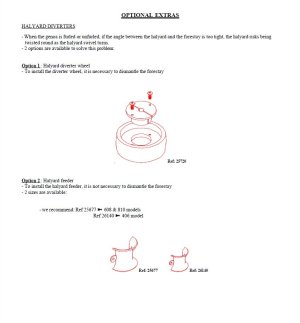
I'mabout to fit new halyards to my Hunter Medina, which is being launched next week. I want to make sure that everything up the mast is where it should be. When I bought the boat last year it had cord sleepers, no running rigging so I've never seen what was originally there. In the photo, I'm assuming that the spinnaker sheave is the one on the right (top). Then is the T slot for the forestay, then below the forestay is the jib halyard sheave, but then what would the D ring/fairlead on the left be for? And why would he have put the jib halyard sleeper through that? Any suggestions? Thanks.
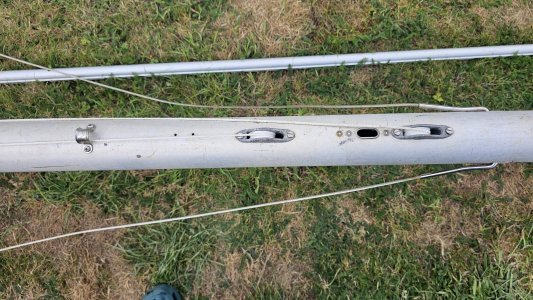
Mast running rigging.jpg
 
Does it have a furling genoa? Probably a "halyard deflector" to stop the halyard wrapping when furling the jib.
Well yes it does, but I thought that was the point of having the halyard sheave a fair bit lower than the top of the roller foil. Does that mean you'd have to have a separate line from the swivel through the eye and down the outside of the mast? The genoa halyard obviously goes down inside the mast.
 
No that looks to be in the right place for a diverter. Measure the foil to the point where the top swivel attachment is when the sail is hoisted. you will find that is lower than the diverter
 
No that looks to be in the right place for a diverter. Measure the foil to the point where the top swivel attachment is when the sail is hoisted. you will find that is lower than the diverter
OK, will do, it just seems odd to have a nice, free running pulley and then introduce a load of friction with a fairlead.
 
As I see it, the halyard comes up the mast & over the top of the sheave then down through the halyard deflector and then at an angle to the top swivel of the furling gear. From memory the angle between the forestay and the halyard should be about 20 degrees, thus preventing the genoa halyard wrapping around the forestay. There are pictures if you ask Google.
 
The halyard myst not run parallel to the forestay as it would cause halyard wrap and cause problems, hence the halyard deflector.
Yes, I realise that. It's happened to me before and it usually happens in a blow when you want to get the damn thing away ASAP. I thought the fact that the halyard mast sheave was a long way below the forestay fixing, it would be well clear.
 
Yes, I realise that. It's happened to me before and it usually happens in a blow when you want to get the damn thing away ASAP. I thought the fact that the halyard mast sheave was a long way below the forestay fixing, it would be well clear.

Its the furler and genoa luff length that is important ... that determines the halyard angle to the stay ..

My 25 ft boat has a different arrangement ... I installed the 'doughnut' diverter wheel but that was unreliable ... if it stuck to top of furler - wrap would occur. So I went back to the previous owners solution ... a two line affair.

EBgHerWl.jpg


The furling gear and genny was always short when I bought the boat ... and previous owner had added the second lighter line to control the action and prevent wrap. Yes its a bit of a pain hoisting the sail as you pull on two lines together - but as the sail only goes up / down once or twice a year - its acceptable.

I could add a section to the furler ... get a taller luff .... but the boat is fine with existing.

A number of people have mentioned trouble with halyard wrap with the wheels etc - and I have shown them mine .. with a good number of them adopting the same ... and thanking me for the solution. I repeat though - its not my idea .. and in fact I did find in an old furlers installation guide - this arrangement.

My 38ft - I have a strop from genny head to the top furling swivel - its only about 20cms long - but that makes all the difference and is the recc'd solution in the Furlex installation guide .... When I bought the boat - it was a fight to use the furler ... we spent ages on the dockside with binoculars .. rasing / lowering the genny etc ... trying out ways to get it to work .... (Furlex 2000) .... but in the end - the strop cured it 100%.

What I am illustrating - is that the halyard to stay angle is paramount importance. Get it right and you can enjoy .. get it wrong and its a pain.
 
Do you have the manual for your furler ?
I haven't, but I understand the main dimensions. I just don't understand why you would use a fairlead, with the rope going through at an extreme angle, rather than another block, for the diverter. It must introduce a lot of friction when hoisting.
 
Its the furler and genoa luff length that is important ... that determines the halyard angle to the stay ..

My 25 ft boat has a different arrangement ... I installed the 'doughnut' diverter wheel but that was unreliable ... if it stuck to top of furler - wrap would occur. So I went back to the previous owners solution ... a two line affair.

EBgHerWl.jpg


The furling gear and genny was always short when I bought the boat ... and previous owner had added the second lighter line to control the action and prevent wrap. Yes its a bit of a pain hoisting the sail as you pull on two lines together - but as the sail only goes up / down once or twice a year - its acceptable.

I could add a section to the furler ... get a taller luff .... but the boat is fine with existing.

A number of people have mentioned trouble with halyard wrap with the wheels etc - and I have shown them mine .. with a good number of them adopting the same ... and thanking me for the solution. I repeat though - its not my idea .. and in fact I did find in an old furlers installation guide - this arrangement.

My 38ft - I have a strop from genny head to the top furling swivel - its only about 20cms long - but that makes all the difference and is the recc'd solution in the Furlex installation guide .... When I bought the boat - it was a fight to use the furler ... we spent ages on the dockside with binoculars .. rasing / lowering the genny etc ... trying out ways to get it to work .... (Furlex 2000) .... but in the end - the strop cured it 100%.

What I am illustrating - is that the halyard to stay angle is paramount importance. Get it right and you can enjoy .. get it wrong and its a pain.
That's fine, I get the whole angle thing, but my point is: In that picture, you have a block, which adds little friction to the system. I have a fairlead. Have you tried to pull a rope through a tiny fairlead, under load, at a 60° angle?
 
I haven't, but I understand the main dimensions. I just don't understand why you would use a fairlead, with the rope going through at an extreme angle, rather than another block, for the diverter. It must introduce a lot of friction when hoisting.

Some people I know have used a block instead of the plain diverter ... but in reality - how often are you going to hoist / down that sail ?

I've attached the Plastimo manual for the older series - I suspect you may have based on the boat.
 

Attachments

Thank you for all the comments. I'm sorry if I haven't made myself clear. I know all about diverters and the angle needed to keep the halyard away from the swivel. It's happened on more than one of my boats. My main point was Why not use a small block rather than a fairlead?
 
That's fine, I get the whole angle thing, but my point is: In that picture, you have a block, which adds little friction to the system. I have a fairlead. Have you tried to pull a rope through a tiny fairlead, under load, at a 60° angle?

My block is a 2nd line .... not the same halyard. I weould not want to put halyard tension through that block. I would need a more substantial block.

Second - my angle is far more than Furler manuals state ... >

"20 - 25 deg maximum of halyard angle"

Thery don't say much about why - but the idea is that if you have a greater angle than 25 deg - the halyard tension will then cause the stay to be pulled out of straight line - causing friction to the furling extrusion. This actually is one reason why some advocate slacking halyard when furling the sail ... something that I do not support - if halyard and sail are correctly hoisted - then there should be no reason to slack halyard. We will ignore those who talk about tensioned luffs etc for points of sail.

But think about it .... during the hoist of the sail - that angle to the diverter only becomes significant at the highest point of hoist ... from start of hoist till a good way up - the angle is negligible with little friction .. the diverter has a flaired entry / exit to smooth the line passing through ..

I get your thoughts on it - but honestly - I think you may be over-thinking this. That diverter has been used by many and it works.

Note : Should I add extrusion and increase my luff length - I would most likely change to the simple diverter mounted higher up ...
 
Last edited:
Top