Fitting a graving piece

Poignard

Well-Known Member
Joined
23 Jul 2005
Messages
55,657
Location
South London
Visit site
In November 2006 forum member roly _vola posted this advice on fitting a graving piece :

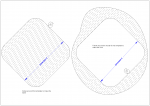
"To make life easier you can make up some templates in 10mm perspex - Use a top bearing guided flush cutter and cut the outer one the diameter of the router cutter larger than the inner one then you use the SMALL on to rout out and the larger one to make the graving piece. Bit fiddly but you can test it on scrap till you get it right and then get a perfect fit everytime."

I can't quite understand what he means, and as he doesn't seem to be around any more, I wonder if anyone else can clarify the above for me.
 
I'm sure that's cobblers on two accounts.

First the template to route the insert has to be 2 cutter diameters larger than the template for the hole.
Secondly, there's little chance in routing two concentric templates unless you have a CNC machine.

Edit: Actually it's much better to route the 'hole' with the hole template so you can't ever go outside the line and you want to route the insert with the solid template so you can't go smaller than the template. So both the hole and the solid must be exactly the same size. So CNC them to stand any chance of getting them perfect.

Or do it the traditional way: Cut your graving piece first ensuring the edges are exactly vertical (90° to the top).
Then trace around it very carefully onto the substrate to be repaired.
Route out the bulk of the material free hand.
Trim to the line with a sharp chisel.

Templates.png
 
Last edited:
Bit tricky to CNC it if on the boat?
Over on the Tally Ho vids, Leo fits a graving piece into the keel. Worth a look.

Also, if in planking, one might want to shamfer each end to avoid a hard point.
 
Some advice ...

A good set of sharp bevel edged chisels is the tool of choice.

The graving piece should be the shape of an elongated diamond cut with the grain. This maximises the eventual glue line along the grain and avoids a glue line across the grain which will not be strong. The socket likewise follows the grain of the wood to be repaired. The graving piece needs to be thicker than the depth to be filled to make it easier to remove/insert as you fine tune the dry fit. Plane away/ fair once the glue/epoxy has set.
 
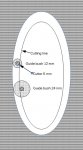
You only need one template, two guide bushes and a straight cutter (no need for a bearing-guided cutter). There's also no need for anything fancy when making the template. It isn't particularly difficult to keep the guide bush against the template when cutting the graving piece, but it's not the end of the world if you get that wrong at the first attempt - you can practice on scrap wood or MDF.

Template.jpg
 
Last edited:
Some advice ...

A good set of sharp bevel edged chisels is the tool of choice.

The graving piece should be the shape of an elongated diamond cut with the grain. This maximises the eventual glue line along the grain and avoids a glue line across the grain which will not be strong. The socket likewise follows the grain of the wood to be repaired. The graving piece needs to be thicker than the depth to be filled to make it easier to remove/insert as you fine tune the dry fit. Plane away/ fair once the glue/epoxy has set.

That is what I have done in the past. Time and patience are your friends.
 
Top