Fitting a bilge pump

pij27

Well-Known Member
Joined
22 May 2016
Messages
125
Location
Ryde Isle of Wight
Visit site
After returning to my boat after a few weeks away through work and injury, find the nice people at the marina had moved my boat closer to the hard so that she wouldn't sink if took on too muck water. Need to fit a bilge pump, should I go for a manual pump so always able to operate or fit an electric one, with a float switch and a battery? There is no electrical supply from the walkway do I go manual or always bring a spare battery and swap over when leave?

Also, what is best way to fit the pick up hose? Just attached to low point or via a small cover to stop anything being picked up?
 
It sounds as if your boat takes in water on a regular basis.

A manual pump would be fine, except if you are away again for a longer time than anticipated there might be a problem.

That leads to an electric pump. Without a shore based elec socket, you really need a dedicated service battery and some form of charging, either wind or solar.

A small battery 60 ish Ahr plus a 10W solar charger would be a good, reliable, setup and relatively cheap to the scale and value of the job it does.

Most bilge pumps have the body and sensor unit immersed and delivering "uphill" to the outlet, rather than drawing through an intake tube - which needs a beefier suction pump.

FWIW I have a small automatic Rule, running off a small battery via a fused feed, The battery is permanently linked directly by a fused feed to a 10W solar panel which I leave in the cockpit facing S. The intake has a longplastic pipe about 18 inches, cut in half length ways and with a mesh .

It's as simple, and Fit and Forget as possible.
https://www.amazon.co.uk/s/ref=nb_s...orts&field-keywords=rule+automatic+bilge+pump

EDIT
Oh yes, don't forget a inverted loop leading down to the exit hole, to prevent syphon problem
 
Last edited:
The usual advice is “both”. And both need to have a “strum box” (a filter) at the start of the intake pipe, at the deepest point in the bilge.

You do not say what your boat is built with, but it’s often thought best to avoid the submerged type of electric pump if the hull material is wood, steel, aluminium or ferrocement, because of the damage that can be done by stray current electrolysis.

It’s a requirement under many racing rules, and an MCA requirement for “coding” to
Have two manual bilge pumps one in the cockpit and one in the cabin.

As to “which pump?”, probably the commonest manual bilge pump now is the Henderson Mark V, and there are two good reasons for that - it’s fairly cheap - they do turn up secondhand - and it’s very, very, reliable.
 
Last edited:
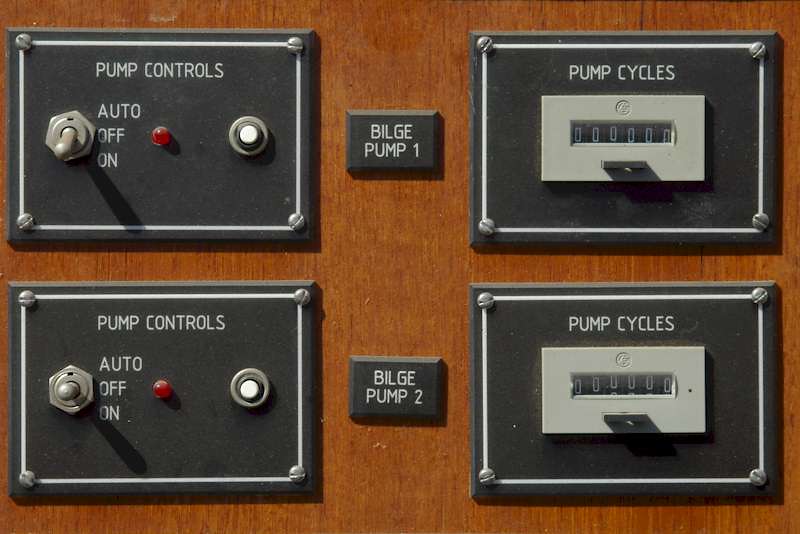
The arguments against electric pumps are that they don't shift a lot of water and, if left on on a leaky boat, they'll ruin the battery. Personally, I'm in favour, because not much that isn't engine or mains powered will keep you afloat if a through-hull fails, and I'd far rather have a flat battery than come down to find enough water inside to damage things. I think the best compromise is as high a capacity pump as you can conveniently fit and solar panels to help keep the battery going. It won't keep your boat afloat if she's determined to sink while your back's turned, but it will give you a chance. I haven't done it yet, but I am considering fitting little timers to my pumps, so I'll know if they've run and, if so, how much.
 
I haven't done it yet, but I am considering fitting little timers to my pumps, so I'll know if they've run and, if so, how much.


Consider fitting on of these electromechanical counter.

36086098055_41a3e4af67_b.jpg
 
It’s a requirement under many racing rules, and an MCA requirement for “coding” to
Have two manual bilge pumps one in the cockpit and one in the cabin.

We don't even know that his boat has a cabin. Routinely filling with water, and being dragged up the hard so that it won't totally sink, sounds more applicable to a 10' dory than a yacht.

The question is impossible to answer properly without knowing what sort of boat the OP has.

Pete
 
Boat is a seafarer 18ft, small covered area up to mast and open rear. Think large dinghy with a seated area under cover. Probably fit a small pump, battery and solar cell and also a manual pump. So when around can use manual pump and when away the electric pump can keep water out. Or possibly look for a boom tent to keep most water off
 
We used to have a Dragon. Moored on a buoy in Abersoch April to September. Open deck, but with a cover over the whole deck, so never needed more than a few pumps on a manual bilge pump... probably a Henderson IIRC.

There is no way we would have considered anything electrical.
 
I might sound really rude here but I think the days of a cockpit open to the bilge are long gone. If it is a GRP boat then consider making the cockpit floor sealed. (above water level with drains). If it is a wooden boat (more likely) then perhaps you should look for a similar GRP with self draining cockpit and self righting. I imagine the cost of a marina berth for an 18fter would overshadow the cost of an 18ft GRP. One with no through hull holes and sealed against rain.
If you are determined to keep the unsealed cockpit then you really need as large a solar panel as can be mounted. You might try a regulator on the panel driving a bilge pump via switch without battery. Sure it will only work during the day but may be a good answer. ol'will
 
Looking at some electric bilge pumps, as well as a cover, and now have a question regarding whether to install a pump with a separate float switch or one with an integral float switch? I will just have this connected to a 12V supply, (small car battery 35Ahr) so should be good for when away for a few weeks.
Any thoughts or recommendations?
 
There is a pump called (I think) The Drainman. This works by using the action of the boat pulling against something like a mooring bouy, or a pontoon. Thus, it requires no electricity, and should work whilst you are away from the boat. I recall seeing similar products, which worked using the natural rocking of the boat, but can't remember what these are called. Might be a solution?
 
Will have a look at this, think that was also the link from earlier. However, the mooring I have on the Itchen dries out towards low tide so for some of the time there will be no movement and therefore no pump action.
 
Start with the cockpit cover!

It will well repay the cost, in reduced worrying, better condition of boat, etc.

In fact with a cover you will probably be able to get along with a bailer and a bucket..

Don’t buy a bailer from a chandler; buy a big plastic container of washing detergent and cut half the top off leaving the handle at the side. Don’t ask me how I know this.
 
Top