Fishing buoy campaign

20m of high water or low water?
Unusually, and not something you would know - totally irrelevant. On Tasmania's west coast, where we had a private cray fish licence, tides are 30cm. Around Sydney tides are 2m.

However was not thinking of depth but distance. We laid our pot in 10m depth but on the shore line. It was very difficult to access, impossible in a commercial cray boat, and we accessed in the tender, with Josepheline anchored behind the little island we chose to lay the pot.
Quite a few years ago sailing past St Vaast we noticed lots of small lights. As we got close found out that they were lights on pot markers. I don't know whether it was a trial by the French as I now try to avoid night sailing.
I've also seen quite large pot buoys, some in deep water, being dragged under by the tide, so trying to keep them visible all the time, regardless of tide is a problem.

Our cray pot weighed 26kg and was a bit of a handful to retrieve - but it had to be heavy to be stable in the Southern Ocean

Jonathan

IMG_0307.JPG
 
I was on a friends boat, near Oban and we picked up a defunct fish farm anchor rope (2" polyprop") around the prop. It took the lifeboat 4 hours to free us and the boat was a write off. Like fishermen, fish farms have little respect for the wellbeing of others.
 
It's possible fishermen have their own secret spots that they don't want others to know about therfore minimum markers.
I ran over a fishing net with little surface floats in the dark up a creek. Having a long keel meant it went under the boat and popped out the stern.
Make your keel choice wisely ?
 
My local harbour, Sunderland, has a long standing notice to mariners that no fishing gear should be laid within the harbour or the seaward approaches. Is this adhered too? No, is anything done about it? No.

This is the problem, a complete lack of enforcement or policing. It seems to me to be the hobby fisherman who are the worst and prone to setting gear with empty bottles as floats etc...
 
Marking fishing gear is something of a complex issue. Previously there was EU regulation that required static gear to be marked outside the 12nm limit and the EU updated their rules last year but they no longer apply to the U.K. of course.

Inshore there is no general legal requirement to mark gear so it is a mixed bag with some IFCAs (Inshore Fisheries and Conservation Authority) having byelaws that manage fisheries such as whelk, crab and lobster that include requirements for marking static gear. These organisations have enforcement officers and boats so such byelaws are enforced. The thing is that the byelaws are primarily developed with the objective of ensuring fishery sustainability and because there are 10 IFCAs in England whose priority is to manage locally there is no consistency in gear marking requirements around the coast, not least because it has not been necessary to apply additional management measures for particular species everywhere. Of particular note is that IFCAs cannot require gear to be marked for navigational purposes so any marking requirement must be for fisheries management purposes.

Over recent years there has been a working group comprising relevant public authorities and organisations such as the RYA that has been considering the issue and a report was published. A key difficulty is that no single govt organisation has ownership of marking fishing gear and neither the Marine Management Organisation nor the IFCAs (both of whom have enforcement officers and boats) are empowered to police gear marking from a navigational safety perspective.

A practical factor for inshore fishermen is that marking gear costs money and many operate within very tight margins so that is why you see some really cutting corners with abysmally ineffective marking and others take a more responsible approach and do what they can. Interestingly, I have found black buoys with short poles and a small black flag that are used locally to be quite good for spotting against a grey sea.
.
 
Last edited:
My wife fears sailing at night as she was traumatised by being ‘potted’off Padstow and needing RNLI assistance to get us clear

In the western English Channel we have found pots miles off shore and even between traffic separation zones- we presume gps used to find for harvest

Our present long keeler seems less vulnerable and we have run over a few pickup lines unharmed on boisterous rainy days when visibility poor
 
Last edited:
Even in areas where marking pots is required has anyone seen a fisheries protection vessel enforcing the rules? Without viable enforcement rules are irrelevant.
 
What really get my goat are pots laid in the way of obvious leisure boat routes, such as those in the Small Craft Channel just off the breakwater at Harwich. :mad:

While not as frequent as anchor threads, these ones on the bane of poorly marked pot buoy/lines are almost as predictable! ;)

Salvation may be at hand, though. I envision the arrival of cheap marine drones fitted with lobster-like robot claws and AI pot line target seeking. :D
 
Even in areas where marking pots is required has anyone seen a fisheries protection vessel enforcing the rules? Without viable enforcement rules are irrelevant.

I see you are in Scotland so don’t have IFCAs (who do enforce in England - see post #25) but you do have the Marine Directorate who operate fisheries protection vessels and have enforcement officers.
.
 
Don't worry. A few more years of overfishing and it won't be worth the cost of deisel for them to go out.

I'm as worried about entanglement in a pot as anyone, but I think you should be more charitable here. Potting, aka creel fishing, is not that bad because it's:
  • species specific
  • only takes adults above a certain size
  • can easily adapt for instance releasing 'pregnant' lobsters (and 'tail notches' females of breeding age)
  • has a maximum catch allowed per day
  • is obvious if done in a 'no-take' zone, so is policeable (even if not currently so policed).
Contrast this, if you please, to bottom trawling which wrecks the environment and catches all manner of 'by-product' ie living organisms, 100 or more of which which are killed for every individual of the target species landed, or to the Dutch trawler operating in UK waters just S of the IoW which took 40% of the entire European population of one species (Mackerel Scad) in one trawl - all of which were destined for low-grade fertiliser - I have too few exclamation points to do this justice, in fact I'm, 5 years on, I'm still pretty mad about it.

And pot fishermen are not those fat plutocrats; they live pretty much hand to mouth. So our real concerns have to understand this if they are to translate into useful action.

I think that slow pressure - the drip effect - can change attitudes. Were we to say that it's just bad for the planet and you should be ashamed to use floating rope that would be a start. We (us yachties) could even create a sponsorship scheme to allow professionals to buy better kit (God knows, this weekend I (was forced to) sponsor loads of shit that does immense societal harm via my annual tax bill, so it would be a gnat when I've already swelled the camel).

Instead of moaning, why not state best practice? I've spoken to inshore fishermen, and the (A)IFCA about this, and the one common enemy are amateur cowboys who set pots which they then abandon to the detriment of all, so there is an open door for better practice. But for heavens sake we must be consistent - moaning about visible marking misses the point by a mile, its entanglement which counts so why does everyone keep talking about a secondary issue?
 
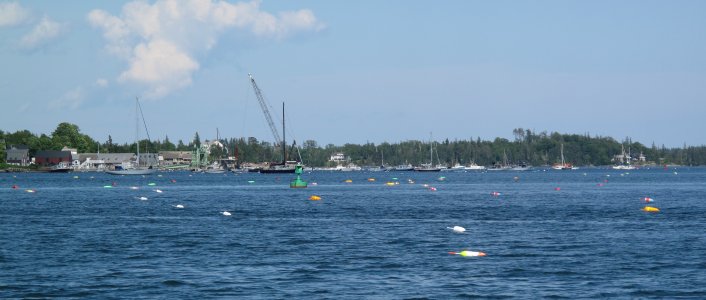
In Maine where the lobster traps are like snow, the lines are weighted to go straight down and the boat just pushes them out of the way. The exception is Penobscot Bay where 'toggles' are used and the line stays close to the surface. I've seen them about twice as dense as this photo.
IMG_0597.jpg
 
I see you are in Scotland so don’t have IFCAs (who do enforce in England - see post #25) but you do have the Marine Directorate who operate fisheries protection vessels and have enforcement officers.
.
My point was that even if there are organisations with the power to enforce the rules are they prioritising this and do they have the resources? I have never heard of any enforcement action taken about incorrectly marked pot boys.
 
My point was that even if there are organisations with the power to enforce the rules are they prioritising this and do they have the resources? I have never heard of any enforcement action taken about incorrectly marked pot boys.
In fairness most pots in Scotland are correctly marked, and I would not be surprised if the policy is education is preferable to punishment.
 
Unusually, and not something you would know - totally irrelevant. On Tasmania's west coast, where we had a private cray fish licence, tides are 30cm.
Yeah I can see how 20m from shore works there (assuming of course that where the fish are too!). In some places 20m from MHWS would spend most of the year out of water whilst 20m beyond MLWS would still mean vast acres of high risk water for yachts at high tide.
 
This incident of my sheared P bracket (Broken P bracket) has caught the eye of Katy Strickland, editor of PBO, as part of their campaign alongside the RYA and Cruising Association. I have submitted my thoughts on how fishing buoys should be marked.

Have a brightly coloured square flag of dimensions of 400x400mm and with the bottom of the flag at least 1.2 metres above the water.
The main marker buoy should not have a recovery line longer than 2,5 metres with a floating line or 4 metres with a sinking line.
It should have a small white light to illuminate it during the hours of darkness.
Each buoy must be marked with the fishing boat’s registration and contact details.

Any unmarked buoys and fishing gear should be removed by a Fishery Protection Officer and confiscated. This would cost many fishermen a fortune as long lines of lobster pots can be laid between two fishing markers. The new cost of each lobster pot is £60 to £80. I found this out by chatting with many fishermen around the country.

Does anyone have any additional thoughts.
A few weeks back I anchored in a known anchorage in the Menai Straits. When daylight came I was shocked by all the lobater pot buoys all over the area. It was a stroke of luck I never hit one.
 
I went into stangate last October. There was a very long polypropylene rope on the surface by the entrance all away to the first bend towards the shore...very very long. It had a tiny float marking it. It was just waiting for a vessel to get caught on it. I'd only just seen it due to the shadow of the ripples. I pulled it all up onboard eventually pulling up a grab pot. Rescued two crabs and tied the lot to one of the large metal buoys.
 
Top