First Time Channel Passage Tips

I’ve always used the term ‘fetch’ to refer to how much room there is from land to allow the wind to build up waves. Eg. Close inshore to a windward shore there’s no ‘fetch’ and the sea is calm (unless there’s an underlying swell coming from another direction). Conversely in an easterly gale the east coast can be very rough inshore as there is a long fetch allowing the sea state to build.

However, I understood perfectly what someone went when they said they’d had a close fetch from a certain port. I think it’s a valid alternative use but what do I know…

In addition to that we often use the word in racing to signify being able to reach a mark to windward without tacking . A close fetch then becomes having the boat just about close-hauled although the division between a close fetch and a close reach is probably a matter of personal taste. We'll often use it in the context of "can we hold the spinnaker on a tight reach and still fetch/make the mark"? It seem to be a bit of a Swiss Army Knife of a word and it wouldn't surprise me at all if it's usage varied from region to region.

There is of course the the more mainstream dog-retrieving-stick usage of the word too...
 
Leave Fambridge & moor in the small bay right near the mouth of the crouch on the south side. Pick up the Hw ebb at first light & head for the Black deep buoy at the top of the Longsand head. Use the echo sounder to round the top of the sand bank.You want to arrive there right on LW or no later than 30 mins after
Once clear, head 127 degrees for Ostend. The tide will carry you 4.5 miles south of the course but that suits the shipping lanes better. After 6 hours it will carry you back on track & at 10 hours & 59 miles you should be aiming for Ostend. You can see the 22 storey Centrum building from 15 miles away as a guide.Try to arrive up tide as it will be strong.
So much to do in Ostend & unlike Nieport you are right next to the town.
Take a tram or cycle ( Hire from Candy,s) to the Atlantic wall, Cycle round the 2 parks & get a coffee. Cycle to Blankenburg & enjoy the ride along the coast. Enjoy the shrimp croquets & salad in the RNSYC & sit & watch the boats come & go. Enjoy walking the town & buy chocolates for the wife back home. Get iscream from the australian icecream shop near the cathedral
Last month was my 80th visit & I spent 22 nights so perhaps I am biased
As for night trips- Leave at first light & it will not be an issue. My average trip time is 14.5 hours from Bradwell but the other day I did it in 13.5 hours. I like night sailing & it is nowhere near as hard as they say Just do it.
 
Leave Fambridge & moor in the small bay right near the mouth of the crouch on the south side. Pick up the Hw ebb at first light & head for the Black deep buoy at the top of the Longsand head. Use the echo sounder to round the top of the sand bank.You want to arrive there right on LW or no later than 30 mins after
Once clear, head 127 degrees for Ostend. The tide will carry you 4.5 miles south of the course but that suits the shipping lanes better. After 6 hours it will carry you back on track & at 10 hours & 59 miles you should be aiming for Ostend. You can see the 22 storey Centrum building from 15 miles away as a guide.Try to arrive up tide as it will be strong.
So much to do in Ostend & unlike Nieport you are right next to the town.
Take a tram or cycle ( Hire from Candy,s) to the Atlantic wall, Cycle round the 2 parks & get a coffee. Cycle to Blankenburg & enjoy the ride along the coast. Enjoy the shrimp croquets & salad in the RNSYC & sit & watch the boats come & go. Enjoy walking the town & buy chocolates for the wife back home. Get iscream from the australian icecream shop near the cathedral
Last month was my 80th visit & I spent 22 nights so perhaps I am biased
As for night trips- Leave at first light & it will not be an issue. My average trip time is 14.5 hours from Bradwell but the other day I did it in 13.5 hours. I like night sailing & it is nowhere near as hard as they say Just do it.
In my experience people vary considerably in their ability to cope at night, so I would be cautious in thinking that just because you and I have managed for many years, anyone else would find it no problem on their first major offshore trip. The whole purpose of cruising is to enjoy the occasion and although GPS and AIS have taken most of the hard work out of proceeding safely, I would still, if it were me, want to make things as stress-free as possible, especially if young family are involved. If there is one advantage in night sailing it is that the wind tends to be less and a quieter crossing can be expected, though the downside of this is that it often means that the engine will be needed more often.
 
In my experience people vary considerably in their ability to cope at night, so I would be cautious in thinking that just because you and I have managed for many years, anyone else would find it no problem on their first major offshore trip. The whole purpose of cruising is to enjoy the occasion and although GPS and AIS have taken most of the hard work out of proceeding safely, I would still, if it were me, want to make things as stress-free as possible, especially if young family are involved. If there is one advantage in night sailing it is that the wind tends to be less and a quieter crossing can be expected, though the downside of this is that it often means that the engine will be needed more often.
If you do not do it then you do not know. Plus leaving at very first light means that there is far less likely hood of more than an hour or two of dark & one can see the destination long before one arrives.. As for the engine-Use it. Get the sails down as it starts to get dark & motor the last hour or two if you are unsure. The OP says his engine is OK & that really is a must on any cross channel trip. The thing about Ostend is that I have never seen a pot nearby. I have hit underwater obstacles & one might snag a net, but there is still the sail option. Dunkirk & Nieuport need a bit more navigational experience, due to & fish farms, banks & wrecks - some of which can be exposed at LW. Ostend one can sail straight in, subject to IPCS. None of the banks cause a problem , just avoid the buoys - Same for Blankenburg but one gets more involved in the shipping lanes & anchorage zone, being further east & nearer Zeebrugge.
.
The first time I took my wife on a night passage it was to Boulogne. She had done day skipper theory. She really enjoyed it because suddenly all those lights on buoys & ships that she had been taught actually meant something. Somehow she said that she preferred sailing at night & was not in the least bit concerned after the first hour of darkness.
.
Arriving at a foreign port at night, for the first time, is a fantastic experience never to be forgotten. I still love doing it.
 
Last edited:
All I am suggesting is that the OP, who is apparently at the exciting early part of his sailing career, should consider facing challenges one at a time. For all I know, he is someone who will take everything in his stride and will have no trouble whatever he chooses, but since I don’t know him my advice will tend towards the cautious.

If he wants a real challenge he can try approaching Deauville from the west in the dark. Partly hidden by the shore lights the moles are lit by a series of red and green lights. Just to make it more fun, some of them are flashing and some occulting. Since that isn’t hard enough, many of them have both coloured and white sectors, so you can be faced with a green flashing light that seems to have disappeared and replaced by a red occulting light that wasn’t there before, in the middle of the whole mess.
 
All I am suggesting is that the OP, who is apparently at the exciting early part of his sailing career, should consider facing challenges one at a time. For all I know, he is someone who will take everything in his stride and will have no trouble whatever he chooses, but since I don’t know him my advice will tend towards the cautious.

If he wants a real challenge he can try approaching Deauville from the west in the dark. Partly hidden by the shore lights the moles are lit by a series of red and green lights. Just to make it more fun, some of them are flashing and some occulting. Since that isn’t hard enough, many of them have both coloured and white sectors, so you can be faced with a green flashing light that seems to have disappeared and replaced by a red occulting light that wasn’t there before, in the middle of the whole mess.
I was talking about a milk run for a beginner :rolleyes:
 
In addition to that we often use the word in racing to signify being able to reach a mark to windward without tacking . A close fetch then becomes having the boat just about close-hauled although the division between a close fetch and a close reach is probably a matter of personal taste. We'll often use it in the context of "can we hold the spinnaker on a tight reach and still fetch/make the mark"? It seem to be a bit of a Swiss Army Knife of a word and it wouldn't surprise me at all if it's usage varied from region to region.

There is of course the the more mainstream dog-retrieving-stick usage of the word too...
A copy of admiralty tidal atlas is invaluable on cross channel trips. Best arrive iup wind & tidealso avoid wp straight line nav. I always steered a compass course & "rodevthe tidal flow. That makes for a faster passage time due to sailing a shorter distance, hope you have many more trips across, such freedom
 
A copy of admiralty tidal atlas is invaluable on cross channel trips. Best arrive iup wind & tidealso avoid wp straight line nav. I always steered a compass course & "rodevthe tidal flow. That makes for a faster passage time due to sailing a shorter distance, hope you have many more trips across, such freedom
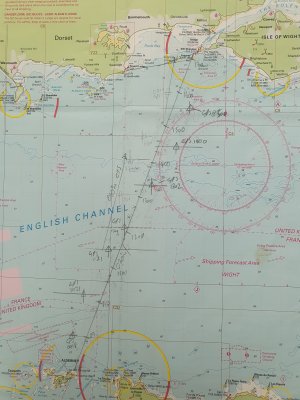
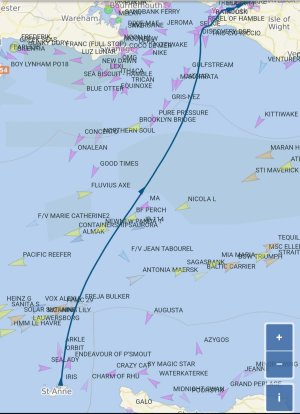
Me to. Work up a course to steer and stick to it. The plan ...

20240808_093052.jpg

The result ..

Screenshot_20240828_092451_Gallery.jpg

Steered 010 mag all the way.
 
A copy of admiralty tidal atlas is invaluable on cross channel trips. Best arrive iup wind & tidealso avoid wp straight line nav. I always steered a compass course & "rodevthe tidal flow. That makes for a faster passage time due to sailing a shorter distance, hope you have many more trips across, such freedom
Reeds is just as good & more use. A decent Imray chart has tidal diamonds, but much harder to interprete. Admiralty tidal atlas is not very accurate, but normally that is not an issue until close in shore. That is why I think Reeds is better.
I have all 3 and the Admiralty tide tables just give a quick overview for passage plans as opposed to accurate navigation.
i have no idea how electronic charts square up to the task as I do not use such gear.
 
Reeds is just as good & more use. A decent Imray chart has tidal diamonds, but much harder to interprete. Admiralty tidal atlas is not very accurate, but normally that is not an issue until close in shore. That is why I think Reeds is better.
I have all 3 and the Admiralty tide tables just give a quick overview for passage plans as opposed to accurate navigation.
i have no idea how electronic charts square up to the task as I do not on oostende trip, myself &crw were in the bar, on a forumite came in, "oh your already here", when I came past syh moorings at 07.30, you were still there, how many mile logged he asked, i said 72 from landguard, we have done over 90 was the reply, he must have been punching the tide, we rode,it. When he pitched up in the bar. we had showered &on 2nd 🍺 just think outwear the tidalflow is on a north sea crossing, fighting it adds milesto the trip& that adds hours too
 
I had a tidal atlas of the channel and used it for a while but generally found Reeds just as good. Tidal diamonds can do the same job but the only place I found them essential was at the mouth of the Elbe. The current predictions on my plotter aren't bad as a general guide.
 
I had a tidal atlas of the channel and used it for a while but generally found Reeds just as good. Tidal diamonds can do the same job but the only place I found them essential was at the mouth of the Elbe. The current predictions on my plotter aren't bad as a general guide.
It's likely to be the same data source. Tide info on a plotter is only a digital almanac adjusted to display current date & time.

You'd still need to correct chart plotter info for local influence (eg air pressure).
 
I'm certainly no expert, having a grand total of two (return) channel crossings under my belt in 18 months of yacht ownership.

Our (two-handed) Nieuwpoort trip experiences mirror the above. It was really great to be able to borrow the bikes, both for trips to town and for exploring inland along the river Ijzer / Yser. The marina was Vlaamse Yachthaven Nieuwpoort and both the staff and the police could not have been more welcoming.

Our other trip was to Dunkirk (YCMN). Again, helpful marina staff. The marina is also fairly close to town. Lots to see and do there and the buses in Dunkirk are frequent and free. Immigration formalities were a PITA though (this was last year), simply because the PAF office is several miles away near the commercial ferry port (where the police were very friendly and helpful). However I believe it may now be possible to have the marina carry out formalities under the new workaround procedure.

Oh, and both trips made via Ramsgate.

Top tips:
- Have AIS (which you've indicated you have)
- Maintain a good listening watch on the VTS VHF channels (Channel VTS, Gris Nez VTS and Dunkirk VTS). It's good to know what the traffic is up to. We encountered 3 examples of 'big boys' violating COLREGS, two of them to the exasperation of VTS. It's really useful to know what's going on if there's a rogue vessel out there.

Oh and, if in Ramsgate, don't miss the world's most glorious Wetherspoons. In good weather, their balcony is superb. The seagull attacks on unwary diners can also be entertaining.
Regrettably Dunkirk Marina are not playing so it is still the long bus or cab ride.
 
The Channel is a remarkable bit of water; it is much longer going from east to west than it is going from west to east.
 
In my experience people vary considerably in their ability to cope at night, so I would be cautious in thinking that just because you and I have managed for many years, anyone else would find it no problem on their first major offshore trip. The whole purpose of cruising is to enjoy the occasion and although GPS and AIS have taken most of the hard work out of proceeding safely, I would still, if it were me, want to make things as stress-free as possible, especially if young family are involved. If there is one advantage in night sailing it is that the wind tends to be less and a quieter crossing can be expected, though the downside of this is that it often means that the engine will be needed more often.
We are completely up for a night passge, but not for a first time adventure, that's just asking for trouble. As the weather/tide/annual leave variables didn't align we are putting things on hold until next year.
 
All I am suggesting is that the OP, who is apparently at the exciting early part of his sailing career, should consider facing challenges one at a time. For all I know, he is someone who will take everything in his stride and will have no trouble whatever he chooses, but since I don’t know him my advice will tend towards the cautious.

If he wants a real challenge he can try approaching Deauville from the west in the dark. Partly hidden by the shore lights the moles are lit by a series of red and green lights. Just to make it more fun, some of them are flashing and some occulting. Since that isn’t hard enough, many of them have both coloured and white sectors, so you can be faced with a green flashing light that seems to have disappeared and replaced by a red occulting light that wasn’t there before, in the middle of the whole mess.
Speaking as the OP, it would be *her* career, and yes, *she* is fully prepared for challenge and adventure, on a risk-based, balanced basis. Thanks for the guidance, will bear it in mind.
 
Top