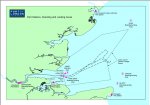
First night passage...

Thanks! It won't be my first night at the sea, but first as a skipper and on challenging waters like Thames Estuary. I will read through @LittleSister post as it's discouraging which will help me decide if this is something too risky. Truth is, my boat is quite small (24 ft) but very capable at the same time. I think Lowestoft-Ramsgate because it will give me some room in case I will have an engine issue (outboard). Do you think it's worth investing in radio with an AIS display? I need to buy new radio (currently I own only a handheld) and wonder if this would be useful.

It is said that a military officer’s plans seldom survive contact with the enemy. Yacht skippers’ plans seldom survive contact with the weather.

In a capable 24 footer you will do fine until you have to beat. As soon as you go hard on the wind, everything goes to pot, all your navigational calculations go pear shaped, etc.

So, given a leading wind, and a steady forecast, I’d do the passage in one go, outside everything.

In less ideal conditions, make Harwich, then pull out Roger’s book and act accordingly!

I haven’t had radar and AIS for long, they are lovely, but they don’t stop me from making mistakes. I would not worry about not having them.
 
Last edited:
That's a sensible plan if you'd otherwise be making a night landfall after a long ocean passage but I'm not sure it's more than an idealised and probably impractical situation on a shorter coastal trip on which you arrive when the en-route tides dictate. If I was approaching Bermuda at night I'd time my arrival that way but beggared if I'd hang around for a couple of hours in the Thames estuary to do the same at Ramsgit.
...
My first experience of the Thames Estuary was coming round from Brighton in strong Sou-westers and deciding to go outside everything.

We ended up being two hours early and had to heave to, of the Naze before we could get into the Backwaters!
 
Thanks! It won't be my first night at the sea, but first as a skipper and on challenging waters like Thames Estuary. I will read through @LittleSister post as it's discouraging which will help me decide if this is something too risky. Truth is, my boat is quite small (24 ft) but very capable at the same time. I think Lowestoft-Ramsgate because it will give me some room in case I will have an engine issue (outboard). Do you think it's worth investing in radio with an AIS display? I need to buy new radio (currently I own only a handheld) and wonder if this would be useful.
If you want a complex navigational challenge where you spend all night looking for buoys go through one of the thames estuary routes. Or if you want to feel you've done a proper little offshore passage without needing to quarantine, but other than that hardly any navigational challenge to worry about, then go due south from Lowestoft outside of all the shallows. Even though it's busy no one would claim you need AIS. I guess you have a plotter so you can see at a glance where the routes into the Thames for ships are, so will know where you're likely to meet anything you can see coming. You'll be going down the outer edge of the pilotage area, where the ships pick up pilots, so the ships you might meet should have an alert watch on. Considering you're up to 30 miles offshore there is a lot of activity so help is in theory never very far away. Probably no issue raising an alarm with a hand held DSC VHF with the anchored ships you'll be passing, wind farm vessels, pilots and fishing boats. In the highly unlikely event you need to!

2021-02-27_232354.jpg
 
I don't think that setting off with the idea that you might want to raise an alarm is a good idea, if only for psychological reasons. I believe that every trip should be undertaken as if it involved crossing an ocean with no help at hand. Any sensible person would go equipped with flares and radio etc, but even a radio is optional even if it is rarely omitted these days.
 
I need to buy new radio (currently I own only a handheld) and wonder if this would be useful.
Stating the obvious but a handheld strapped to yourself is worth a million times more than a ships radio if you fall overboard with it. I don't think having it strapped to you will make you psychologically less likely to hold on tight.

I totally agree with assuming the need for total self reliance and have never needed to TRY to call for help, I would take it as a crushing failure to do so. But I think its a sound part of passage planning to consider all your back up plans and fail safes. Whether of not you'll likely be out of range with your handheld seems worth considering. Range standing on deck is one thing but even if you go for a swim with one it will probably do in a high traffic area. Bit of chat on the subject here: Handheld vhf: range when transmitting from water level With DSC you can at least hold it as high as possible when pressing send which should help a lot compared to trying to talk into one from the water.

Solo at night i have a 6W DSC handheld and one of these flares on me, to feel I'm doing my bit to be a responsible risk taker Odeo Flare LED MK3 - SAF0602: Amazon.co.uk: Electronics
 
I don't think that setting off with the idea that you might want to raise an alarm is a good idea, if only for psychological reasons. I believe that every trip should be undertaken as if it involved crossing an ocean with no help at hand. Any sensible person would go equipped with flares and radio etc, but even a radio is optional even if it is rarely omitted these days.
I have sailed my dinghy around Sheppey from the Medway to Faversham overnight in February, of course I didn't have flares or even a handheld radio. One of the pilots came to have a look at me, and I will carry a radio in future in the hope of saving them the bother. But it was a marvellous trip and doing the passage on a February night tide allowed me to arrive on the morning flood.
 
A night passage can be one of the most wonderful and satisfying experiences to be had on a boat and you have been given a lot of valuable information in the previous posts.
I would just like to add a few observations of my own:

You say you have done night passages before and that is a valuable experience. However, being the skipper, with or without crew, ads a whole new psychological dimension to the trip, one that should not be underestimated.

Astonishingly, boats float surprisingly well without the aid of AIS or radar and our current boat seems to have managed just fine without on quite a few night passages. Barring poor visibility, it is often a lot easier to see and interpret ship and vessel movements at night from the disposition of the nav lights. It pays to swot up on the ColRegs and go over the handy test cards to know what one might be looking at and which direction it is traveling; seriously.

Do not enter a port at night, unless you absolutely know it like the back of your hand. Making out the nav aids against the light clutter of a town can be extremely difficult and after awhile you may well discover that the starboard buoy you've been diligently heading for is a pedestrian crossing in front of the gas station. Close in, do not rely blindly on your plotter; Navionics & Co, as we found out, do not, or cannot always keep up with the rapidly changing conditions in areas with a soft sea bed. We had a nasty surprise when entering the Waddenzee between Terschelling and Vlieland at night; we ended up carefully feeling our way through the gatt, shining a light on each buoy as it came up to identify it by it's number, which for some strange reason is always on the other side.

IMHO, you really do not have to worry all that much about what to do if you fall over board at night, other than whether your affairs might be in order or not. Even with a crew you may as well consider yourself to be as good as dead. At 6 kts, a boat travels 200m in a single minute, think about it. The, obviously, broad approach would be as not to fall over in the first place.

For a first trip I would choose something that is not too demanding or requires constant navigational attention. You will be tired and wired at the same time, ducking in somewhere is really not an option and you may well end up scaring the proverbial out of yourself rather than having what should be a magical experience. On my first night passage in the pre-electronic era, the moon came out at the last moment to reveal that I had underestimated the tidal set by a mile and that there, right in front of me, was Brandt reef, only a few metres off and named after the coal ship that had found it, long before me, on a similarly dark night and which, according to the local dive guides, can still be viewed in situ.
 
My first night passage was a very modest one from the Blackwater to Harwich, but I will always remember the really good scare I gave myself. I was steering on the Wallet No.4 buoy. I had completely forgotten about the adjacent wreck buoy which in those days was unlit. I was closing the buoy and starting to look for the Medusa buoy when a large black shape blotted out the shore lights as it flashed past the end of the boom.

There but for the Grace of God...
 
But if your jackstay is a bit too long you can at least radio for help if you find yourself waterskiing off the back ;)(y)
 
Night sailing is great I love it. It is good to arrive early morning as you can home in on any lights then see the entry in daylight. that being said I often arrive at Bradwell just after midnight before I start to need sleep
If you are kicking off from Osea I would suggest lowestoft as the first night trip. the bit past Cutler may challenge you but the navigation until near lowestoft is fairly straight forward . There is the Owell to stop of if things are proving difficult. Never be frightened to cut a trip short.
At the Lowestoft end you may encounter a few wind farm vessels but no big deal. they are always on the look out for yachts that may be a bit "unconventional" in their passage.
Ramsgate is a bit more challenging because there is less land to guide one. & alternatives are restricted. So coming from Osea - better than from Lowestoft- i would suggest Swin Spitway then rather than the lower sunk crossing, which is not buoyed , you go to barrow 3 & 2 & cross the sunk at 130 degrees & enter the Black Deep 1.7 miles above one of the black deep buoys ( is it No 7?).

You can use the tide to here & may start from an anchorage near Bradwell for a start. Arriving as the tide turns you may be lucky to get to Ramsgate in 6 hours on the tide but it will be a push so arriving in the Black deep to make it before the tide turns at Ramsgate might be necessary. You may have to anchor somewhere off the kent coast then sail round the corner, others will advise.
Watch for shipping & keep to one side.& run down the side of the wind farm. Go through Fishermans Gat where there are loads of buoys, then you have a nice launching point. Watch the echo sounder for a spit at the end of the Gat. Once over that it is 12 miles to N Foreland & you can see the light. A buoy half way to guide you, Some anchored ships to navigate There will certainly be a ship cross your path, keep a good look out, they tend not to notice you. Then you only have to worry about carrying the tide down to Ramsgate. Ramsgate is dead easy to enter but can be a bit choppy outside so drop the sails in the outer harbour if you need.
When crossing the Sunk have a really good look round & establish in your mind the layout of the Gunfleet & London array wind farms. Especially the Transformer in the London array. When you go home it helps to orientate yourself .
if you decide to try the lower sunk crossing try it on the way home rather than the way out, as you can head for it from Fishermans Gat which is only a short hop from a known point
With no buoys is is unnerving aiming for open water & looking at breaking waves on the sands to the south of you
By taking a more northern route you can do it without GPS if you get an electric failure- quite possibly in a 24 ft boat.
 
Last edited:
Just bought ColReg's cards on eBay. I could do Osea Island - Harwich/Lowesoft, but exiting Blackwaters at night is tricky I guess, and I like the idea of having space. If I would set off in Yarmouth around 8 PM, I should be around 2-3 PM in Ramsgate, providing I can reach 4 knots. I will do this in June/July, which gives me not much darkness. I will calculate my idea and will compare it with suggestions here - didn't really had time to read through them. For sure I will take into account refuge points, and sailing from Lowesoft gives me the possibility to cut my trip short, without having to go through tricky parts of Thames Estuary. I will prepare proper passage plan. For sure will note bouys I am planning to pass and their characteristic and prepare plan what if I can't meet one. Ofcourse, I will work out tides and prepare plan accordinghly. One reason to cut trip short will be lack of communication - I don't want my family to be worried to much. Or will get something like Garmin InReach subscription (looks like 50 GBP).
I always have radio strapped to myself - I need to ask my crew to get their radio certificate for handheld (or risk ;)).
 
Just bought ColReg's cards on eBay. I could do Osea Island - Harwich/Lowesoft, but exiting Blackwaters at night is tricky I guess, and I like the idea of having space. If I would set off in Yarmouth around 8 PM, I should be around 2-3 PM in Ramsgate, providing I can reach 4 knots. I will do this in June/July, which gives me not much darkness. I will calculate my idea and will compare it with suggestions here - didn't really had time to read through them. For sure I will take into account refuge points, and sailing from Lowesoft gives me the possibility to cut my trip short, without having to go through tricky parts of Thames Estuary. I will prepare proper passage plan. For sure will note bouys I am planning to pass and their characteristic and prepare plan what if I can't meet one. Ofcourse, I will work out tides and prepare plan accordinghly. One reason to cut trip short will be lack of communication - I don't want my family to be worried to much. Or will get something like Garmin InReach subscription (looks like 50 GBP).
I always have radio strapped to myself - I need to ask my crew to get their radio certificate for handheld (or risk ;)).
I think they can use the radio under your supervision if you have a license. But you need to train your family better if you can't be out of reach for a few hours without them panicking! Actually I had mobile signal for at least half of that route, just some of the middle is out of range. Can't remember exactly TBH but its just a short trip sat phone seems way OTT.
 
Just bought ColReg's cards on eBay. I could do Osea Island - Harwich/Lowesoft, but exiting Blackwaters at night is tricky I guess, and I like the idea of having space. If I would set off in Yarmouth around 8 PM, I should be around 2-3 PM in Ramsgate, providing I can reach 4 knots. I will do this in June/July, which gives
So you are going to leave at 20-00 hours after a day when you probably will not have any kip ( unless a shift worker or similar used to day time sleeping) then you will sail through the night when you may not get any sleep if your crew is as inexperienced as you then be awake through to 15-00 hours the next day
You could be without sleep for over 30 hours.
Perhaps leaving at say 09-00 then have a days sail when you are fully awake. .75 miles with a SW wind you might be lucky to make 4 kts in a 24 ft boat.
However, a 20 hour trip would get you at ramsgate at 05-00 just as it starts to get light. By that time you will be well knackered. I find that the wind always seems to bend a bit south as I approach N Foreland, requiring a bit of tacking.
When the tide turns you might find yourself well to the east if you go outside the Kentish knock in rougher water & no chance of tacking back towards land
 
Last edited:
So you are going to leave at 20-00 hours after a day when you probably will not have any kip ( unless a shift worker or similar used to day time sleeping) then you will sail through the night when you may not get any sleep if your crew is as inexperienced as you then be awake through to 15-00 hours the next day
You could be without sleep for over 30 hours.
Perhaps leaving at say 09-00 then have a days sail when you are fully awake. .75 miles with a SW wind you might be lucky to make 4 kts in a 24 ft boat.
However, a 20 hour trip would get you at ramsgate at 05-00 just as it starts to get light. By that time you will be well knackered. I find that the wind always seems to bend a bit south as I approach N Foreland, requiring a bit of tacking.
When the tide turns you might find yourself well to the east if you go outside the Kentish knock in rougher water & no chance of tacking back towards land
The only thought against that is leaving at night from Gt Yarmouth the first part is the least complicated leaving the more interesting part for the next day. For that route it would be an idea to get to where you cross the main shipping lanes into the Thames for daylight and plan to be there with a favourable tide to get through it as quick as possible. Other advantage of doing the night part first is less time for the weather to change from the prediction. A young lad doesn't need a lot of sleep (I'm assuming you're young?), as long as I could grab 1 hour in 24 I was OK for a day or 2. Not any more!
 
So this is an idea behind leaving towards the night - depending how well we will sleep during the night we might decide to cut the trip early and go back via already familiar route to Harwich/Blackwater. The amount of sleep I need right now is bit unknown, as I haven't been doing such trips for some time now, but knowing myself it shouldn't be much of a problem. 3 - 4 hours should be sufficient.
We can decide, if both of us didn't have any sleep we cut the trip. We are both ~35, relatively fit (well, my crew run marathon recently ;)).

Weather and wind is very different story and I will watch those closely.

I would depart from Lowesoft, I might say Yarmouth by mistake.
 
Mention of Yarmouth. I was under the impression that Yarmouth is not a yacht friendly port. Is that correct? Also lowestoft is an hour nearer Ramsgate.
Gt Yarmouth doesn't have much facilities but I've been in and tied up to the wall and its fine for a stop. Expected to contact port control on the radio to get the all clear before entering or leaving but there is no restriction or problem with going there as far as I know.
 
Lowestoft to Ramsgate... You have to deal with all the TSS systems associated with the Thames Estuary London Felixstowe or go through the sand banks.
Avoiding all the TSS means going well outside the wind farms as well but if the wind is SW you will be fine on the wind if it is a classic SW and you will possibly end up beating to windward.. Not the easiest nav taking account of tides.

You like a challenge?
 
Top