Final wiring diagram before install, fusing & cable sizes, have I missed anything?

steve yates

Well-Known Member
Joined
16 Oct 2014
Messages
4,268
Location
Benfleet, Essex at mo/Scottish West coast soon
Visit site
I am installing this next week, thanks for the advice on my initial circuit diagram on my thread a couple of weeks ago.
How does my fusing and cable sizing look, have I missed anything? The green boxes are fuses :)
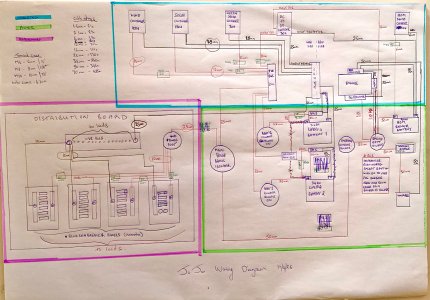
IMG_2298.jpegIMG_2298.jpeg
I have deliberately not fused the engine battery as I have read a few times its not a good idea, though it feels like I should!
 
@steve yates .... my 10 cents for what it is worth.

  • I don't believe the Wind Gen is 100A or the Solar Controller is 150A, check it because if it is then the wiring needs to be bigger - perhaps it is Watts?
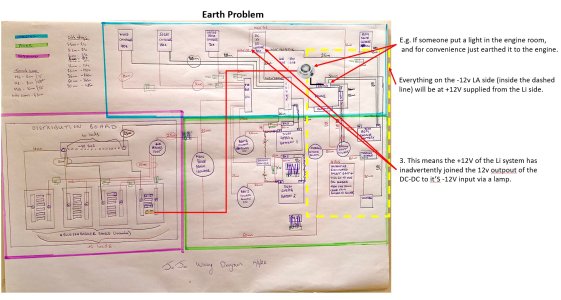
  • The grounds of the Li system and the LA system need to be joined to avoid stray currents trying to find a way to ground through your components - worse case in engine start there is no Li -ve to the engine ... so start current will try and flow through your components - eek. It is also difficult to know if someone has previously wired something directly to a LA -ve somewhere in the boat, instead of returning the circuit to the panel ground. If they have, then you will have a stray current problem - Do you know every wire and component in your boat? Connect your LA -12v to your Li -12V with a 50mm cable IMO. ..... See pic for explanation.
  • The wires between your Main House Bank Isolator and the Li system are 25mm ... the wiring to the starter from the engine battery is 50mm. If the Starter Battery fails completely and you use the combine as an emergency start then the 25mm wiring will be the weak point of the circuit from your Li batteries to the starter - make it all 50mm ... or remove the combine.
  • With the combine closed, the DC-DC which is limiting charge current to the Li system to 30A (saving your alternator) will allow direct alternator connection to the Lithium system, which if left running with depleted Li batteries could fry your alternator. Another reason to remove the combine switch connection to the Li system - in an emergency combine the windlass and starter instead.
Screenshot 2026-04-18 124257.jpg
Got to go, hopefully others can continue.
 
Last edited:
Thanks Baggywrinkle, yes you are right, I wrote down the controllers wattage, not amps! They are 20 and 30a.
There snould be no stray wires to engine ground as I stripped out every instrument & cable apart from the engine wiring harness and the existing starter and alternator connections to the engine ground.
I was trying to keep the two systems completely seperate, but that doesn’t actually work if want an emergency combine, as I would need a negative connection.

I might up the 25mm to 35mm cable from the house batteries, as the class t fuse is mebbe a bit high a rating to protect 25mm cable? And its far cheaper to buy some thicker cable than new class t fuses :)
The windlass is powered from the engine battery, it does not have its own seperate battery so can’t combine.

I’m thinking I will get a double pole isolator as an emergency combine, and run a negative cable from that to the engine ground. The engine battery will also run to that ground so when engaged, there is a negative connection between the engine and house system’s but they will be completely separated under normal use when the isolator is off.
I’m now also thinking I miay need to upgrade the t fuses if I wanted to use the house bank for engine starting in an emergency, and that maybe I should just buy one of the small jumper packs for engine starting in an emergency, and just have the combine switch to be used should I need to power nav instruments in an emergency if the bms has shut down my house bank? Running ais/radar/vhf for instance from the engine battery.
Might be the simplest and cheapest way to back up both systems.
 
Out of curiosity, what wind turbine / controller do you have that works for lifepo4?
I don’t yet, that bit is future proofing :)
I haven’t even got the solar panels yet, but thats not future proofing, I’ll buy them as soon as I have installed the batteries, switchboard and chargers.

Is there an issue with lifepo and wind then? I had actually assumed that an mppt controller would handle a wind turbine in pretty much the same way as a solar panels, as both sources would output varying power levels according to atmospheric conditions, but I hadn’t looked into much beyond that vague assumption.

Don‘t some controllers handle both solar and wind inputs simultaneously?
 
I don’t yet, that bit is future proofing :)
I haven’t even got the solar panels yet, but thats not future proofing, I’ll buy them as soon as I have installed the batteries, switchboard and chargers.

Is there an issue with lifepo and wind then? I had actually assumed that an mppt controller would handle a wind turbine in pretty much the same way as a solar panels, as both sources would output varying power levels according to atmospheric conditions, but I hadn’t looked into much beyond that vague assumption.

Don‘t some controllers handle both solar and wind inputs simultaneously?
I thought only the eye wateringly expensive Rutland was when I last looked.

I have just had a look and there are more charge controller options on the market these days! Happy days.
 
Thanks Baggywrinkle, yes you are right, I wrote down the controllers wattage, not amps! They are 20 and 30a.
There snould be no stray wires to engine ground as I stripped out every instrument & cable apart from the engine wiring harness and the existing starter and alternator connections to the engine ground.
I was trying to keep the two systems completely seperate, but that doesn’t actually work if want an emergency combine, as I would need a negative connection.

I might up the 25mm to 35mm cable from the house batteries, as the class t fuse is mebbe a bit high a rating to protect 25mm cable? And its far cheaper to buy some thicker cable than new class t fuses :)
The windlass is powered from the engine battery, it does not have its own seperate battery so can’t combine.

I’m thinking I will get a double pole isolator as an emergency combine, and run a negative cable from that to the engine ground. The engine battery will also run to that ground so when engaged, there is a negative connection between the engine and house system’s but they will be completely separated under normal use when the isolator is off.
I’m now also thinking I miay need to upgrade the t fuses if I wanted to use the house bank for engine starting in an emergency, and that maybe I should just buy one of the small jumper packs for engine starting in an emergency, and just have the combine switch to be used should I need to power nav instruments in an emergency if the bms has shut down my house bank? Running ais/radar/vhf for instance from the engine battery.
Might be the simplest and cheapest way to back up both systems.
The grounds from both systems can be connected permanently with no adverse effects - in fact I would even go as far as to say it is expected. If you have any AC systems on the boat then you need to connect the AC ground to the DC ground - but in your isolated systems you have two DC grounds .... make them one and ensure everything is correctly grounded.

Check Boat Wiring Before Installation According to ABYC E-11

1. Before installing a charging device, confirm that there is a good connection between AC and DC grounds. If there is not a good connection, the charger/inverter grounding, when it is installed, may become the main connection between AC and DC grounds and must be sized for the boat's entire electrical system in order to avoid the risk of shock or fire. The AC grounding system and the DC grounding system should be firmly connected at a main grounding bus or at the engine block.,/p>

These connections help prevent faults in a boat's wiring from becoming lethal leakage currents that flow into the surrounding water or energize exposed metal on a boat. Some boat builders omit this grounding connection as a means of reducing galvanic corrosion resulting from coupling to adjacent vessels through the power system. A better way of preventing galvanic corrosion is to install this ground connection and install a galvanic isolator or isolation transformer in the AC power system.

https://www.bluesea.com/articles/101
 
Thanks Baggywrinkle, yes you are right, I wrote down the controllers wattage, not amps! They are 20 and 30a.
There snould be no stray wires to engine ground as I stripped out every instrument & cable apart from the engine wiring harness and the existing starter and alternator connections to the engine ground.
I was trying to keep the two systems completely seperate, but that doesn’t actually work if want an emergency combine, as I would need a negative connection.

I might up the 25mm to 35mm cable from the house batteries, as the class t fuse is mebbe a bit high a rating to protect 25mm cable? And its far cheaper to buy some thicker cable than new class t fuses :)
The windlass is powered from the engine battery, it does not have its own seperate battery so can’t combine.

I’m thinking I will get a double pole isolator as an emergency combine, and run a negative cable from that to the engine ground. The engine battery will also run to that ground so when engaged, there is a negative connection between the engine and house system’s but they will be completely separated under normal use when the isolator is off.
I’m now also thinking I miay need to upgrade the t fuses if I wanted to use the house bank for engine starting in an emergency, and that maybe I should just buy one of the small jumper packs for engine starting in an emergency, and just have the combine switch to be used should I need to power nav instruments in an emergency if the bms has shut down my house bank? Running ais/radar/vhf for instance from the engine battery.
Might be the simplest and cheapest way to back up both systems.
You're making things more complicated than they need to be.

There is no downside (in your case) to having a common negative. If you don't your battery monitor will not be able to see the charge from the alternator. Also, your DC-DC charger will not work.

As i have said before, i would use a pair of 25mm cables. You have 25mm going to the main domestic isolator, then 50mm to the combine switch, makes no sense. The combine switch needs to connect to the domestic and engine isolator load terminals.
 
You're making things more complicated than they need to be.

There is no downside (in your case) to having a common negative. If you don't your battery monitor will not be able to see the charge from the alternator. Also, your DC-DC charger will not work.

As i have said before, i would use a pair of 25mm cables. You have 25mm going to the main domestic isolator, then 50mm to the combine switch, makes no sense. The combine switch needs to connect to the domestic and engine isolator load terminals.
I often do when I don’t fully understand the theory behind processes :)

As in run a cable from the engine ground to the loadside of the shunt? Would that do the job to give them a common ground? (I’ve ditched the negative busbar obeyween the batteries and the shunt and will just run the cables from the neg terminals straight onto the battery side)
And if I’m overcomplicating it can I forget a double pole and just go back to a simple bep combine switch?

I’m not quite understanding the pair of 25mm cables? Are they supposed to equate to one 50mm cable? And doesn't that just give me more crimps to make and more lugs stacked on studs? As opposed to just running 35mm instead?

If I give up, on the idea of using the house side as an emergency engine start, which I pretty much have in favour of the jump pack, then I can see the 50mm to the combine switch is overkill if I just want to use it to power the kit from the engine battery.

I don't need heavy duty cables on the house side, and if my lithiums go down, as long as I ensure the combine switch is off if I have to start the engine, the house side won’t be getting loads of current through it that would require heavier cable?
 
The grounds from both systems can be connected permanently with no adverse effects - in fact I would even go as far as to say it is expected. If you have any AC systems on the boat then you need to connect the AC ground to the DC ground - but in your isolated systems you have two DC grounds .... make them one and ensure everything is correctly grounded.


https://www.bluesea.com/articles/101
No AC in this boat. I just use a shorepower cable with 4 gang outlet and mini rcd on it.
 
I often do when I don’t fully understand the theory behind processes :)
:ROFLMAO:
As in run a cable from the engine ground to the loadside of the shunt? Would that do the job to give them a common ground?
Yep, cable from the engine battery and from the engine, both to the load side of the shunt. Gives a common negative and the shunt will see alternator charging.
(I’ve ditched the negative busbar obeyween the batteries and the shunt and will just run the cables from the neg terminals straight onto the battery side)
That's fine. I'd put the busbar after the load terminal of the shunt.
And if I’m overcomplicating it can I forget a double pole and just go back to a simple bep combine switch?
I would.
I’m not quite understanding the pair of 25mm cables? Are they supposed to equate to one 50mm cable? And doesn't that just give me more crimps to make and more lugs stacked on studs? As opposed to just running 35mm instead?
2x25mm does = 50mm. I prefer to use 25mm on the shunt connections, 50mm looks clumsy to me. 35mm to the isolator, then going up to 50mm doesn't make sense.
If I give up, on the idea of using the house side as an emergency engine start, which I pretty much have in favour of the jump pack, then I can see the 50mm to the combine switch is overkill if I just want to use it to power the kit from the engine battery.

I don't need heavy duty cables on the house side, and if my lithiums go down, as long as I ensure the combine switch is off if I have to start the engine, the house side won’t be getting loads of current through it that would require heavier cable?
I think you need to decide what you're going to do. Either use 25mm cable (correctly fused) and scrub the combine switch, or keep the switch and uprate the cables.
 
As in run a cable from the engine ground to the loadside of the shunt? Would that do the job to give them a common ground?
“Yep, cable from the engine battery and from the engine, both to the load side of the shunt. Gives a common negative and the shunt will see alternator charging.”


This is where I get confused. The battery monitor is for the house system only, I would just have a simple voltmeter on the engine battery to keep an eye on that. There would be no need for the monitor to read the input from the alternator surely if it is seeing what comes in via the dc to dc charger.
I also get confused by this common ground business.
I thought taking a cable between the shunt and engine ground would suffice as the engine battery negative already goes directly to the engine ground and that would make a common ground?
So do I need to also run another cable from the engine battery to the shunt? I don’t actually want the monitor reading the alternator charging input if it is already reading the dc to dc input.
If that makes sense?

And I have never figured out how to use these bloody quotes.
 
Last edited:
And yes I agree about the 50mm, it was there when I was thinking I would use the house bank to start the engine in an emergency. As you say I need to decide about the combine switch, if I stuck to the original idea of the combine switch what size of T class fuse would suffice to handle the current draw when the starter turns over?
 
No AC in this boat. I just use a shorepower cable with 4 gang outlet and mini rcd on it.
Shorepower is AC. You should have a through-hull bolt and an anode somewhere on the boat to provide AC earth a route to ground.

Normally, AC shore power is grounded on the shore side, but if a portable generator is used or the shore power installation (including your cable) is dodgy, this will not be the case and your RCD will not trip.

IMO it is not a good idea to tailor your electrical system to your personal use cases as anyone else working on, or using the boat, including the next owner, will make certain assumptions based on how the electrical system is supposed to work.
 
Last edited:
They cannot make any assumptions regarding AC if it doesn’t exist. I take your point but I’ll have a final wiring diagram for whatever I decide, (and the whole boat will be tailored to my personal use :)). That would go with the boat so any new owner will have full information about the electrical set up.
I teally have no interest in an AC installation. This boat will not spend much time in marinas ( at least not when I am aboard) and will be moored afloat even in winter.
It is useful to know about grounding requirements for both for education, but telling me the theory rather than spelling it out in laymans terms doesn’t always help, i am more of a stick that wire there and put this one here kinda person!
I don’t even understand sail trim properly, I just stick the boom out a bit or in a bit then put the kettle on and enjoy the view :)
 
“Yep, cable from the engine battery and from the engine, both to the load side of the shunt. Gives a common negative and the shunt will see alternator charging.”


This is where I get confused. The battery monitor is for the house system only, I would just have a simple voltmeter on the engine battery to keep an eye on that. There would be no need for the monitor to read the input from the alternator surely if it is seeing what comes in via the dc to dc charger.
I also get confused by this common ground business.
I thought taking a cable between the shunt and engine ground would suffice as the engine battery negative already goes directly to the engine ground and that would make a common ground?
So do I need to also run another cable from the engine battery to the shunt? I don’t actually want the monitor reading the alternator charging input if it is already reading the dc to dc input.
If that makes sense?

And I have never figured out how to use these bloody quotes.
Forget that last bit, I am pretty certain I do not want to cable the engine battery neg to the shunt as well as the engine ground if I have cabled the shunt system side itself to the engine ground already. That makes no sense to me.
The engine block must be the common ground between the house and battery systems if each system has a cable running to it. Feel free to correct me if I have that wrong.
 
Connection procedure:
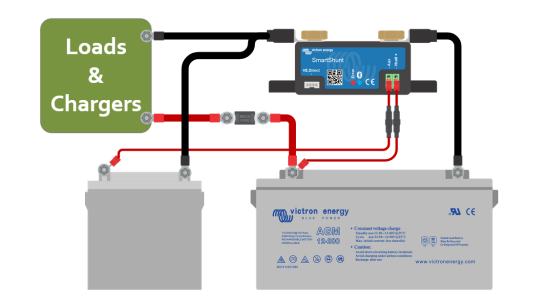
  1. Verify that the negative pole of the second battery is connected to the SYSTEM MINUS side of the shunt.
  2. Connect the ferrule pin of the second red cable with fuse to the shunt by pushing the pin into to the Aux terminal.
  3. Connect the M10 lug of the second red cable with fuse to the positive terminal of the second battery.


Screenshot 2026-04-19 141055.png
 
You risk confusing me even more paul by showing me diagrams of two batteries that the monitor is looking at.
Is that illustrating my two lifepo’s? Or myhouse bank and engine battery?

I only need the monitor to tell me about the house side. (It would only give me the voltage of the agm anyway I believe, and I already have a little voltmeter back in place where it will be installed which if I I don’t use leaves a hole in the side )

If its the house bank and engine battery, yes I can connect the agm neg to the shunt system side, OR I can connect the shunt system side to the engine ground. Both do the same thing do they not?

As far as understand it,what I do NOT want to do is both of those.
 
You risk confusing me even more paul by showing me diagrams of two batteries that the monitor is looking at.
Is that illustrating my two lifepo’s? Or myhouse bank and engine battery?

I only need the monitor to tell me about the house side. (It would only give me the voltage of the agm anyway I believe, and I already have a little voltmeter back in place where it will be installed which if I I don’t use leaves a hole in the side )

If its the house bank and engine battery, yes I can connect the agm neg to the shunt system side, OR I can connect the shunt system side to the engine ground. Both do the same thing do they not?

As far as understand it,what I do NOT want to do is both of those.
It is showing the domestic battery on the right and the engine battery on the left. You need a single common negative point, that's the negative busbar, so the engine battery connects to it, the engine connects to it, the domestics connect to it, the DC-DC charger connects to it, everything connects to it. Running a cable from the engine battery to the engine, then another cable back to the busbar does not give you a single common negative.

You're wiring from scratch, why not do it the best practice way ?
 
Last edited:
I’m guessing you meant why not do it the best practice way?
I absolutely agree, I would and I hope I will. If I can understand what that is!
Something it appears I am obviously struggling to understand.

For instance when you talk about negative busbar, do you mean the shunt?

I do have a negative busbar in the distribution box to take the house battery negative and for all the domestic loads, like vhf, lights etc. but I cannot imagine you mean it should also be taking cables from the engine battery and the engine? For a start there is no room.

Its the introduction of an engine that throws me I think. In my wee boat the 12v system was simple, none of this common ground stuff, and no engine involved at all.

If someone could tell me, from my wiring diagram above, which two points to draw a black line between to make sure my dc to dc charger works and if any of the black lines in it are wrong, then that would tell me so much more than any explanation involving the words common ground. And probably make sense of what you are all trying to tell me.
 
Top