Filling aluminum at exhaust

asteven221

Well-Known Member
Joined
6 Jul 2003
Messages
1,414
Visit site
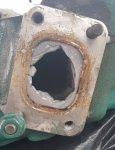
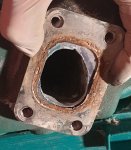
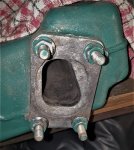
The photo I have attached is where the exhaust elbow bolts on the the heat exchanger/manifold on my Volvo D2-55 engine. As you can see, there is some missing metal due to corrosion. I took the assembly to a engineering repair shop but they didn't fancy having a go at welding it, but did recommend a product called Pegatanke which is an epoxy, to fill the gap. I did some research and it seems a good range of products, but never heard of it myself. I was wondering if anyone used it for this sort of repair? Or has any ideas on a better way to repair it. At about £4000 for replacement assembly I will try pretty much anything to avoid buying a replacement!!!

I did know about the corrosion last year as I replaced the elbow bend. At that time I got some sealer (can't recall the name) and along with a new stainless steel gasket, didn't give me any problems with water or exhaust leaks. Now that I have the heat exchanger off, I would like to try and get a better repair if possible. I was hoping that it would have been possible to get it fixed with welding of some sort.

Thanks for any advice.
 

Attachments

  • Exhaust.jpg
    Exhaust.jpg
    516.1 KB · Views: 129
I've used a Belzona product for similar problems in the past. They make several products, I expect there will be something suitable.
 
Thanks everyone for the advice.

After reading the excellent link from jwfrary, I am going to explore getting it repaired at an engineering workshop as that seems to be a more robust repair.

I will report back on what happens in case it benefits someone else.
 
It was, genuinely, the best thing to do. The engineering shop that did the repair for me were skilled, not expensive, and gave me back a pressure tested and fixed unit (it was very interesting also, they invited me into their shop and explained the process). Mine was worse than yours (as mine had got to the point of leaking). That flange could have leaked exhaust gas's into my daughters cabin, so I wanted to be sure it was done right.

Do it right, don't bodge it, and then you will not need to revisit it again and you'll have peace of mind (so long as you sort out that gavanic process going on there by putting a composite gasket between the elbow and the heat exchanger).
 
Good advice MagicalArmchair and advice I have taken. Your experience from the thread gave me all I needed to choose to follow your path and get it done at a engineering shop. I cancelled the order for the epoxy Pegotanke, which I have to say did look good, but having proper metal is far better!!!

I took the HE to an engineers yesterday who are quite happy to do the job.

This forum turns up trumps again!!! Thanks.
 
I am wondering if this comes from corrosion on aluminium. It more likely looks like someone did play around with a dremel grinder. But anyhow, for a fast fix i also would go with JB weld. Covering all of the surface with a thin 2mm layer but fill up a little more on the left side to increase the sealing wall thickness . But JB will take 300C max, and this area could become hotter than that.

On the long therme welding is best if you find a shop wich can weld casted aluminum alloy! So make sure that the shop is not used to weld handle bars and railing parts only. Google for resurface welding or bult up welding to get the right shop.

Good luck!
 
Good advice MagicalArmchair and advice I have taken. Your experience from the thread gave me all I needed to choose to follow your path and get it done at a engineering shop. I cancelled the order for the epoxy Pegotanke, which I have to say did look good, but having proper metal is far better!!!

I took the HE to an engineers yesterday who are quite happy to do the job.

This forum turns up trumps again!!! Thanks.

Finding a specialist welder, as iveasmalta said, is the key. GoToEngineering on the Medway City Estate were real artisans and craftsmen who understood welding aluminium. Good luck and let us know how you get on!
 
Well I have me HE welded and returned. I am not sure how great a welding job it is as I am not very knowledgeable on welding, but it looks as if there is sufficient metal to make it a better bet than epoxy.

The one thing I was a bit disappointed with was the extra material left, as I would have been expecting a finished article similar to what MagicalArmchair got...............

MagicalArmchair HE Repair.jpg

I got this, shown with the old gasket for scale.:-
Note that the gasket is not the shape of the exhaust port. Not sure why?

20220208_193907.jpg

I started to clean it up:-

Welded cleaned showing gasket.jpg

Can anyone advise me on how perfect do I need to grind it back or is what I have done sufficient? Maybe I am over thinking it, but if the hole is too narrow (not perfect) could the exhaust gases be restricted enough to effect the performance or reliability of the engine? Another thought in my paranoid little brain (when I am repairing things I have not done before) is that the raw water injected in to the elbow, could find it's way back towards the engine if the exhaust gas isn't strong enough to blow all of it the correct way i.e. towards the exhaust hose.

Incidentally I paid £200 for the repair. The guy doing it said it turned out to be quite difficult. When he started the job he found that there were a lot of impurities in the metal which he had to deal with. Something to do with bubbles!!! No idea what he was talking about and mentioning it in case anyone else finds it useful to know!!!

As always, I really appreciate the advice given.
 
Well I have me HE welded and returned. I am not sure how great a welding job it is as I am not very knowledgeable on welding, but it looks as if there is sufficient metal to make it a better bet than epoxy.

The one thing I was a bit disappointed with was the extra material left, as I would have been expecting a finished article similar to what MagicalArmchair got...............

View attachment 130058

I got this, shown with the old gasket for scale.:-
Note that the gasket is not the shape of the exhaust port. Not sure why?

View attachment 130060

I started to clean it up:-

View attachment 130061

Can anyone advise me on how perfect do I need to grind it back or is what I have done sufficient? Maybe I am over thinking it, but if the hole is too narrow (not perfect) could the exhaust gases be restricted enough to effect the performance or reliability of the engine? Another thought in my paranoid little brain (when I am repairing things I have not done before) is that the raw water injected in to the elbow, could find it's way back towards the engine if the exhaust gas isn't strong enough to blow all of it the correct way i.e. towards the exhaust hose.

Incidentally I paid £200 for the repair. The guy doing it said it turned out to be quite difficult. When he started the job he found that there were a lot of impurities in the metal which he had to deal with. Something to do with bubbles!!! No idea what he was talking about and mentioning it in case anyone else finds it useful to know!!!

As always, I really appreciate the advice given.
I suspect your gasket is the source of your original problems. Stainless steel and hot gases getting to the bare aluminium, plus a bit of seawater in the mix blowing back. Was the elbow constricted? That would allow water blow back, a common prob on some of these engine installations. Get a fibre gasket from parts4engines.com or get some high temperature fibre gasket and make one yourself.
Volvo Penta MD2010, MD2020, MD2030 and MD2040 engine parts - Page 3
£200 seems an awful lot! I would have expected to see a similar job as the other. Your cleaning up is good enough.
 
Honestly: i do have some problems figuring out wich is the upper and wich is the lower exhaust part you are showing. But it is for sure a problem of my non english birth language.

The welding guy was talking about "Lunker" in german and "shrink hole" in english. As an expert, you know that shrink holes can occure in casted materials, This ist not new.
If there realy have been any we would have seen at least one in your photo of the corroded exhaust channel. (my personell thinking)

What ever he claimed about "lunker", 200 pounds = approx 240 Euro is let me say "atheltic" to confirm with the olympic games presetly going on. I hope he said 4 times "thank you my dear friend" after receiving the money ;-)

But to save money, we are not boat drivers/riders...

Make you a mask. Get a pice of a thicker paper and copy the dimension of the bolt bores and the exhaust channel from the upper side, cut out where the openings are.. Then place this mask onto the new "build up" welded lower manifold. Take care about not to flip the mask into the wrong direction! Doublecheck! Then use a water proof edding marker or any other metal marker pencil to copy the upper opening to the lower.

Buy a simple Dremel grinder with one chipping/milling tool (not a grinding tool). Ask in the home depot store for: need it for milling aluminum (porting an aluminium exhaust channel)

Then champfering from the line you marked from the mask to a soft line towards the original exhaust channel deeper in the manifold. If unsure, better leave material in rather than milling it out.

Or: Hand over the upper part of the manifold to the 200 Pound weling guy and discuss to port it for you as a late discount.

Hope you could catch what i tried to say with my ginglish.

Good luck!
 
Thanks for taking time to respond and to iveasmalta for the welding education. I agree that £200 seemed a bit much, especially as he quoted me £80 after seeing the photo! However when the alternative is potentially over £3000 for a new HE from Volvo, £200 comes as a welcome relief. :)

The stainless steel gasket is the genuine Volvo part, however it is strange it's not the correct hole shape and from what Beneteau381 says it doesn't seem an ideal metal to use either. I actually got a gasket set from Parts4enginess as I renewed the o'rings, plus I needed a gasket to mount the HE back on to the engine. A composite gasket for the exhaust bend was part of that set, so I will use that,. Interestingly, it doesn't have the correct hole shape either. I guess it doesn't matter.

The elbow bend was renewed near the end of last season, which is how I noticed the corrosion on the HE exhaust port. The old bend wasn't blocked, but was badly corroded and when I poked at it and without too much effort, I managed to poke straight through casting. Replacement needed! The replacement I bought wasn't stainless steel, (although I thought about buying stainless) but in the end decided to buy the genuine Volvo bend.
 
The photo I have attached is where the exhaust elbow bolts on the the heat exchanger/manifold on my Volvo D2-55 engine. As you can see, there is some missing metal due to corrosion. I took the assembly to a engineering repair shop but they didn't fancy having a go at welding it, but did recommend a product called Pegatanke which is an epoxy, to fill the gap. I did some research and it seems a good range of products, but never heard of it myself. I was wondering if anyone used it for this sort of repair? Or has any ideas on a better way to repair it. At about £4000 for replacement assembly I will try pretty much anything to avoid buying a replacement!!!

I did know about the corrosion last year as I replaced the elbow bend. At that time I got some sealer (can't recall the name) and along with a new stainless steel gasket, didn't give me any problems with water or exhaust leaks. Now that I have the heat exchanger off, I would like to try and get a better repair if possible. I was hoping that it would have been possible to get it fixed with welding of some sort.

Thanks for any advice.
Repaired the exact same part 2 years ago for a friend using j b weld or similar .worked and is still working . No degradation . I suggest you try that before the expensive alternative . I have used metal epoxy now 4 times on parts that engineers said we’re not repairable ( welding and cast material)
 
Repaired the exact same part 2 years ago for a friend using j b weld or similar .worked and is still working . No degradation . I suggest you try that before the expensive alternative . I have used metal epoxy now 4 times on parts that engineers said we’re not repairable ( welding and cast material)

That's good to know!! (y)
 
Thanks for taking time to respond and to iveasmalta for the welding education. I agree that £200 seemed a bit much, especially as he quoted me £80 after seeing the photo! However when the alternative is potentially over £3000 for a new HE from Volvo, £200 comes as a welcome relief. :)

The stainless steel gasket is the genuine Volvo part, however it is strange it's not the correct hole shape and from what Beneteau381 says it doesn't seem an ideal metal to use either. I actually got a gasket set from Parts4enginess as I renewed the o'rings, plus I needed a gasket to mount the HE back on to the engine. A composite gasket for the exhaust bend was part of that set, so I will use that,. Interestingly, it doesn't have the correct hole shape either. I guess it doesn't matter.

The elbow bend was renewed near the end of last season, which is how I noticed the corrosion on the HE exhaust port. The old bend wasn't blocked, but was badly corroded and when I poked at it and without too much effort, I managed to poke straight through casting. Replacement needed! The replacement I bought wasn't stainless steel, (although I thought about buying stainless) but in the end decided to buy the genuine Volvo bend.

The stainless OE gasket is half the problem. Talk to the experts at Parts3Engines - the one they supply with their stainless elbows is composite to prevent the galvanic corrosion caused by the more noble stainless gasket sitting next to the less noble aluminium, in damp conditions (electrolyte). The Parts4Engines composite gasket should prevent a reoccurrence - I would never put a stainless gasket back in there.

The argument from Volvo is that there should never, ever be water at that point of the exhaust as it gets hot, and I mean really, 1,000 degree Celsius hot, however, when the injection elbow gets clogged or rusty, it can spray back, and water can get up there, condense, and sit. Galvanic corrosion will happen, eat through the flange and leak exhaust gases into your boat.
 
By the way, spray back of water can also caused by too agressive camshaft design, means too much overlap from intakte and exhaust cam duration.
See this when guys using Car Performance camshafts on Marine setups…
Ok, this was off topic, ?
 
Top