
Feedback needed for basic wiring diagram

Akestor

Well-Known Member
Joined
12 May 2018
Messages
428
Location
Athens, Greece
www.youtube.com
I did this diagram for installing basic circuits, still havent considered engine instruments, i left that for the future. I used a template from Tony Brook's website and customized it a little bit to mach the existing equipment. Can't see an error but an extra glance would be good, thanks!
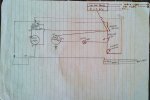
IMG_20180711_112026.jpg
 
If the master switch is an isolator next to the battery, something you turn on when you get on board and off before you leave it looks fine to me, give or take a couple of things. If the master is something easily accessible, so there's a risk of it getting turned off accidentally, I'd add a red key type isolator near the battery and take the alternator output to the switched side (away from the battery). You don't want the alternator getting disconnected from the battery while the engine's running.

Have you checked the earth return to the battery from the alternator? I don't know if the dynastart is isolated from the engine, but I've a vague idea it may be. If so, you'll need an earth point on the engine connected to the battery negative.

Fuses: I'd add a fuse in the ignition circuit, between the key switch. A quick google suggests 10 amps should do it, but do check for yourself. I'd also put one in the feed to the switch panel, as close as practicable to the master switch, to protect the wiring between the switch and the fuses in the panel. Add up the current draw for everything you've got going through the panel, plus a bit for new toys and add a margin so the fuse isn't running near its limit. I used something like this http://uk.farnell.com/multicomp/mccq-211cn/fuseholder-in-line-ato-30a/dp/1586600 on my boat.
 
I assume from your drawing that you only have one battery.

I agree you need some more fuses, situated at Stemar suggests. As the one between the isolator switch and the domestic fuse panel is only there to protect the wiring, there is no need to add up the current draw, just fuse it for the max cable rating.

No need to run the alternator B+ all the way back to the switches, that can be connected to the battery terminal of the starter relay.
 
If the master switch is an isolator next to the battery

The master switch is an off/1/all/2 type, i believe if no one turns it by hand it will stay in place while engine working.

Have you checked the earth return to the battery from the alternator?

I still havent connect the battery, but i have checked with multimeter (for continuity) the casings of engine/alt, engine/dyna, and dyna/alternator, and it beeps in every combination. Is there a prefered point for connecting the battery negative? The Dynastart has a D- terminal (M4 screw) but the alternator only the casing.

I added the 2 single fuseholders to the diagram

Thanks for your feedback!
 
I assume from your drawing that you only have one battery.

I agree you need some more fuses, situated at Stemar suggests. As the one between the isolator switch and the domestic fuse panel is only there to protect the wiring, there is no need to add up the current draw, just fuse it for the max cable rating.

No need to run the alternator B+ all the way back to the switches, that can be connected to the battery terminal of the starter relay.

Thanks for the tips! diagram updated:)
 
The master switch is an off/1/all/2 type, i believe if no one turns it by hand it will stay in place while engine working.


I still havent connect the battery, but i have checked with multimeter (for continuity) the casings of engine/alt, engine/dyna, and dyna/alternator, and it beeps in every combination. Is there a prefered point for connecting the battery negative? The Dynastart has a D- terminal (M4 screw) but the alternator only the casing.

I added the 2 single fuseholders to the diagram

Thanks for your feedback!

As long as you have a good connection from the engine block to earth via the D4 terminal, that should be fine. Check the voltage between the engine block and the battery -ve when the engine's running. It should be 0v, More than about 0.5v and I'd consider running a separate earth from battery -ve to a convenient bolt on the engine

A digital multimeter is an extremely useful bit of kit, and doesn't have to be dear. IMO, it's a must-have for anyone who's planning on doing their own electrics.
 
Thanks for the tips! diagram updated:)

You need to ensure good connections between the engine block and battery negative for the alternator and between the Dynastart D- and battery negative for the Dynastart......... I would be looking at possibly doing this by taking a heavy connection from battery negative to a convenient bolt on the engine block and connecting the Dynastart D- to the same point
 
I suggest that if the boat is kept in the water an automatic bilge pump should be connected so that it is not turned off by the master switch but separately wired to the battery with its own isolator.
If the engine is a diesel you also need a circuit for the stop solenoid.
 
I suggest that if the boat is kept in the water an automatic bilge pump should be connected so that it is not turned off by the master switch but separately wired to the battery with its own isolator.
If the engine is a diesel you also need a circuit for the stop solenoid.

On engines with dynastart that's usually called a stop cable :)
 
I suggest that if the boat is kept in the water an automatic bilge pump should be connected so that it is not turned off by the master switch but separately wired to the battery with its own isolator.
If the engine is a diesel you also need a circuit for the stop solenoid.

On engines with dynastart that's usually called a stop cable :)

ITYWF that it is an MD2B which, unless modified, does not have a stop solenoid
 
You need to ensure good connections between the engine block and battery negative for the alternator and between the Dynastart D- and battery negative for the Dynastart......... I would be looking at possibly doing this by taking a heavy connection from battery negative to a convenient bolt on the engine block and connecting the Dynastart D- to the same point

Hi Vic!
I was looking today for a point to connect the heavy negative cable somewhere on the MD2B but couldnt find a surplus stud or nut. I thought of attaching the heavy -ve cable on the Alternator's holder with an M8 screw and nut, and from the same screw a shorter cable running to the dynastart's D-
Unless this idea has some error it is handy doing it this way.
 
I suggest that if the boat is kept in the water an automatic bilge pump should be connected so that it is not turned off by the master switch but separately wired to the battery with its own isolator.
If the engine is a diesel you also need a circuit for the stop solenoid.

Indeed i ll install the pump that way. The engine is an old MD2B with just a stop/pull cable
 
Hi Vic!
I was looking today for a point to connect the heavy negative cable somewhere on the MD2B but couldnt find a surplus stud or nut. I thought of attaching the heavy -ve cable on the Alternator's holder with an M8 screw and nut, and from the same screw a shorter cable running to the dynastart's D-
Unless this idea has some error it is handy doing it this way.

If that makes a good connection, it's fine.
 
Top