Favourite anchorages along the south coast?

I know you sail with a family full of little ' uns, sometimes night passages across calm water and low windspeeds are ok too because the heat noise and vibration of the Donk seems to help em sleep? The West Country has its fair share of anchorages. Prob worth joining the N Trust though if its gonna be prolonged wet...
 
Anchorages between Selsey and Weymouth

This list is far from exhaustive and is only intended to indicate some places that I or friends have found useful or enjoyable. Where an anchorage is well known but I haven’t tried it, I have said so.

In principle we can anchor anywhere where it isn’t actually prohibited – we aren’t restricted to areas with an anchor symbol on the chart. However, common sense will suggest that anchoring in channels, among swinging moorings, near charted submarine cables or in locations with strong tidal streams is not a good idea. Under the ColRegs vessels of under 50m LOA are obliged to show a black ball on the forward part of the boat in daylight, and an all-round white light in a similar position at night. I’m assuming a suitable type and weight of anchor and sufficient cable (to anchor with confidence in depths up to 10m requires 40-50 m of cable of which at least 20 m should be chain) and that the cable is laid out properly rather than dropped it in a heap. A particular anchorage may be OK in a slight roll for a heavy sailing cruiser but much less acceptable in boats with less ballast and flatter bottoms and especially for fast motor cruisers. Comfort at anchor can often be improved by:


  • Reducing snubbing by bending a strong nylon warp to the chain with a rolling hitch, paying out a few more metres of chain and warp, making the warp off to a strong fore-deck cleat and easing the chain until the load is taken by the more elastic warp
  • Bringing the bows to face a side-on chop or swell (Braye Harbour is the classic case of this, though I have also used this locally in Sandown Bay) by means of a longer relieving line taken to a cockpit winch or aft cleat
  • Encouraging the boat to lie bow to wind by setting a mizzen, or by setting a small sail (eg a spitfire, small storm jib or a home-made item) on the backstay, sheeted in to the centre
  • Giving up and going somewhere more sheltered

For most anchorages I have given a latitude-longitude position that lies more or less in the middle. However, these coordinates are only intended to assist finding the right general area on the chart; they should not be taken as “X marks the spot” for anchoring. Decisions on where to drop the hook will always require a combination of chart work, bearings or transits, tidal information and depth sounding, combined with an awareness of any likely changes in wind strength and direction.

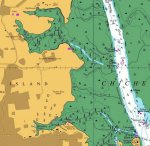
Chichester Harbour is sheltered and suitable for any type of boat to anchor, but available places are more restricted than you may expect, largely because most of the anchoring space has been filled with swinging moorings and much of the rest turns to mud at LW.

  • Nearly everybody knows East Head anchorage (50, 27.33 N; 000, 54.60 W), where the channel passes close to the sandy beach of the Head. The beach is steep-to so you can get in quite close. Holding is moderate but shelter from most wind directions is excellent (though not a good place in a fresh breeze between N and E). When it’s crowded, you may find yourself exposed to strong tidal streams if you have to anchor on the edge of the channel.
  • Nearby and quieter is Pilsey Island anchorage (50, 48.08 N; 000, 54.20 W) at the west side of the lower end of Thorney Channel. Don’t try to land on Pilsey Island in spring or summer – the rare birds that nest there won’t like it.
  • Another useful spot, within dinghy reach of the pub at Itchenor, is to fetch up clear of the down-harbour end of the moorings on the Itchenor side, below the Northshore yard and its associated moorings (50, 48.50 N; 000, 52.60 W).
  • Ingenious use of a Chichester Harbour chart will allow you to find a few small holes in side-channels where you can lie afloat at LW. I won’t spoil the fun by giving lat and long.

Spithead has little to offer on the mainland side apart from open anchorages on its abundant shoals. These can save an unnecessary Pan-Pan call if the engine fails and the boat is being swept off by the tide, but are not generally places of choice for a lunch-hook or overnight stop, The Island side, however, has several good possibilities between Culver Cliff and Ryde:
Whitecliff Bay (50, 40.20 N; 001, 05.50 W) is a small anchorage tucked behind the N end of the prominent white nose of Culver Cliff. Holding is only fair but it is well sheltered from anything between S and W. Swell tends to creep round into it, so it can have quite a roll unless the sea is fairly flat. I’ve been in to have a look but haven’t tested it overnight yet.
There are several minor anchorages in the approaches to Bembridge Harbour. Inspection of the chart will show possibilities outside the drying area NW of St Helen’s Fort, but bear in mind that the banks shift about and the depth gauge is more important than the charted soundings. Shelter is good from W through S to SE, and holding is pretty good too.

It is possible to anchor almost anywhere in sufficient depth in Priory Bay (50, 42.7 N; 001, 05.1 W) and off Seaview (40, 43.5 N; 001, 06.5 W). Small local moorings take some space off Seaview (there are also a few visitors’ moorings), but Priory Bay has few obstructions beyond the odd lobster pot. These are peaceful and attractive places, well sheltered from W to S, and with a grandstand view of the big ships coming and going from Southampton and Portsmouth. The only disadvantage is that the ferries tend to create a bit of wash from time to time.


The Eastern Solent


The area of Ryde Sands is generally so shallow that any anchorage tenable at LW would be miles offshore at HW. However, there are plenty of opportunities for lunch stops around HW if you feel mildly adventurous. Much the same is true to the west of Wootton Creek as far as Barton Point. However, the best-known (for many, the only) anchorage on the island side between Wootton and Cowes is Osborne Bay (50, 45.4 N; 001, 15.1 W). This gives good shelter in anything with any south in it, and is also reasonable in westerlies. The main problem is the number of other boats at lunchtimes and afternoons, though there is always room for a few more round the edge. However, it is excellent as an overnight stop, with good holding in most places (the few rocky patches are obvious from the chart), relatively weak tidal streams and an excellent view of the big ships rounding Brambles Bank. The shoreline is very attractive, but it all lies within the grounds of Osborne House and no landing is allowed.

The only well-known possibility on the mainland side is Stokes Bay (50, 46.8 N; 001, 09.7 W), lying to the W of Gilkicker Point. This is very useful in any wind with north in it. The classic sailing-school approach is to follow the transit of the sailing club flagpole with the square tower of Alverstoke church until you are in your required depth. Done carefully, this leads to lots of boats anchoring on top of each other. However, it is all totally unnecessary and the main consideration is to avoid anchoring where you will interfere with the dinghy-racing activity during daylight hours. There aren’t any swinging moorings here, so if you pick one up it is probably one of the marker buoys for the day’s course.

West of Stokes Bay, the shallow area on the mainland side of the big ship channel is bisected by the North Channel, used by ships of lesser draft to avoid the precautionary area round Brambles Bank and Calshot Spit. The whole area between the North Channel and the low-lying mainland shore offers endless possibilities for open-water anchorage in quiet conditions. As the chart shows, everywhere is shallow but a moderate-draft yacht can only go aground by getting too close to the beach. Tidal streams are slight in this whole area, and the North Channel and its surroundings provide an excellent route for beating a foul tide if you are heading for the Hamble, Southampton Water or the Western Solent.

Southampton Water has little to offer except limited anchorages off the main areas of small boat moorings, but who would want to stop there anyway? In the Hamble every possible anchorage was gobbled up by marinas and swinging moorings long ago. The quiet beauties of Ashlett Creek, improbably placed between Calshot power station and the Fawley oil refinery, are denied us for anchoring purposes because most of it dries below half tide, and even at HW you are either in the channel or aground. However, it is well worth a visit for a lunchtime pint at the stand on HW springs – moor to the piles on the (often slightly submerged) concrete quay and visit the Jolly Sailor, but clear out before the ebb starts unless you plan to dry out overnight.

Cowes and the Medina River are hopeless, the problem in the Medina being the usual one of moorings everywhere, plus the fact that the bottom is littered with old chains and other junk that would spoil your day if your anchor fouled it.
 
We started plotting these last night and working out whether the south west is viable. It's no distance for the boat but SWMBO is nervous about getting trapped there by bad weather, looking at Navionics is seems about 220nm from the Deben which at 5knts is four long days. I guess the trick is to take 10 days getting there in comfort and a month slowly working our way back, spending longer in the places that were marked as worth more time.

Leave Harwich / Deben @ HW straight for Dover,Brighton,Solent if conditions allow
 
Newtown and east of Hurst Spit (right hand of oldbilbo's chart) are good - the latter excellent for an early start out of North Channel to take the tide to Poole. Studland and several places inside Poole Harbour, Swanage and then in fine weather Chapmans Pool (not overnight) Worbarrow, Lulworth Cove.

Chapmans Pool - could have done with the not overnight suggestion. Is it me or is there a large rock in there somewhere?
Yes we had the wrong scale chart but it seemed a good place to stop and wait for the tide to come East.
 
If you are starting on the East Coast you could break your journey at Dover: the port authority will give you entry instructions through the Eastern breakwater entrance, and then if you proceed past the ferries there is a lovely shallow sandy anchorage off the beach: no-one asked us for anything. Then you can leave through the western entrance.

You may find there is a charge which could be collected. Do listen to and communicate with Port Control - for obvious good reasons.
Adequate, eat all you can, Chinese up in the town.
 
We started plotting these last night and working out whether the south west is viable. It's no distance for the boat but SWMBO is nervous about getting trapped there by bad weather, looking at Navionics is seems about 220nm from the Deben which at 5knts is four long days. I guess the trick is to take 10 days getting there in comfort and a month slowly working our way back, spending longer in the places that were marked as worth more time.

Or 220 miles is between 24 and 36 hours of continuous sailing. Get a friend to help crew and sail round the clock? You really eat the miles up and it's easy when you get into a pattern of watch keeping. Once you're there you can pootle your way back at your leisure.
 
Or 220 miles is between 24 and 36 hours of continuous sailing. Get a friend to help crew and sail round the clock? You really eat the miles up and it's easy when you get into a pattern of watch keeping. Once you're there you can pootle your way back at your leisure.

Hmm, nights are short then as well, certainly 18 out of 24 is possible, especially if the tides make those 6 dark hours foul tide. Makes me wonder about going Deben/Dover Dover/IOW IOW/Weymouth Weymouth/Devon. Four days and we're in the West Country. It would take more time by car at that time of year ;)
 
Hmm, nights are short then as well, certainly 18 out of 24 is possible, especially if the tides make those 6 dark hours foul tide. Makes me wonder about going Deben/Dover Dover/IOW IOW/Weymouth Weymouth/Devon. Four days and we're in the West Country. It would take more time by car at that time of year ;)
you need to take the flood from sandwich into Dover. then the tidal gate @ Dungeness
 
Hmm, nights are short then as well, certainly 18 out of 24 is possible, especially if the tides make those 6 dark hours foul tide. Makes me wonder about going Deben/Dover Dover/IOW IOW/Weymouth Weymouth/Devon. Four days and we're in the West Country. It would take more time by car at that time of year ;)
Starting and stopping (ie going into a harbour and going alongside) takes a lot of time. If you really have a foul tide and are going nowhere then kedging for a few hours can make sense. As I said, sailing round the clock, once you get used to the idea of watches and sleeping at sea, can really eat the miles. If you find the crew getting tired and you REALLY need a break there are plenty of places to stop. If you have only day sailed before its a different mind set, and you have to be organised about actually cooking at sea, but its a great way to travel longer distances. If sea sickness is a worry, in 99 times out of a hundred it wears off after the first day or two, but that's another topic...
 
Yes, just work out how much water you need and drop the hook there. We will be there Friday night, so leave us some room!
 
I can't understand why people love lovely remote anchorages & then go & tell all & sundry,bloody stupid in my opinion.

Probably because they realise they have no personal control over who goes into the anchorages and are happy for other like minded people to share in the good fortune!
 
Foul tides are only foul for so long, for example, the last time I went west the winds were E to SE and quite light, left Pompey entrance at 1200,cruising chute n main, stood still off Portland for a few hours in the evening, light m/sailing thru the night and 20 min naps/look out, took a reef in around 4 am, Dartmouth for breakfast. The trick was to seize the wind and keep going..
By contrast I beat from there to Fowey double reefed. One more beautiful afternoons sail= Falmouth for music n beer. Another day sail,cruising chute, tadaah, Scilly. Then spent three months wandering east..Boat sails well but has a smaller engine than the OP.

Go on, you know you want to...
 
Last edited:
Top