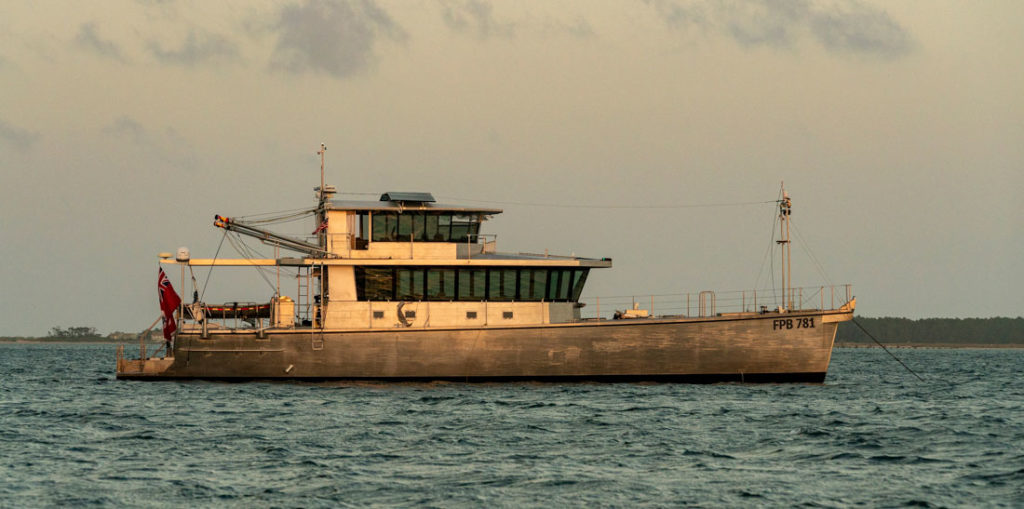
Extreme passage maker - new build

Similar in visual context to the FBP designs developed by whatsisname that Berthon had an involvement with.

(btw - No disrespect intended - I’m travelling and can’t remember their names.)
 
Similar in visual context to the FBP designs developed by whatsisname that Berthon had an involvement with.

(btw - No disrespect intended - I’m travelling and can’t remember their names.)

Steve Dashew

looks pretty similar.
7311560-1024x509.jpg


clip_image001_thumb.jpg


but the use of a Gardener spot on. Nice project though.
 
Last edited:
Möbius, a 23.8m Extreme Passage Maker, started build 250 days ago in Turkey by Naval Yachts.

Is she different? Oh, yes. And she has a Gardner.

The philosophy behind the design: https://mobius.world/project-goldilocks-mission-impossible-or-just-right/

And she has a Gardner: https://mobius.world/mr-geeeeeeeeeeeeee-is-in-the-house/

So much more to read on their site.

Thanks for the kind words and for posting this reference here Piers, much appreciated.

You can check out this week's update on the Mobius.World blog to get an in depth answer to your question last week about "rubbing strakes" and see what you think about our version of these.

-Wayne
 
Nice project and nice alu construction by Naval Yachts.
The spec is intriguing. Lots of things make perfect sense, but then they are fitting Vacuflush loos. Sealand? =Work of the devil, with lots of horrible injection moulded cheap parts and a million things that can and will go wrong, urgh. A project like this needs Tecma or Planus. And the decision not to fit stabilisers is quite a surprise, though each to their own of course. For a big seas passage maker you need to be quite brave not to fit fins. Paravanes are not a substitute for stabilisers because they do something different and for starters paravanes cannot know where horizontal is. The Gardner main engine sounds a complete delight - made me wonder whether there is a reduction gearbox (no need for reverse due to CPP) and whether there are SAE flanges for PTOs (for power steering as well as general hydraulics or cranes, winches and of course stabilisation) but I couldn't find all the tech spec on the blog. Definitely a blog to check in on as this develops
 
And the decision not to fit stabilisers is quite a surprise, though each to their own of course.
Indeed.
Even more so in the light of WH words: "There was never any question that we would want and need some form of stabilisation on this boat it was a question of what solution would be best for us and here is where we have ended up".
How this premise can possibly bring to the conclusion of building the hull for fins but install paravanes instead, is something well above my pay grade, if I may steal an expression which I recently learned from another forumite. The idea of having booms and fishes hanging around in sea conditions where stabilization is most critical (with their inherent effectiveness limits, btw), well, that's just about the opposite of my idea of boating for pleasure.
But +1 also ref. the "though" part of your comment, of course!

Oh, and welcome Wayne to the asylum.
I for one would appreciate if you could post in this thread some links to any major updates to your blog, whenever available.
It's already hard work to keep up with one boating forum, you know... :rolleyes:
Regardless, all the very best for your epic project, of course! :encouragement:
 
Long range cruising with a Gardner?

That's right up my street. On a 88' steel canoe-stern Fairmile M.Y. from the mid 60's, we were running twin Gardners, best bit of kit I've ever worked with. Took it down to South America. Just lovely.
 
Nice project and nice alu construction by Naval Yachts.
The spec is intriguing. Lots of things make perfect sense, but then they are fitting Vacuflush loos. Sealand? =Work of the devil, with lots of horrible injection moulded cheap parts and a million things that can and will go wrong, urgh. A project like this needs Tecma or Planus. And the decision not to fit stabilisers is quite a surprise, though each to their own of course. For a big seas passage maker you need to be quite brave not to fit fins. Paravanes are not a substitute for stabilisers because they do something different and for starters paravanes cannot know where horizontal is. The Gardner main engine sounds a complete delight - made me wonder whether there is a reduction gearbox (no need for reverse due to CPP) and whether there are SAE flanges for PTOs (for power steering as well as general hydraulics or cranes, winches and of course stabilisation) but I couldn't find all the tech spec on the blog. Definitely a blog to check in on as this develops

Thanks for your interest in our boat and your comments JFM. I guess we have just had a very different experience with VacuFlush toilets and in my case I wouldn't want to live aboard with anything else. Our previous boat had VacuFlush toilets for 24 years when we sold her and the only maintenance I did in the 11 years I owned her was to replace the duckbill valves in the Sealand pump about every 3-5 years and the rubber seal on the ball valve once. Perhaps we had a different model than you did, ours was the 5000+ and our new ones are the 5006 models and on those there is really only one moving plastic part, the big ball valve so one of the things I came to appreciate them most with VacuFlush was their simplicity and longevity. Our new VacuFlush, now owned by Dometic, were the very first items we purchased for the build so as you can tell we are big fans.

As for stabilisers, we have designed and built the hull to have active stabilisation so the hull has all the additional framing, sealed coffer dams, etc. to be fitted with active stabilisers in the future, either by ourselves or a distant future owner. As you've noted we have also built in a passive stabilisation with A-frame booms and paravanes and we will use those for the first year or so and see how they work out. Not any act of "bravery" on our part I assure you, just that passive paravanes are the best fit with our overall KISS approach to the whole boat. To the best of my knowledge all stabilisers are designed to deal with roll attenuation so in that respect they are doing the same thing, just achieving the goal using different methods. In all cases that I know the stabilisers are exerting forces on the hull to counter act the forces trying to roll the boat. It is true I guess that paravanes "cannot know where horizontal is" but they now where lack of vertical motion is and constantly seek to find that point. Poled out to the sides vertical motion of the paravanes would equate to the hull rotating or rolling so as they seek to cancel any such vertical motion they will therefore be keeping our decks as horizontal as possible. I think the key differences between active and passive stabilisers of any kind are cost, reliability, maintenance, energy use, ease of use, drag and what percentage of roll they can attenuate.

FYI, If we find that we want to reduce the roll more than the paravanes are doing then we can relatively easily install active stabilisers. Right now if I was to go with active stabilisers we would go with ones based on the Magnus Effect such as RotorSwing or MagnusMaster rather then fins based, and keep these all electric rather than hydraulic.

We certainly do agree with you on our overall propulsion system with our Gardner 6LXB and Nogva CPP prop setup. There is indeed a "servo gear box" between the Gardner and the prop with a 2.95:1 reduction that will drop our prop RPM's down to around 4-500 at 10kts open ocean cruising speed. No reverse as you noted, this CPP is fully reversing with the pitch control. No PTO housing as the only hydraulics we have onboard are the steering cylinders which have redundant 24v hydraulic pumps.

Appreciate your interest and for following along with our progress. Please add your comments and suggestions in the "Join the Dicussion" box at the end of each blog post.

- Wayne
 
Long range cruising with a Gardner?

That's right up my street. On a 88' steel canoe-stern Fairmile M.Y. from the mid 60's, we were running twin Gardners, best bit of kit I've ever worked with. Took it down to South America. Just lovely.

Thanks for the vote of confidence and sharing your first hand experiences with Gardner engines. What model were the twins you ran? Every Captain we've met who has had Gardner's speaks as highly of them as you do so we are very much looking forward to joining those ranks.
 
Thanks for the vote of confidence and sharing your first hand experiences with Gardner engines. What model were the twins you ran? Every Captain we've met who has had Gardner's speaks as highly of them as you do so we are very much looking forward to joining those ranks.

The Gardner guys in Kent built us a pair 6LXBs while the boat was being restored in Spain. The only problems we ecountered was some poor fitting by the boatyard. Crap inlet fittings, hoses and exhausts; usual stuff found on old boats.
 
Poled out to the sides vertical motion of the paravanes would equate to the hull rotating or rolling so as they seek to cancel any such vertical motion they will therefore be keeping our decks as horizontal as possible.
That's not always true I'm afraid, because paravanes do nothing to correct listing - which is what jfm meant by being unaware of the horizon.
In other words, if and when the hull is grabbed sideways by a long ocean swell, making the boat list for quite some time (as opposed to rolling back and forth), paravanes can only resist the initial motion for a very short time. Once the boat is listing, their effectiveness is lost completely.
In sharp contrast, fins can keep the boat horizontal forever - even if unbalanced, hence inherently listing also in flat waters.

There are good reasons why fins are still the installation of choice in most ocean going vessels (cruise ships included!), and while I understand the appeal of Magnus stabs on paper, imho the only possible doubt when speccing a boat like yours is not whether to adopt fins or anything else, but just which type.
Apropos, since you mentioned that you are not having any hydraulic equipment onboard, these folks build fully electric fin stabs which are well tried and tested by now, specifically designed for long range vessels, up to megayacht size.
Just saying, in case you never came across them.

Also on the matter of electric vs. hydraulic, I saw in your blog that the hull has a 12" bowthruster tunnel, but I couldn't find which type of equipment you will fit, if you don't mind me asking.
I'm curious because at that size, and for such all-weather boat, I guess you wish to have some continuous duty stuff, and while some electrical equipment are indeed designed for that, the more usual way to skin this cat is with PTO hydraulic pump(s) and thruster(s)...
 
Top