External sensors for holding tank

tudorsailor

Well-Known Member
Joined
12 Jun 2005
Messages
2,756
Location
London
zebahdy.blogspot.co.uk
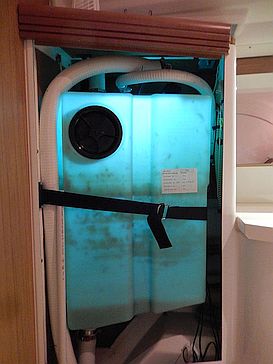
I do not have a sender in the holding tank to show how full it is. Tapping the outside is not very accurate. However I have now found that non-contact liquid sensors work through the wall of the holding tank. So I have made a system that will warn me when the tank is nearly full

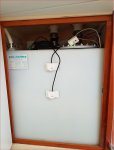
I have used sensors that incorporate a NPN transistor. They can also be bought on eBay. They do need adjusting with the little screw that is hidden under the cap
I have also used LEDs configured for 5v with inbuilt resistor.
I included a buzzer so that when the red LED lights the buzzer will sound too
Finally I used a buck converter to reduce the input down to 5v.

In the photo and video, the traffic light LEDs are on top of the holding tank for ease of showing the system, but I am going to put them on the outside.
Power comes from the light in the heads, so when the light is turned on the sensors are powered

The holders for the sensors and the LEDs are 3D printed

Before anyone says it, I do appreciate that one could just have the single sensor at the nearly full level and no external LEDs. You would need to see the little light on the sensor itself to know the tank is nearly full.

If anyone wants more details of the wiring, I am happy to share.
holding tank on board.JPG
https://youtu.be/6YNe4JIMuuY

TudorSailor
 
I just hold a little torch on the side of the tank and slide it up and down; easy to see the level of contents.

Ditto, but with a fixed source. I bought a small LED patch from a Chinese bazaar years ago in Spain. I think it cost about 3 euro. Jeanneau had thoughtfully supplied spare wiring for a fan and I already had a switch.

Thank goodness the tank isn't too see through. Very easy to see the exact level.

HoldingTankLight.jpg


I thought about adding an alarm but found it just as quick to look. I wouldn't wan't to leave some LED lights on all the time, though power usage would be small.
 
Last edited:
You lucky people with your non-steel tanks. Although we've only actually filled up one tank once it was an unpleasant enough experience (5 of us were swimming nearby and the breathing fitting spurted half into the dinghy drifting by the hull and half into the water near us).

So I've always been a little nervous after 2 or 3 days in the same bay not knowing whether it's half or a quarter or nearly full. Any suggestions for a metal tank most welcome (that doesn't involve having to unscrew the panels to access the tank every time.
 
I fitted a small float switch into the top of all my tanks 2 water 3 fuel and a single holding tank.

These are commented to its own LED with a switch to select which tank to monitor during filling with a buzzer.

The holding tank is always connected to the buzzer when the water and fuel are not being filled.
 
I fitted a small float switch into the top of all my tanks 2 water 3 fuel and a single holding tank.

These are commented to its own LED with a switch to select which tank to monitor during filling with a buzzer.

The holding tank is always connected to the buzzer when the water and fuel are not being filled.

What kind of float switch is it? And do you put it three quarters of the way up the tank or ??
 
What kind of float switch is it? And do you put it three quarters of the way up the tank or ??

The switches are like this mounted under the top of the tanks

side-mounted-float-switch-water-level-switch-liquid-level-sensor.jpg


The water and fuel tanks all have both electrical and dip stick/ float mechanical level indicators.
 
I do not have a sender in the holding tank to show how full it is. Tapping the outside is not very accurate. However I have now found that non-contact liquid sensors work through the wall of the holding tank. So I have made a system that will warn me when the tank is nearly full

I have used sensors that incorporate a NPN transistor. They can also be bought on eBay. They do need adjusting with the little screw that is hidden under the cap
I have also used LEDs configured for 5v with inbuilt resistor.
I included a buzzer so that when the red LED lights the buzzer will sound too
Finally I used a buck converter to reduce the input down to 5v.

In the photo and video, the traffic light LEDs are on top of the holding tank for ease of showing the system, but I am going to put them on the outside.
Power comes from the light in the heads, so when the light is turned on the sensors are powered

The holders for the sensors and the LEDs are 3D printed

Before anyone says it, I do appreciate that one could just have the single sensor at the nearly full level and no external LEDs. You would need to see the little light on the sensor itself to know the tank is nearly full.

If anyone wants more details of the wiring, I am happy to share.


TudorSailor

Really interesting, thanks. I have a plastic tank for fresh water but the plastic is so dark I can't use the bright torch to illuminate the contents as other have suggested so i like your idea. However, in its simplest form and not as good as your traffic light system, could i supply power to the sensor and slide it up and down the wall of the tank watching the little led on the sensor going on or off to tell me where the level is?

Www.solocoastalsailing.co.uk
 
The switches are like this mounted under the top of the tanks

side-mounted-float-switch-water-level-switch-liquid-level-sensor.jpg


The water and fuel tanks all have both electrical and dip stick/ float mechanical level indicators.

Thanks - ordered with a wall mounted red flashing LED. I just need to work out what to put on the label below the light. Something like, “If this light flashes leave the loo immediately and tell all swimmers to get out of the water NOW!”
 
Really interesting, thanks. I have a plastic tank for fresh water but the plastic is so dark I can't use the bright torch to illuminate the contents as other have suggested so i like your idea. However, in its simplest form and not as good as your traffic light system, could i supply power to the sensor and slide it up and down the wall of the tank watching the little led on the sensor going on or off to tell me where the level is?

Www.solocoastalsailing.co.uk

Absolutely! The simplest set up would be one of these sensors that does not include a resistor. There are various ones on eBay. A bit cheaper if you get from a Hong Supplier

Then you power them with anything from 5v - 24v. I have just tested one and it works perfectly from a 9v battery

They come with a JST connector (size XH). Your choice in connecting to power is to use breadboard jumper leads into the connector and hold them with tape, or buy a male JST connector and solder 2 wires to the connector, or to cut the connector off and splice to the red and black power wires.

With a 9V battery connector you would have a neat little hand held device!

Let me know how you get on!

TudorSailor
 
Absolutely! The simplest set up would be one of these sensors that does not include a resistor. There are various ones on eBay. A bit cheaper if you get from a Hong Supplier

Then you power them with anything from 5v - 24v. I have just tested one and it works perfectly from a 9v battery

They come with a JST connector (size XH). Your choice in connecting to power is to use breadboard jumper leads into the connector and hold them with tape, or buy a male JST connector and solder 2 wires to the connector, or to cut the connector off and splice to the red and black power wires.

With a 9V battery connector you would have a neat little hand held device!

Let me know how you get on!

TudorSailor

Have ordered the sensor, thanks, will let you know.

Www.solocoastalsailing.co.uk
 
Last edited:
For a bag tank, the only way I can see is to measure the amount of flush water used, and then interpolate from that.
I have actually have a steel tank, and I use this principle with a simple flow meter (https://www.conrad.com/p/garden-hose-water-flow-meter-552059). My tank is 50L, when the meter reads 40L I know it is time for a pump-out.
Works pretty well for me, never had a overfull tank incident.
And it is a cheap solution.
 
For a bag tank, the only way I can see is to measure the amount of flush water used, and then interpolate from that.
I have actually have a steel tank, and I use this principle with a simple flow meter (https://www.conrad.com/p/garden-hose-water-flow-meter-552059). My tank is 50L, when the meter reads 40L I know it is time for a pump-out.
Works pretty well for me, never had a overfull tank incident.
And it is a cheap solution.

I like the idea of the flow meter - is there an issue with the diameter of the heads pipes and the relatively small fitting of the meter; or is it just plumbed in with some fittings to take up the difference? We have a metal tank with no access hatch and this idea seems ideal. Thanks.
 
Top