Extended low power operation

ss2016

Well-Known Member
Joined
24 Jul 2016
Messages
192
Visit site
I have a D6 400hp VP engine. Since I am interested to take the boat into the European canal and river system I have been trying to understand the impact of extended very low power operation on the engine. To stay within speed limits will require it frequently operate well below 1000 rpm for hours at a time. Thoughts?
 
Lots of seagoing boats with large engines based on inland waterways with no real issues. Some will say that prolonged use may lead to bore glazing, which has been debated on here many times.
 
I agree with Greg.
I keep my boat on inland water and while I like to give it a good workout the reality is the majority of hours each year are at 5kts.
If 5kts is spent over years this might become an issue such as turbocharger issues due to lack of use.

How many years and engine hours do you intend to spend not exceeding 5kts without giving the engine a workout ?
 
This article all about plant machinery suggests 15% to 20% of hrs run can be allowed for idling, any higher can create many problems.
Excessive Idle Running of Diesel Engine and the Effects

Indeed but that is idling whereas even at low speeds we are talking about engines under load. We have always had twin engined boats and often run on one engine inland, which puts the revs above idling and with some load so they are working. The OP appears to have a single engine and in reality is likely to be above idling revs, particularly on rivers.
 
Personally I wouldn't let fear of excessive engine wear or decline influence how I use my boat or, more correctly, I wouldn't let it stop me doing what I want to do with the boat. I bought it for my pleasure and I'd rather have to perform major maintenance more often than forego what I want to do. Life's too short.
 
Modern CR + stuffed with computing ECU s can and do adjust the fuelling down at low rpms , so the bore glazing thing ( one of the points on Greg2 link ^ ) is NA , or should be on your D6 400 if VP are up to date “on the curve “with diesel tech so to speak .

How ever your injectors are also todays tech .Multiple canuli with sequencing of squirts .As opposed to old school less precise one large hole with a needle + spring to overcome the pressure ,Point being at lower cylinder temps + pressures of sub optimal rpm running the soot that forms clumps together and is more likely to stick / clog up those tiny canuli in your injectors .

Hence the adage of an Italian tune up , ie a good burst at decent rpm every now and again to burn off the accumulation of soot and clean the injector tips .I think this still applies, more so with your CR injectors I am afraid .

As for the ring sealing , lack of heat to expand to correctly seal etc , that’s just a function of increased oil degradation.You can mitigate that by reducing the oil change frequency.
Agglomeration is the soot particles and they form longer chains , more abrasive ones at lower clylinder temps / pressures .Talking soot and even more now aggressive abrasive particles getting into the oil excessively at long low rpm running , past the loose fitting rings .That’s why diesel oil turns black very quickly after a lub change , it gonna get blacker quicker and fill up with potentially abrasive particles with yours .So consider extra lub changes ?

Its inaccurate to suggest it’s ok to run them , too much at low rpms .Manufacturers will list the operation percentages of each variant in terms of % time spent @ various loads inc 100 %.The higher rated ( 400 Hp sounds at the high end of the spectrum ) the less time is recommend at the lower end ,the more at the higher rpm ( load ) end ,

For constant lower rpm ,river type usage say a barge marine engine manufacturers usually produce a variant to suit say in your case a D6 with 280 hp and prop it via a suitable gear box so it reaches the correct cylinder temps / pressures .

What difference does all this make with my high speed planning boat on D6 400 s ? I hear you ask .
Well if it’s stays all it’s life in a river it might need a rebuild at 1/3 rd or 1/2 the hrs of the derated barge D6 .But 15000 hrs to 7000or 5000 hrs ?? You are not gonna notice .

But as said you might end up throwing injector codes as the tiny canuli clog up = premature injector failure .

As said consider additional supplementary lub changes as you go , not one annual .
 
Thanks for the replies. Lots of useful thoughts there, and yours Portofino in particular was what I was hoping to hear. I agree with the early oil change but otherwise apart from taking every opportunity to use higher power think enjoying life as Irish Rover said is more important. Just wanted to hear nothing cataclysmic would happen. 2850rpm from France to Falmouth coming home should make for a good sort out. Thanks for the input.
 
Apart from any issues caused by low rpms for a sustained time (which I am of the opinion that it’s 100% not great for any big turbocharged diesel)…the other issue you can find is that boats like this…it’s just simply a nightmare for slow speed close quarters handling.
The Princess 385 we have has fairly seriously pitched props with well over 600hp driving them. At idle on both engines in gear…she will do around 6 knots. Fairly ferocious lurch forward too, when going into gear. She went through the crinan and Caledonian canal a few years ago. Not ideal for such a thing really.
I’d imagine if you were to put a boat in such an environment for any length of time, it may be worth having props that were better pitched and suited to it. Would make handling much less of an issue. Also easier to keep to the speed…and also being the rpms up too. Perhaps not enough to have any real sign of boost from the turbos and keeping a clean combustion…but should keep the temps up at least and work the engine harder
 
QBhoy, that is an interesting comment. Fortunately the newer D6 has a 'snail' mode which drops the prop rpm wrt the engine. It's not a gear change but some sort of slip in the hydraulics which I don't really understand. It makes for very gentle input of power and slow speed with the throttle on tickover.
As I started to read your reply I thought you were going to raise the other concern. Steering the boat in a straight line at idle speed is very difficult and tiring for any extended period. There is a way around this however. The Garmin autopilot can do it faultlessly, so I steer it on a little wheel which is just inputting course to steer. (It's on a little control panel Garmin call Grid20)
 
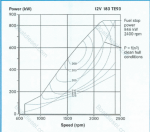
You can work out the load from the engine manufacturer curve at a given rpm, there is a site https://boatdiesel.com/ which is absolutely worth the 20$ a year subscription. If I understand it correctyl and I may be wrong by a mile - for displacement speed:

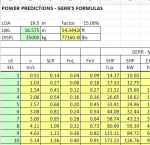
This MTU for example just around 1000 rpm will have around 180 kw of max output at 100% load, and effectively deliver 50kw at 30% load. Then I use a spreadsheet (Gerrs power predictions) to work out at which speed the vessel will travel with 2 engines at 1100 rpm (100kw).

For a vessel with 16.5 mt waterline lenght and 35tons Shaft HP 100kw will be around 9.5 kn. So I should be able to drive this hull with those engines on board at around 9kn using 100kw - using 225 ml Diesel / kwH - that is 22 l/h to drive around 9kn (hull not clean 1kn less, bit of waves another 0.5kn less etc). Water lenght is king of course, my actual boat has maybe 9.5mt at water line and I require the 100kw to drive around 9kn with a hefty bow wave (which makes no sense as the boat uses 3l/mile at 30kn).

Now if you look carefully there is a even a better deal somewhere there, like 7kn for measly 43kw. And in this case that means running 1 engine only would still be able to push me at 7.5kn for 10 l/h at 1000 rpm.

The issues with old engines (but we are talking stuff from the 80s) was that the lowest possible rpms to prevent "damage" to the engine was quite higher - that is you will still burn a lot of diesel even if you go slow, basically you needed to get closer to hull speed (and therefore big bow wave and big diesel tab) or the engine would not be happy.

For your case - you could get hold of the load curve and see where you are when the engines can get a bit of load. But having done the canal route from Kiel in Germany to Port Saint Louis myself, lots of the time is idling and lots of it is 8 km/h - which is like 5kn and every hull over 12-13 mt will need just 10-15 kw to move. So you may find yourself in a situation where even idling you are too fast (my actual boat travels 4kn/h with the 2 360HP Volvo engines idling).

The old trawler of the Kiel - Port Saint Louis trip was longer but equipped with a 60PS engine idling at 300 rpm - so at around 600rpm it would generate the 15kw necessary to move it.

1667217395596.png1667217908380.png
 
QBhoy, that is an interesting comment. Fortunately the newer D6 has a 'snail' mode which drops the prop rpm wrt the engine. It's not a gear change but some sort of slip in the hydraulics which I don't really understand. It makes for very gentle input of power and slow speed with the throttle on tickover.
As I started to read your reply I thought you were going to raise the other concern. Steering the boat in a straight line at idle speed is very difficult and tiring for any extended period. There is a way around this however. The Garmin autopilot can do it faultlessly, so I steer it on a little wheel which is just inputting course to steer. (It's on a little control panel Garmin call Grid20)
Sounds not so bad then. Fair play. Wasn’t pleasant with the P385 I remember. Constantly in and out of gear to keep her from running away at speed. Close quarters to the hire boats was another worry altogether ?.
 
You can work out the load from the engine manufacturer curve at a given rpm, there is a site https://boatdiesel.com/ which is absolutely worth the 20$ a year subscription. If I understand it correctyl and I may be wrong by a mile - for displacement speed:

This MTU for example just around 1000 rpm will have around 180 kw of max output at 100% load, and effectively deliver 50kw at 30% load. Then I use a spreadsheet (Gerrs power predictions) to work out at which speed the vessel will travel with 2 engines at 1100 rpm (100kw).

For a vessel with 16.5 mt waterline lenght and 35tons Shaft HP 100kw will be around 9.5 kn. So I should be able to drive this hull with those engines on board at around 9kn using 100kw - using 225 ml Diesel / kwH - that is 22 l/h to drive around 9kn (hull not clean 1kn less, bit of waves another 0.5kn less etc). Water lenght is king of course, my actual boat has maybe 9.5mt at water line and I require the 100kw to drive around 9kn with a hefty bow wave (which makes no sense as the boat uses 3l/mile at 30kn).

Now if you look carefully there is a even a better deal somewhere there, like 7kn for measly 43kw. And in this case that means running 1 engine only would still be able to push me at 7.5kn for 10 l/h at 1000 rpm.

The issues with old engines (but we are talking stuff from the 80s) was that the lowest possible rpms to prevent "damage" to the engine was quite higher - that is you will still burn a lot of diesel even if you go slow, basically you needed to get closer to hull speed (and therefore big bow wave and big diesel tab) or the engine would not be happy.

For your case - you could get hold of the load curve and see where you are when the engines can get a bit of load. But having done the canal route from Kiel in Germany to Port Saint Louis myself, lots of the time is idling and lots of it is 8 km/h - which is like 5kn and every hull over 12-13 mt will need just 10-15 kw to move. So you may find yourself in a situation where even idling you are too fast (my actual boat travels 4kn/h with the 2 360HP Volvo engines idling).

The old trawler of the Kiel - Port Saint Louis trip was longer but equipped with a 60PS engine idling at 300 rpm - so at around 600rpm it would generate the 15kw necessary to move it.

View attachment 145382View attachment 145383
Loving this ! Takes me back to the early days, learning the Marine Engineering game, before they let me loose and sent me to sea !
 
This article all about plant machinery suggests 15% to 20% of hrs run can be allowed for idling, any higher can create many problems.
Excessive Idle Running of Diesel Engine and the Effects

Hi,

interesting article but it looked at idle. I have asked about my own Cummins qsb 5.9/380hp machine from the manufacturer US and I got an answer from the technical department that this enginee can do everything correctly 24 hours 7 days etc. when the rmp are over 830 rpm and idling max 5 minutes. no glazing, no leakage piston rigs, no carbon, apparently the common rail can adjust the combustion optimally.

Here is another interesting article.

Low Speed Running & “Break-In” of Marine Diesels
 
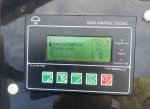
Just under 800 rm ( tick over is 600 ) low load eco running .
We are doing 51 % load @ 9.2 knots . Burning 2x15 L and can carry over 2000 L…..so you do the maths endurance/ range ?

The thing is the EGTs are low so at the end of the day for the last 1/2 hr I do get it up to 1760 rpm circa 560 * C EGTs to clean the injector tips . Burn rate goes to 170 L / hr for 1/2 hr , and speed nearly 30 knots .

I have noticed if I pootle to a anchorage at this speed , anchor and get in the sea there is a film , a rainbow film of unburnt fuel washing out of the rear fart pipes .We are talking 2003 ish EDC , but not CR .I don’t think the electrotwackery unlike todays CR has the capability to reduce the fuel ing on my boat like a modern boat .

Anyhow the current usage pattern fits what we do , because I can open her up before berthing up , blasting it all clean .
Last yr we did 80 hr s so the oils not exactly over thrashed either .A long way off the manufacturers 400 hrs recommended change interval .

It’s not really a river boat , never was intended and I can’t see any owners using them as such .
But sure some days , long hot calm days we do pootle along .


If I nudge the sticks up a bit further we get 9.8 ish knots , 60 % load and 18/20 L / hr …..the bow waves just beginning .
The manufacturers manual says I can spend something like 50 % of my running hrs at around 50;% load btw .20 % at WOT fwiw , which I never do in the interest of mechanical sympathy.

WOTs a bit scary consumption wise . 280 l / h eek !
0BB8DA66-0A01-4E27-82DC-520623F09C67.jpeg
 
Last edited:
  • Like
Reactions: NBs
Top