
Experience with epoxy barrier on wet hull?

Seems to me that there is some confusion here about what is a "wettish" hull (as in original post). The moisture readings are not particularly high and the surface of the hull will be completely dry when any coating is applied. So is the question really whether applying a less permeable new epoxy barrier coat will result in blisters in the underlying gel coat by trapping moisture in the hull. Given that there seem to be no blisters at present, nor any suggestion of repaired blisters from the past there is no reason to think that blisters will develop in the future.

I suspect your moisture levels will not change over the next 3 months so the decision might be whether you think it is worth the cost and effort to apply epoxy or just prime an antifoul.
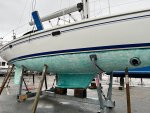
 
I have a similar dilemma on my 2006 Catalina 34. I had the hull shot blasted this December, the intention being to to remove the accumulated AF layers only. Unfortunately, the GelShield 200 layer beneath it was ‘powdery’ and came off with it. The keel is fine (see photo).

Now I’m wondering what to do. Clearly, winter isn’t the best time to expect a dry hull and temperatures >5c so should I wait until spring, or will a winter on the hard result in a hull that’s too wet to epoxy? Alternatively, should I try to get the layers on as soon as we have mild spell?
 

Attachments

  • 29E9D329-A7B6-45F0-A2CD-5974F1C612A3.jpeg
    29E9D329-A7B6-45F0-A2CD-5974F1C612A3.jpeg
    308.6 KB · Views: 16
I am still undecided. I've spent a ridicilous amount of time thinking and reading about this (and I have zero experience re barrier coats & osmosis). At the moment I am slightly inclined towards epoxy coating. The product I am considering is not a marine epoxy, but Antel's heavy-duty solvent free product. I have been recommended Antel's water-based epoxy, but the company told me that the solvent-free heavy-duty paint would be more suitable, and is being used to coat GRP boats.


I painted a small patch with this epoxy to "test" it as much as you can without the boat being in the water. It was very easy to apply, and cured well at 10ºC 72% humidity, which does happen in winter. It seems to have adhered well, and sands easily.

(Also in light of the comments above) the reasons why I am inclinded to go ahead with this and cover the bottom with this epoxy are below. I hope this thinking helps with your decision making.

1) If the coating fails, the *epoxy* will blister. That would happen if the *epoxy* acts as a semi-permeable membrane. That's different to the GRP blistering, when the gelcoat acts as a semi-permeable membrane.
2) I am prepared to do spot repairs, or in the worst case scenario, remove all antifouling, primer and epoxy. The epoxy was not difficult to sand off, so I'm happy to do that.
3) The moisture readings are not dropping any further, and *to my understanding* is that this is not just "water moisture" but it is "GRP juice" = laminate broken down by historic water ingress (which happens to every boat at some rate). This stuff does not pass the semi-permeable membrane, and there is no way the hull can be drier without a osmosis treatment (gelcoat peel etc).
5) I had the chance to compare our moisture readings with some other boats, and the levels are the same with much younger boats (despite being higher than 5 on Sovereign scale A)
6) If the epoxy sticks, then the boat will be as dry as it can possibly be without osmosis treatment. If I don't use the epoxy, then it might absorb more moisture, break down more GRP, and risk greater osmosis headache.
7) Peeling all the paint might be expensive, but it the epoxy costs about £80. I'd be happy to risk that much if it might slow down osmosis (any coating is not 100% waterproof, so osmosis can only be slowed down, not prevented) without doing any damage to the hull.
 
It's a bit counter-intuitive, but a good spell of wet weather on the stripped hull may well help to dry it by washing styrene ("GRP juice") off. It certainly won't do any harm.

When I did my old boat, I was lucky and got a good spell of mild dry weather in spring which allowed me to put several coats of Gelshield and then Coppercoat (don't bother if you're on a drying mooring). It took 15 years or more for blisters to re-appear, and then only a few.
 
I think the OP has got the right idea(s) with the above post.

I might query the £80 cost, though. Is it a very small boat?! We used half a tin of Jotun per coat - 41’ boat. Jotun themselves said 5 coats were required to really ‘do anything’. Three coats would be the absolute minimum beyond which it isn’t worth bothering with at all.

[Edit - just re-read the above re: solvent free epoxy - that will obviously required far fewer coats, but still minimum 3 (hot coated) I’d argue]

As I said before/above - we did this job outside in ‘mixed’ UK weather and don’t regret it.
 
I am still undecided. I've spent a ridicilous amount of time thinking and reading about this (and I have zero experience re barrier coats & osmosis). At the moment I am slightly inclined towards epoxy coating. The product I am considering is not a marine epoxy, but Antel's heavy-duty solvent free product. I have been recommended Antel's water-based epoxy, but the company told me that the solvent-free heavy-duty paint would be more suitable, and is being used to coat GRP boats.


I painted a small patch with this epoxy to "test" it as much as you can without the boat being in the water. It was very easy to apply, and cured well at 10ºC 72% humidity, which does happen in winter. It seems to have adhered well, and sands easily.

(Also in light of the comments above) the reasons why I am inclinded to go ahead with this and cover the bottom with this epoxy are below. I hope this thinking helps with your decision making.

1) If the coating fails, the *epoxy* will blister. That would happen if the *epoxy* acts as a semi-permeable membrane. That's different to the GRP blistering, when the gelcoat acts as a semi-permeable membrane.
2) I am prepared to do spot repairs, or in the worst case scenario, remove all antifouling, primer and epoxy. The epoxy was not difficult to sand off, so I'm happy to do that.
3) The moisture readings are not dropping any further, and *to my understanding* is that this is not just "water moisture" but it is "GRP juice" = laminate broken down by historic water ingress (which happens to every boat at some rate). This stuff does not pass the semi-permeable membrane, and there is no way the hull can be drier without a osmosis treatment (gelcoat peel etc).
5) I had the chance to compare our moisture readings with some other boats, and the levels are the same with much younger boats (despite being higher than 5 on Sovereign scale A)
6) If the epoxy sticks, then the boat will be as dry as it can possibly be without osmosis treatment. If I don't use the epoxy, then it might absorb more moisture, break down more GRP, and risk greater osmosis headache.
7) Peeling all the paint might be expensive, but it the epoxy costs about £80. I'd be happy to risk that much if it might slow down osmosis (any coating is not 100% waterproof, so osmosis can only be slowed down, not prevented) without doing any damage to the hull.


I have used Inernational Gelshield on one boat and have it on the boat I own at the moment. Both have held up very well, despite not being applied with any great attention to detail. I strongly suspect that both had fair amounts of moisture in the laminate (coated at about 10-15 years of age) but it was before the time when we worried too much or even had easy access to accurate testing equipment.

The epoxy on my present boat is now about 30 years old, it seems ok, touch wood. Certainly on the scale of things to worry about, pretty low down.

Provided that the moisture readings are reasonably uniform by the spring, in the topsides and below the waterline, I agree with you and would epoxy. As someone has mentioned, the exposed fibres could well wick moisture and I am not a great fan of simply patching areas of concern.
I agree, peeling a known good hull would be crazy.
.
 
Top