exhaust water trap leak

scrambledegg

Well-Known Member
Joined
2 Nov 2015
Messages
264
Location
Portsmouth
Visit site
Dear all
Below is a picture of the top of the exhaust water trap in the engine bilge of my sailing boat. Yes, I know... I do spoil you with shots of her best, most intimate bits.
It has developed a leak of 1 bucket per hour when the engine is running and i am in need of some reassurance about fix/replacement.
Sorry it's not well exposed.
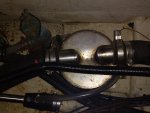
exhaust water trap.jpgexhaust water trap.jpg
Firstly, I can't see anything quite like it available. Anyone able to identify it? it seems to be made of metal. I presume that corrosion has got it, and it's terminal.
Secondly, I am a bit befuddled by the fact that the external diameter of the hose from the engine (big one on the left side) has an outer diameter of 62mm but the hose going out to the exhaust (right side) has an o.d. of 56mm. Water traps these days look like they have tubes of equal diameter on their inlet and outlet. Should I be concerned about the size mismatch? Is exhaust hose flexible enough to fit to different sized tubes, within reason? I'd rather not have to replace most of the exhaust run. The actual exhaust elbow of the engine is 50mm o.d.
What size hose would naturally fit a 50mm exhaust elbow? Parts website seem very careless about specifying inner and outer dimensions of hoses.
Grateful for your thoughts.
 
50, (or 51) mm exhaust hose would fit your elbow. This size is easily obtainable, OD would be ~60mm, which yours seems to be.
The smaller hose is probably 45mm. again a standard size. Looking at you photo though, the inlet and outlet stubs seem the same size. Has the hose from the engine been crushed down to fit a smaller, 45mm stub? If so then bad practice from a durability point of view, though I doubt if it has any effect on engine performance.
Hose and pipe stub sizes need to be reasonably well matched for reliable leak tightness.
Can't identify the water lock. Platic Vetus items are easily obtainable and are fitted to many installations. You may also need some form of hose reducer to avoid too much re-plumbing.
 
Last edited:
Firstly, I can't see anything quite like it available. Anyone able to identify it? it seems to be made of metal. I presume that corrosion has got it, and it's terminal.

Looks a bit bespoke to me, not an off the shelf item. If that is the case then take it to a fabricator, they may well be able to reuse the top bits of it.
 
ID 50mm is a common size
if you can find a reducer 45/50mm ID you only need some cm’s of new hose.
you might find that you need to destroy parts of hose to get it apart.
 
50, (or 51) mm exhaust hose would fit your elbow. This size is easily obtainable, OD would be ~60mm, which yours seems to be.
The smaller hose is probably 45mm. again a standard size. Looking at you photo though, the inlet and outlet stubs seem the same size. Has the hose from the engine been crushed down to fit a smaller, 45mm stub? If so then bad practice from a durability point of view, though I doubt if it has any effect on engine performance.
Hose and pipe stub sizes need to be reasonably well matched for reliable leak tightness.
Can't identify the water lock. Platic Vetus items are easily obtainable and are fitted to many installations. You may also need some form of hose reducer to avoid too much re-plumbing.

Some well considered words. Thank you. The mist is clearing.
 
When I re-engined several years ago, I noticed that the stainless water trap had obviously been leaking from a weld, so fitted a a Vetus plastic water trap to replace it(plus the fact the engine hoses were a different size). I sold the ss water trap on ebay, but did say that it had been leaking, and it sold quickly.
 
Almost certainly custom made as your boat was built before plastic and GRP water traps became commonly available. You might be able to get it welded but it is the welds that are the weakness of the design. You won't know if it is possible until you get it out and take it to a good fabricator.

You can get similar shapes traps from either Vetus in plastic or Halyard Marine in GRP. Both do different size spigots for inlet and outlet if yours turn out to not be the same.
 
Funnily enough my friend showed me his Volvo water trap the other day; it was very much like the one in your pictures but was made to fit horizontally. It consisted of two stainless steel "endcaps" with a piece of "rubber hose" in the middle; the inlet and outlet hoses were attached to a neck welded to the metal endcaps similarly to yours. His was leaking where the inlet neck was welded to the endcap. His unit was clearly stamped Volvo and spares are available from Volvo - at considerable cost!! Apparently some years ago you could find the separate parts (e.g. an end cap) available as spares but now only a complete unit!

Alan.
 
Dear all
Below is a picture of the top of the exhaust water trap in the engine bilge of my sailing boat. Yes, I know... I do spoil you with shots of her best, most intimate bits.
It has developed a leak of 1 bucket per hour when the engine is running and i am in need of some reassurance about fix/replacement.
Sorry it's not well exposed.
View attachment 70930View attachment 70930
Firstly, I can't see anything quite like it available. Anyone able to identify it? it seems to be made of metal. I presume that corrosion has got it, and it's terminal.
Secondly, I am a bit befuddled by the fact that the external diameter of the hose from the engine (big one on the left side) has an outer diameter of 62mm but the hose going out to the exhaust (right side) has an o.d. of 56mm. Water traps these days look like they have tubes of equal diameter on their inlet and outlet. Should I be concerned about the size mismatch? Is exhaust hose flexible enough to fit to different sized tubes, within reason? I'd rather not have to replace most of the exhaust run. The actual exhaust elbow of the engine is 50mm o.d.
What size hose would naturally fit a 50mm exhaust elbow? Parts website seem very careless about specifying inner and outer dimensions of hoses.
Grateful for your thoughts.

I would get the water trap out and cut around the cylinder about half an inch up from the bottom weld. If you are patient you could cut round with a hacksaw although a disc cutter in an angle grinder would be quicker. Then you will be able to see how bad the corrosion is. Most likely it will be at the base. If everywhere else looks ok then take it to a stainless fabricator to get a new stainless plate welded on the bottom. The result will be half an inch shorter but will be a straight replacement to your hoses and will probably last 10 years. If when you cut the bottom off the whole inside looks bad then replace it with a vetus plastic one.

Www.solocoastalsailing.co.uk
 
How about using the old rusted SS water trap parts as an inside mold to be covered with PVC layers and re install it?
I think I read about someone who did it and said it worked.
 
Funnily enough my friend showed me his Volvo water trap the other day; it was very much like the one in your pictures but was made to fit horizontally. It consisted of two stainless steel "endcaps" with a piece of "rubber hose" in the middle; the inlet and outlet hoses were attached to a neck welded to the metal endcaps similarly to yours. His was leaking where the inlet neck was welded to the endcap. His unit was clearly stamped Volvo and spares are available from Volvo - at considerable cost!! Apparently some years ago you could find the separate parts (e.g. an end cap) available as spares but now only a complete unit!

Alan.

Many people replace the Volvo type with a Vetus at less than half the price. The stainless end caps are very thin and tend not to respond to welding. However they can last a very long time. The one in my last boat was till fine when i sold it at 14 years.
 
I recently had to 'mate' exhaust hoses in two sizes - new injection bend into existing hose into Vetus watertrap - and found ASAP Supplies had a range of well-priced reducers made for that job. The OP might find them helpful.

The only question was that there might be an issue with 'back pressure'. The engine's manufacturer told me this was most unlikely - 'not a concern' in the sizes discussed.
 
I'd get it welded. It was almost certainly hand built for the boat and how old is the boat?

As someone else said it will have failed at the lower weld. The repair will be as good as new if the base is cut off and welded back.

It will take you half an hour to remove. £100 spent locally to get repaired? And half an hour to refit. How long will it take you to fit a new one?

I'd worry having a plastic exhaust. I'm stupid enough to forget to turn the engine sea cock on now and then.
 
I'd get it welded. It was almost certainly hand built for the boat and how old is the boat?

As someone else said it will have failed at the lower weld. The repair will be as good as new if the base is cut off and welded back.

It will take you half an hour to remove. £100 spent locally to get repaired? And half an hour to refit. How long will it take you to fit a new one?

I'd worry having a plastic exhaust. I'm stupid enough to forget to turn the engine sea cock on now and then.

A complete new Vetus one will be fine. Thousands are in use without any problems and when did you ever hear of one catching fire? The weakness of stainless in this application is the welds which is the reason why stainless traps are almost never used these days.

Of course it might be possible to repair it, but a Vetus one will cost about £180, will fit the space and give years of trouble free service.
 
It will take you half an hour to remove. £100 spent locally to get repaired? And half an hour to refit. How long will it take you to fit a new one?

Wow I would reweld it for a lot less than 100 GBP but I am too far away.

I made my own for my boat both for my main engine and my water cooled generator very easy.

36086056935_f80242f407_b.jpg


Main engine water trap on the left, Generator on the right
 
Last edited by a moderator:
Top