Exhaust/water mixer.

Rappey

Well-Known Member
Joined
13 Dec 2019
Messages
4,975
Visit site
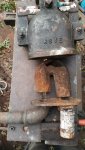
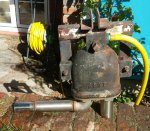
I've no idea what this thing is called. It is upside down ! The dry exhaust enters the straight pipe, sea water from the heat exchanger enters at the top then the water and exhaust leave through the pipe that comes out at 90 degree.
The straight pipe fractured and fell off, filling the boat with water and smoke.
Why would the system be like this rather than the more usual water entering at the end of the heat exchanger ?
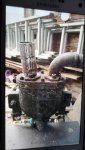

15968253145042099478731.jpg
 
Last edited:
I was at first confused, until I saw that it is upside down. It's just a fairly normal, if old fashioned type of exhaust mixing chamber. The straight pipe should continue up inside the chamber, to near the top. The water mixes with the exhaust gas, and cools it, and both then run down out of the outlet pipe. The exhaust inlet continues up to near the top, to prevent any possibility of water getting back to the engine.
 
I wanted to see if I could replace it if still available or how much, but don't know what to search for.
At 37 yrs old I can't see it coming apart.
Maybe just weld the broken pipe back on and get some more years out of it.

I assumed it had this "unit" due to the engine being below the waterline and the uphill to the transom for the exhaust.
 
Last edited:
It is a Parsons Box, exhaust mixer commonly mounted high up as a part of a swan neck exhaust system to stop water back flow into the engine. They are fitted to many of the larger Rival yachts which is why I know about then, having one fitted to my boat. They are not made anymore as you have probably guessed. They are like that because they allowed vehicle engines with dry exhausts to be used on boats with other marinising parts. They are commonly replaced with modern exhaust parts such as Vetus. The spigot at the top, on my boat, supplies coolant to the stern gear, at least on my boat it does.

Wide collection Boat Exhaust systems at VETUS boat parts

I think that the Parsons part of Parsons Mathey was the original manufacturer but they no longer make these. On my boat there is a reduction gearbox on the tiller which I traced to Parsons Mathway, so maybe useful if you have a boat with that age of steering gear.

Parsons marine engines
 
Last edited by a moderator:
It's what might be called a 'high rise mixing elbow'.
basically raises the injection point 'comfortably' above the waterline.
Obviously, the ijected water needs to be directed to the transom, not the engine.
I'm sure you could get something made to do the job.
 
Some great information. ?
Gave me something to Google .
Seems like it's a good system and at 37 yrs old it did well as all the exhaust system is original other than the dry part of the exhaust, flexipipe !
It is also a marinised vehicle engine. That little bit of information is a little gem .
 
The flanges on the mixer look as if they are threaded onto the pipe. You can cut the pipe off flush and then hacksaw through one side of the pipe inside the flange and bend it free, leaving the flange to be reused. I would soak the whole lot in Plusgas release agent applying regularly to penetrate, say over a week. If the cap screws don't come out they are likely to be easily drilled out undersized, best in a pillar drill to get straight penetration. Once drilled out carefully knock the remaining sleeve shaped part of the thread out. The lid over the mixing chamber of the box may have an asbestos gasket, so keep it wet when removing and don't allow dust.

When reassembled use pipes with spigots. I have a wet exhaust hose from the wet end to the hull skin fitting. From the engine dry exhaust I have one of these flexible steel exhaust hose between the engine and the mixer like this.

Galvanised Steel Flexible Exhaust Hose
 
Your setup sounds just like mine.
The outlet is a threaded elbow threaded into the flange but the inlet is a pipe that has been welded to the inlet flange. I've ground some of it back in the pic so the pipe is just balanced in position.
The weld corroded away but the rest of the steel and cast parts seem to have a fair bit of life left in them.
it's got A S Y E cast into it.
can see inside with a torch.
That's twice this evening my font has changed ?
 
Update time... I removed the unit from the boat so i could weld the snapped pipe back on. Had to cut the stainless dry exhaust off though..
welded the pipe and it didnt go that great so liberally smeared chemical metal over the weld to make it gas tight..
Refitted it and bought a new section of polylock stainless exhaust.. Was not great, a slight bubble from my dodgy welding, but worse was all the gas and water leaks through the polylock exhaust?
After a little use i decided this has to be revisited now rather than waiting until winter as why is there water comming from the dry exhaust?? Only one thing for it - open it up
1 (3).jpg
 
The dry exhaust enters on the right, i have cut the swn neck from the plate it was fixed to.. Water enters in the top of the unit and gas and water exit via the left pipe..
now i can see why water is going down the dry exhaust.
Now what to do ?? I looked into changing the whole system for what is in most boats but my problem is the engine is well below the water line and nowhere to place any exhaust box that is lower than the exhaust manifold outlet..
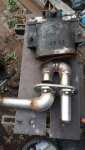
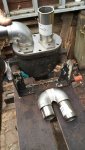
time to rebuild, bought some pipe, some 8mm stainless plate and a few 316 elbows, cut, drilled and tapped the required holes, welded it up, did a water leak test in the garden and its now working perfectly on the boat!
I really do like this system as the sea water feed is higher than the transom outlet so no need for an anti syphon in the system as cranking the engine will just send the water along the system and out rather than filling the engine up.1 (2).jpg1 (4).jpgout rather than filling the engine up. 1 (1).jpg
 
Beyond salvation I would think. By the time a solution was put together a new system could have been installed for a lot less hassle and cost. Now I am wondering if mine is very close to that condition on the inside. It is not that complex a design to replicate the functionality out of pipe. Good luck.

Edit - you posted your solution, tops.
 
I replaced the dry exhaust with 48mm corrugated 316.. Had ends welded on, that was £90 o_O plus £135 for the rest of the stainless elbows and pipes. but it should last me out now !

I took the angle grinder to the allen bolt heads which enabled me to get it apart. Got some flat bar, drilled a hole to go over what was left of the studs, welded it, that gave heat and allowed me to unscrew all the bolts from the cast iron casing. that was still in excellent condition !
 
Last edited:

Other threads that may be of interest

Top