Exhaust elbow any way to prevent corrosion?

Gone sailing

Well-Known Member
Joined
28 Oct 2013
Messages
94
Location
Langstone
Visit site
Just ordered a new exhaust elbow/ manifold on my Nani engine. The old one has corroded where the sea water mixes with the exhaust.
The engine is 7 years old. I was wondering if there is any preventative measures I could take to make the next one last a bit longer? It has a anode fitted to it but doesn't seem to do a great deal judging by its lack of degradation.

Dip it in epoxy?

Thanks

Jim
 
There's a few threads on this forum on exhaust elbows. Corrosion is a common problem. I've had one built from a chemically resistant grade of stainless-steel and it seems to be working well.

The epoxy won't work at the hot end of the elbow. Frankly I don't think there is anything you can do to improve matters with a cast or mild-steel elbow.
 
Get a fabricator to copy it in stainless is about all you could do I think.

I'm assuming the elbow and rest of the system is set up correctly so water doesn't sit back in the injection part of the elbow whilst the engine's off
 
I am not very familiar with the arrangtement of the elbow. So the question comes...is the corrosion from sea water or from hot gasses? If the water injection is down stream from the elbow and point of corrosion then clearly it is the hot gasses. In that case the corrosion would be on the outside of the elbow. I wonder if the internals are at all accessible if a stainless steel plate could be fixed inside the elbow on the outside curve to take the blast from the hot gas. I am not sure how you could fix it inside in place though. You would not want it coming loose and moving down the exhaust system. Just a thought olewill Or could the water injection be moved to upstream of the bend?
 
'is the corrosion from sea water or from hot gasses?'
I think it is the combination of both!
Mine went after about 8 yrs, current one has been in 5 yrs so a job for this winter is to get a s/s one made.
The only problem I haven't solved is what to use as a gasket, and how thick it should be.
 
Last edited:
'is the corrosion from sea water or from hot gasses?'
I think it is the combination of both!
Mine went after about 8 yrs, current one has been in 5 yrs so a job for this winter is to get a s/s one made.
The only problem I haven't solved is what to use as a gasket, and how thick it should be.

It needs to be the right Stainless. Standard Stainless Steel is worse than cast iron.
 
It's a fundamental rule that corrosion rate doubles with every 10 degree C increase in temperature. Stainless steel is particularly poor in strong halides, which includes seawater that has been partially evaporated. Some stainless is better than others but not by a great deal. Some designs of elbows seem to work better than others, presumably by arranging that the seawater sprays downstream rather than on the wall of the fitting. So unfortunately in many cases the elbow must be considered a disposable item.
 
Mermaid supplied an injection elbow with my engine, it is stainless, double skinned, the water enters the outside collar and the exhaust is in the middle. This presumably stops the corrosion caused when water is entered on one side and the exhaust 'fires' it against one spot in the bend. I didn't use it, mine's a dry exhaust.
 
Older Nanni engines had a cast iron elbow without anode - mine lasted 13 years before it gave up the ghost.
Replacement elbow supplied by Peachment in 2012 was made of cast aluminium, fitted with an anode.
How long this will last I have no idea but I have little confidence in a long life.
 
Just ordered a new exhaust elbow/ manifold on my Nani engine. The old one has corroded where the sea water mixes with the exhaust.
The engine is 7 years old. I was wondering if there is any preventative measures I could take to make the next one last a bit longer? It has a anode fitted to it but doesn't seem to do a great deal judging by its lack of degradation.

Dip it in epoxy?

Thanks

Jim


What engine is it
My 4150 cast iron elbow was replaced & 7 yrs. The cast iron replacement was about £80
the problem with mine is the elbow is the raw water bottom feed with a gearbox H/E horizontally below it, this allows a mixture of air / seawater to lay in the elbow spigot.
 
Thanks for your comments
It is a nanni nanni 3.75 he and the replacement is £120+vat so not too excessive!
It has corroded at the point where the hose connects to the manifold.
 
I have always understood that metals, including stainless, become quite reactive at elevated temperatures, so spraying seawater onto a hot exhaust pipe makes an injection bend of any material a consumable item. When they were often screwed together from black iron components, they lasted longer if heated to cherry red and quenched in mineral oil, both carburising and varnishing the surface. There have been similar good reports of extending the life of modern units by applying several coats of epoxy resin to the inside surfaces. I believe most exhaust gaskets are metal foil/asbestos sandwiches which are dry fitted. Last time I opened mine, the delivery on a replacement gasket was around three months. I got a serviceable, used replacement from a car exhaust shop.

Rob.
 
Mermaid supplied an injection elbow with my engine, it is stainless, double skinned, the water enters the outside collar and the exhaust is in the middle. This presumably stops the corrosion caused when water is entered on one side and the exhaust 'fires' it against one spot in the bend.

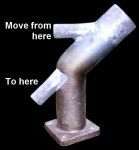
That has given me an idea! Not double skinned but have the water blown straight down the exhaust pipe like this:

The problem will then be arranging the pipe from the heat exchanger to the Exhaust :(
 

Attachments

  • Exhust Elbow 3.jpg
    Exhust Elbow 3.jpg
    40.8 KB · Views: 0
Last edited:
That has given me an idea! Not double skinned but have the water blown straight down the exhaust pipe like this:

The problem will then be arranging the pipe from the heat exchanger to the Exhaust :(

It will perforate at a point between 'here' and 'here' as the exhaust flow fires it at the outside of the elbow. . Move it closer to the end?
 
The exhaust elbow is there to cool the exhaust gases and the elbow before it reaches the rubber hose and the plastic mufflers. To do it effectively the cooling water must be spayed onto a plate where it can form droplets to fill the elbow and hence cool the gases quickly. If you just inject the water straight into the pipe the gases may be too hot for the hose.
 
Top