Exhaust back-flooding

This Marine Engineer reckons he makes a living out of replacing poorly designed exhaust systems and destroyed motors. The article is well worth reading.

Designing a Marine Exhaust System
Very interesting. I remember now why I never changed to a wet exhaust, apart from the need to know instantly if cooling water flow was reduced, in the weed-rich harbour I worked from. I often cleared the seacock twice before reaching open water.
So one recommendation is a high point near the engine and another, slightly lower after the muffler, which makes sense. Some high goosenecks at the transom are a double edged sword: the height keeps water out.......and in.
 
I cannot imagine what your "backpackers" hoped to achieve by topping up your diesel containers with water.
There has been some ill feeling between anglers and a pro fisherman here. Someone replaced his spare petrol with sea water except for the top inch or so, he found out at sea, and some thought it hilarious, until I said if he had an accident I would be calling the plod.
 
Very interesting. I remember now why I never changed to a wet exhaust, apart from the need to know instantly if cooling water flow was reduced, in the weed-rich harbour I worked from. I often cleared the seacock twice before reaching open water.
So one recommendation is a high point near the engine and another, slightly lower after the muffler, which makes sense. Some high goosenecks at the transom are a double edged sword: the height keeps water out.......and in.
But the water-lock muffler is more than large enough to take the gas/water mixture from the gooseneck once the motor has closed down.
 
But the water-lock muffler is more than large enough to take the gas/water mixture from the gooseneck once the motor has closed down.
Is it? Isn't there already an unknown % water in the muffler, before the drain back from aft? Not sure of this, genuine question. However much pipe or capacity there is in the sytem it's always part water., which increases if cranking with no start.
 
Is it? Isn't there already an unknown % water in the muffler, before the drain back from aft? Not sure of this, genuine question. However much pipe or capacity there is in the sytem it's always part water., which increases if cranking with no start.
You are right, you must not keep cranking the motor if it fails to start. The raw water pump will keep pumping water into the exhaust system but there will be no exhaust to blow it out.

I know when I installed my exhaust I made sure the waterlock muffle could handle the volume of water in the hoses/gooseneck. (But of course the hoses are never 100% filled with water).

Here is an article I've just come across that answers your question

"The size of the waterlift muffler is critical; it must be able to hold all the water in the exhaust hose, both ahead
of and behind it, that would run back into the muffler upon engine or generator shutdown. Muffler manufacturers usually provide formulas for calculating the volume of the system. If the calculations yield a borderline result, always go to the next larger size muffler. Also, hose sizes, if changed, must always become progressively larger as
the exhaust travels to the outlet."

https://www.zfmarinepropulsion.com/wp-content/uploads/ExhaustSystems170-FINAL.pdf
 
This Marine Engineer reckons he makes a living out of replacing poorly designed exhaust systems and destroyed motors. The article is well worth reading.

Designing a Marine Exhaust System
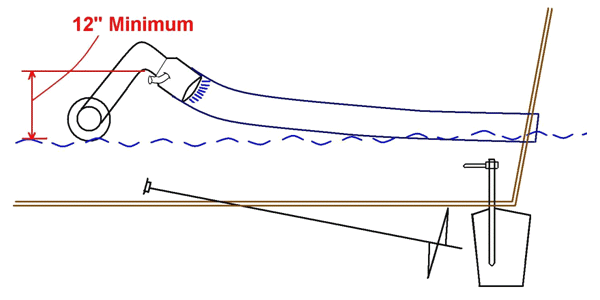
He advocates this:
CARDINAL RULE #1 - Wet Exhaust Height Above LWL REMEMBER this as the SPILL-OVER point
Which will only take a bit of chop slapping the transom to defeat that 12" rise IMHO.

Of course a powerboat is much less likely to be out there with the engine not running and waves attacking it from behind, compared to a sailing yacht.
 
... and, the water already in the muffler?
this backs up what i said earlier about meticulous calculation being key
Calculating what's 'normally' in the system only tells you the 'base load' that the waterlock starts from. That's a good start, but what we want to know is how much that might get added to in rough weather?
 
It's a bit of an exaggeration to say that he's advocating that; he's illustrating what the minimum requirement is in the context of some builders not even meeting that.
He advocates this:
CARDINAL RULE #1 - Wet Exhaust Height Above LWL REMEMBER this as the SPILL-OVER point
Which will only take a bit of chop slapping the transom to defeat that 12" rise IMHO.

Of course a powerboat is much less likely to be out there with the engine not running and waves attacking it from behind, compared to a sailing yacht.
 
He advocates this:
CARDINAL RULE #1 - Wet Exhaust Height Above LWL REMEMBER this as the SPILL-OVER point
Which will only take a bit of chop slapping the transom to defeat that 12" rise IMHO.

Of course a powerboat is much less likely to be out there with the engine not running and waves attacking it from behind, compared to a sailing yacht.

The requirements for a sailing boat and motor boat are similar but not the same, aim of course is similar.

Power boats don't have to contend with a permanent heel! And usually have their engines on at sea, with the exception of generators!

Power boats are usually fitted with transom flaps, these are pretty effective and the 12 inch rise that Tony talks about is a minimum he I and others would usually fit the highest level exhaust riser that will reasonably fit in the space!

I have found yacht builders often get this wrong, even good ones....halberg rassey include some limitations in there owner manuals, 15bdegress of heal for engine or generator running off the top of my head. This is most often a result of a poorly conceived exhaust system and/or the use of the factory elbow, which nearly never is suitable for use unless the engine is mounted above the water line, rarely this is the case in yachts.

I would advocate that a well designed exhaust system should both collect the water present in the exhaust when stopping and be able to resist the ingress of water in normal conditions. In more extreme conditions, the exhaust should be blocked off, a sea cock is a very suitable method for this. The system should also be easily drained. I often fit a hose to the water lock to facilitate this directed to the bilge sump area (shower or sink sumps are also good for this)

These actions keep your main machinery clear of water and guarretee it will be there when you need it.
 
This Marine Engineer reckons he makes a living out of replacing poorly designed exhaust systems and destroyed motors. The article is well worth reading.

Designing a Marine Exhaust System
None of his examples show installations common in (heavy) displacement sailing vessels where injection points invariably are below the WL. I have no doubt that there are some poorly designed exhaust systems out there, but most of what this chap is saying should be common sense and a deal of it is not applicable to sailing vessels, at least not ones with low mounted engines.
I would have thought that a min of 12" for a backflow barrier, be that a riser or goose neck, is ridiculously insufficient.
 
None of his examples show installations common in (heavy) displacement sailing vessels where injection points invariably are below the WL. I have no doubt that there are some poorly designed exhaust systems out there, but most of what this chap is saying should be common sense and a deal of it is not applicable to sailing vessels, at least not ones with low mounted engines.
I would have thought that a min of 12" for a backflow barrier, be that a riser or goose neck, is ridiculously insufficient.

On a sailing boat yes it is, but I think the point is that the injection point where practical should be as high as possible ideally above the transom outlet fitting
 
I have found yacht builders often get this wrong, even good ones....halberg rassey include some limitations in there owner manuals, 15bdegress of heal for engine or generator running off the top of my head. This is most often a result of a poorly conceived exhaust system and/or the use of the factory elbow, which nearly never is suitable for use unless the engine is mounted above the water line, rarely this is the case in yachts.
That is more likely to be down to the machinery manufacturer, they generally specify a maximum heel angle beyond which there may be a lubrication failure due to the sump suction drawing air.
 
When I was designing the exhaust for my yacht I decided not to take the exhaust out through the transom as I thought the volume of water in the exhaust pipe would be too much for any waterlock.

Screenshot 2021-11-14 at 06-59-17 Roberts Mauritius Norfolk 43 Boat Plan Boatbuilding Designs.png
I put the goose-neck in the "engine room" (as high as I could) and took the exhaust out of the side of the yacht. I did a google (image) search on "Roberts Mauritius" yachts and found around 6/10 builders had done the same.

I'm surprised some people are criticizing "12 inch min". Have they got the design of some particular vessel in mind?
 
That is more likely to be down to the machinery manufacturer, they generally specify a maximum heel angle beyond which there may be a lubrication failure due to the sump suction drawing air.

Please go read the manual, this is specifically for water running back to the engine via the exhaust. Regardless of any other limitation
 
I think that our NW gale in port/transom slap was just the last straw and the design was at fault, the water was probably nearly over the top of the riser at rest all the time. Very flat low deck., no muffler, and a boat that sat bow down, big pipe. We relied on the WFA build overseers.
So, it doesn't matter how long or high the system is, what size pipes, at tickover there will be x% gas and y% water, of the total volume of the system, and that needs calculation along with regard to the attitude of the boat at rest or sailing. I suspect most make an educated guess.
Also you often see an exhaust pulsing: burble burble burble sploosh. Shutting down just before or after the sploosh will make a big difference to residual water.
 
When I was designing the exhaust for my yacht I decided not to take the exhaust out through the transom as I thought the volume of water in the exhaust pipe would be too much for any waterlock.

View attachment 125746
I put the goose-neck in the "engine room" (as high as I could) and took the exhaust out of the side of the yacht. I did a google (image) search on "Roberts Mauritius" yachts and found around 6/10 builders had done the same.

I'm surprised some people are criticizing "12 inch min". Have they got the design of some particular vessel in mind?
Above the waterline?
That won't be popular on a pontoon or rafted up, or if the dinghy is alongside.
Below the waterline, look at the 'slamming pressure' a hull panel has to be spec'd for, ITYWF it can be somewhat more than 12" head of water.

The energy in moving water can be converted to potential energy, i.e. height.
Hydraulic ram - Wikipedia

I'm warming to the idea of a flap over my boat's exhaust on the transom....
Our local tea shop has stainless teapots with hinged lids which look the right size....
 
Above the waterline?
That won't be popular on a pontoon or rafted up, or if the dinghy is alongside.
Below the waterline, look at the 'slamming pressure' a hull panel has to be spec'd for, it can be somewhat more than 12" head of water.


Hydraulic ram - Wikipedia

I'm warming to the idea of a flap over my boat's exhaust on the transom....
Our local tea shop has stainless teapots with hinged lids which look the right size....

I'm not at all sure what you are getting at when you start talking about "slamming pressure" and "The energy in moving water can be converted to potential energy, i.e. height.":unsure:

Why don't you buy one of these instead of re-inventing the wheel? :rolleyes:

Screenshot 2021-11-14 at 18-36-12 rubber flap boat exhaust - Google Search.png
 
I'm not at all sure what you are getting at when you start talking about "slamming pressure" and "The energy in moving water can be converted to potential energy, i.e. height.":unsure:

Why don't you buy one of these instead of re-inventing the wheel? :rolleyes:

View attachment 125757
Not seen those rubber flaps in the UK. I'll have a look, thanks.

If you read a bit on hull design, the dynamic loads from wave action can be quite high, in particular that's a concern with the bow slamming into waves. But even small waves impinging anywhere on the hull can be significant pressure at their peak. It doesn't take much pressure or energy to lift some water 12 inches.
 
Top