
jamie N
Well-Known Member
I'm sure that there are, but I can only say about the obvious ones blocking the exhaust from back-flooding.And you don't think there might be other measures in a self righting boat?

I'm sure that there are, but I can only say about the obvious ones blocking the exhaust from back-flooding.And you don't think there might be other measures in a self righting boat?

My contention is that it makes no difference how big the muffler, how long the pipe, it will still contain the same % mix of water and gas, so the system will contain x% water. BUT, it seems very likely that most systems are well over spec in terms of holding water, otherwise there would be more incidents and we would be relating many more experiences of flooded engines.
Both wet exhausts I had were just a swan neck with water injection bend, and a 3m or so hose, in a gentle catenary down and up to the outlet, which was not much lower than the swan neck. I remember being aware of a possible problem when my crew shut the engine down when were loaded and I yelled at him to start it again quick, and no problem. That boat is still fishing and I have spoken to successive owners who have had no trouble. The other one had the slap up flooding, but so did other boats the same night. Its outlet was very high off the water at rest, but the boat sat head down. A flap would have saved it, £8k.
And you don't think there might be other measures in a self righting boat?
I'm sure that there are, but I can only say about the obvious ones blocking the exhaust from back-flooding.

Yes, but it took twenty years to happen. A bad design that clung on until circs got the better of it.I agree with you, except for the last part. There is a high likelihood that that vessel would have had problems anyway, flap or not. It was an expensive lesson....
Yes, but it took twenty years to happen. A bad design that clung on until circs got the better of it.
This thread has certainly raised my awareness about how a boat's exhaust might be vulnerable in less obvious ways....
As I said in one of my first posts, I've seen more damage from bad winterisation and boats being lifted incorrectly than I have from damage at sea. I'd be more worried in my boatyard than I would sailing around this island....


An anecdote from the other side - a marine engineer.
I've replaced more engines that have had water ingress from being lifted incorrectly (stern too high) in the boatyard than I have from water ingress from a following sea. I've also replaced more from blocked exhausts (rags, valves, buckets, hose collapse) than from a following sea.
My view as a sailor is that if I am ever in the situation where I am preparing to deploy a drogue, I don't think I want to be worrying about a gate valve at the exhaust outlet. From an engineering and sailing perspective this just sounds like a solution looking for a problem where one already exists - a properly designed and installed exhaust system, with a suitable rise above the transom and waterlock adequately sized near the engine is not rocket science and is common ground for any engineer worth their salt.
If you happen to be in seas that are so great that water can force itself past that lot, then come and look me up as I'll buy all the beers whilst you tell me that story - it will be epic.. ?
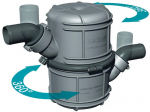
As a coincidence, earlier today for an unrelated reason, I was looking into the engine bay of a chum's boat where the water block was (I believe) upside down. The water block has 2 pipes at it, the exhaust into it, and the exhaust out of it, through a hose and out of the back of the boat. The pipe to the back of the boat was at the top, with the pipe into the water block from the engine, at the bottom.
Is that the right way or the wrong way?
A beer rests on this, so it's important.
I think that I owe him a beer....
View attachment 125942


I recently lost a fully serviceable Volvo 2030 to water ingress whilst out of the water for an annual engine service and powerhose. This boat, a Westerly, has a wet exhaust. The engineers suggested the fault could lie in incorrect lifting, but how could this possibly pitch the boat more than when it tumbles over a wave or wash from a ship?
Could excessively forceful power-hosing drive water into the engine?
Surely a wet exhaust is always more vulnerable than occasional waves crashing into a transom exhaust, but with no problems for 20 years it is obviously a system that works.

If you're going to go below and turn off the inlet, might you just as well open a muffler (low point) drain, after shutdown? That won't cause too much grief if it gets forgotten, for not too long anyway.Moody sailor,
thanks for such a comprehensive and clear response, I appreciate your time.
hopefully a quick question: would turning off the raw water inlet say a minute before stopping the engine also clear the exhaust? Or would you say this is a high risk strategy?
A bad idea as the rubber hose will begin to overheat very quickly once the water stops, even a minute could cause damage and cumulatively over a season likely delaminate and block the exhaust.Moody sailor,
thanks for such a comprehensive and clear response, I appreciate your time.
hopefully a quick question: would turning off the raw water inlet say a minute before stopping the engine also clear the exhaust? Or would you say this is a high risk strategy?