Escape hatches on cats

lustyd

Well-Known Member
Joined
27 Jul 2010
Messages
15,128
Visit site
This is something I’ve long been sceptical of. I’ve never seen a problem exiting through existing hatches or companionway. You’ll get wet either way as the boat is upside down.
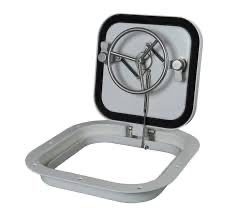
Watching Delos tonight it finally dawned on me, if you open those escape hatches surely the boat immediately sinks? The interior air is your buoyancy so isn’t this a stupid idea?

What did I miss?
 
Surely a hatch between the hulls when opened would just result in the boat settling a bit lower in the water as the hulls would still retain buoyancy unless there were through hull fittings open in each hull!
 
I’ve never seen a problem exiting through existing hatches or companionway. You’ll get wet either way as the boat is upside down.

It would be very difficult to open a conventional hinged deck hatch if it were at any depth when inverted.

Many cats have sliding doors etc. rather than a conventional companionway hatch, and these would be submerged deeper than the deck hatches. Heaven knows how easy or difficult it would to open these when inverted (door catches might be misaligned, etc.).

Surely a hatch between the hulls when opened would just result in the boat settling a bit lower in the water as the hulls would still retain buoyancy unless there were through hull fittings open in each hull!

A friend's Fontaine Pajot 38' (Athena?) had that, I believe. There were clear hatches in the shower/toilet compartment in each hull, facing inwards.

(Without curtains it did mean you could see the person in the equivalent compartment in the other hull! :eek: )
 
It would be very difficult to open a conventional hinged deck hatch if it were at any depth when inverted.

Many cats have sliding doors etc. rather than a conventional companionway hatch, and these would be submerged deeper than the deck hatches. Heaven knows how easy or difficult it would to open these when inverted (door catches might be misaligned, etc.).


A friend's Fontaine Pajot 38' (Athena?) had that, I believe. There were clear hatches in the shower/toilet compartment in each hull, facing inwards.

(Without curtains it did mean you could see the person in the equivalent compartment in the other hull! :eek: )
They are offset.
 
Still a terrible idea though - almost all leak and every serious offshore cat sailor I know has or has planned to fill them in. Most builders and designers hate them, but they are legally mandated by experts who really really do know what they are talking about (is there a sarcasm emoji?) so they have no choice.

I work on cats all the time and have yet to see one with any age without telltale signs of leakage.

Thankfully my own older boat doesn't have anything of the sort and will float right way up or upside down
 
Catamarans like monohulls come in a wide variety of designs. Some such as the Class 50 shown capsized in Frogmans post weigh around 3.5 t and have substantial buoyancy built into the design, others without buoyancy, not uncommon would settle so low as to be useless for survival once the escape hatch is opened. As with all sailing it's up to the
skipper to assess the risk/reward profile.
I have owned a 40 cat with escape hatches for 25 years and they have never leaked, it can be done.
 
Still a terrible idea though - almost all leak and every serious offshore cat sailor I know has or has planned to fill them in. Most builders and designers hate them, but they are legally mandated by experts who really really do know what they are talking about (is there a sarcasm emoji?) so they have no choice.
Mine doesn't leak, but then Danish tris seem to be a bit better built than bendy creaky floppy French cats with their bulkheads made out of cheese on toast. Main bulkhead on a DF35 is 80mm thick. On a Lagoon 450 12mm of wheat based comestible.
 
There's a fair lot of 'previous' with Danish boats coming and going Up Some Hebridean Loch - for several hundred years, if my school-larnin' is right.
And they were robust enough to be hauled on greased logs across some narrow isthmus or two, then back again with the booty.

Again, if memory serves, when the Recreational Craft Directive was first being negotiated, I was 'a fly on the wall' at several of the UK's 'managed' public consultations. It emerged that the lobbying power of the French multihull builders ensured that 'viable means of escape' from entrapment was bolted into the Directive. The builders of larger ( French ) catamarans had no cost-penalty with this, for they provided hatches in their hulls anyway. Builders of smaller catamarans had to face costly redesigns to their molds.

The term 'escape hatch' was much bandied about. I determined - by asking manufacturers - that NO hatch on the market had been designed for 'viable means of escape' and NONE had been constructed/tested against the forces likely to be encountered in the positions where fitted in most existing multihulls.
Hence, much use of sealing compounds and gaffer tape on boats that existed around then.

Designer Richard Woods became involved a couple of years later ( much to the chagrin of his rival James Wharram ) on some sort of consultative committee, with a remit to improve the Essential Requirements here and there. I'm uncertain that much was achieved - except, perhaps, some welcome travelling expenses i.r.o. meetings and consultations.

The RYA, for its part, came away from the public consultations well pleased it had secured a role as a 'Notified Body' - which carried the prospect of another useful income stream.
 
Mine doesn't leak, but then Danish tris seem to be a bit better built than bendy creaky floppy French cats with their bulkheads made out of cheese on toast. Main bulkhead on a DF35 is 80mm thick. On a Lagoon 450 12mm of wheat based comestible.
Same here. Our 920 main bulkhead is a lot more than 12mm though you probably know more tuan me about how thick. Structural stiffness has many benefits, one of which is that your rigid hatches aren’t trying to seal against a moving mount.
 
Mine doesn't leak, but then Danish tris seem to be a bit better built than bendy creaky floppy French cats with their bulkheads made out of cheese on toast. Main bulkhead on a DF35 is 80mm thick. On a Lagoon 450 12mm of wheat based comestible.
I think you’ll find that the bulkheads are made of croque Monsieur.
 
Same here. Our 920 main bulkhead is a lot more than 12mm though you probably know more tuan me about how thick. Structural stiffness has many benefits, one of which is that your rigid hatches aren’t trying to seal against a moving mount.
Dragonflys are so beautifully engineered. Yes, they are expensive boats, but you can see where the money has gone.
 
Top