Enough solar for a modern laptop

lustyd

Well-Known Member
Joined
27 Jul 2010
Messages
14,333
Visit site
Hi all I'm considering how to power my modern laptop (Surface Laptop 3, i7) on the boat without too much impact on the boat. It can be powered through a 12v USB-C charger, lenovo make a decent looking 68W one which is definitely overkill for my laptop which probably uses less than 20W average so I'm thinking around 2A draw? Planning for 10 hours usage a day so wondering how small a panel(s) I can get away with? Also thinking it might be useful to fit a very small leisure battery to get this separated from the domestic bank - I'd prefer the laptop dies alone rather than losing everything!
 
You need to verify that draw for your actual use and charger. One option would be to plug in to the charger from a fully charged battery, use for 10 hours and measure the power required. If short of time then maybe an hour and multiply.

Assuming your 2 A is average, then you need 20Ah average daily input. Typically an 80W solar panel will put that out during the summer months but that will fall dramatically over the winter.
 
I use a small inverter that I plug into a "cigar lighter" socket. Recently "upgraded my laptop" to something that I can run for eight hours on battery and never use it underway.
 
Thanks Jac that's what I was afraid of as 80W is still pretty big and won't easily fit in with things on board. I guess at 20Ah that gives me a couple of charges away from the shore straight from the domestic bank but maybe I'll need to look into a generator for longer periods untethered to be on the safe side. The laptop will easily do a day on its own so changing nothing I'd get a very long weekend, and a smaller panel might bump that up to a working week before having to plug back in.
From an efficiency perspective is it better to use the laptop unplugged and then recharge while it's off, or keep it topped up and run from the boat power?
 
Get one of these and do as Jac said, run it for a few hours in-situ to find out it's power draw.

Then use this site here to work out how much solar you need ...

https://www.victronenergy.com/mppt-calculator

E.g. If you think your device is 20W and you want to use it for 10 hours a day then you need 20 X 10 / 1000 = 0.2kWh reliably from your solar.

In Portsmouth UK from the calculator that would be possible from a 100W panel with a MPPT controller over the summer season.
 
I have a 2018 MacBook Air, before that I had a 12" MacBook, both of which I've run exclusively off 12v batteries.

These MacBooks both ship from the factory with mains chargers rated at 65W or thereabouts, but in my experience the devices draw closer to 15W in ordinary use. I say this because I have 15W and 27W Belkin power adaptors which I run my MacBook off and it'll stay at 100% charge all day using the 15W one. The only exception to this has been during a CPU-intensive task once (was it Photoshop or video encoding?) where it stayed at 85% to 95% charge for hours, also using the 15W charger.

I wrote a lot more before deleting it, as I doubt that you'll get very useful answers without addressing these questions:
  • When you say "house bank", do you mean you have a separate starter battery?
  • What capacity is your house bank?
  • What kind of battery is your house bank? Lead-acid, AGM or lithium?
  • What are your goals in terms of time spent at anchor and in marinas, vs energy independence?
  • Budget?

If you're just anchoring for a day or two at a time then a full charge at a marina will probably be enough to ensure you don't actually need solar. I can manage a week at anchor from a full charge - I have 330AH of house batteries. If you have a fridge then its consumption will dwarf the laptop's - I often find myself turning the fridge off to try and keep the batteries' voltage higher. I also have 4 of these powerbanks that I employ in this juggling cascade.

I think there is probably a huge difference in cost between being completely energy independent and being able to live at anchor for a week. In the former case you have huge battery banks and an ugly solar arch, maybe a hydro-generator on the back of your boat; in the latter case you just go to a marina for a night, spend £20 or so on berthing, have a shower and do some laundry, and leave the next day with house bank fully charged.

I'd ideally like to replace my AGM batteries with lithium, perhaps slightly larger, which would give me multiples more battery capacity. It's quite a big job however, will probably cost £2000 or more and I haven't figured it all out yet. It seems to me that even this would not negate my need for mains charging so this week I've been thinking that I might have to buy a generator.

IMO it's best to think of your batteries like your water tanks - there is a rate at which you drain them, a rate at which you replenish them, and their capacity forms a third leg of the equation.
 
Thanks that's a useful calculator and definitely confirms solar isn't going to be sufficient on its own without some pretty big changes to the boat so it's either going to be more trips in to recharge or a small genny
 
KompetentKrew very useful thanks. I'd forgotten about the fridge in all of this! Ultimately I agree with your conclusion that I'll need to visit the shore every few days or accept a genny. I'd also curiously forgotten about laundry so I guess you're right that I'm realistically only aiming for a week at a time maximum. I have a home berth anyway so can return there easily enough and just pay for a few nights away now and then, which I'll likely do anyway. All of this is just to extend cruising time by working aboard to maximise holiday allowances.
 
I absolutely murdered my batteries working from the boat for a week at anchor with 150W, practically going to need 500 or so which was enough for much of the year in the last one.
 
KompetentKrew very useful thanks. I'd forgotten about the fridge in all of this! Ultimately I agree with your conclusion that I'll need to visit the shore every few days or accept a genny. I'd also curiously forgotten about laundry so I guess you're right that I'm realistically only aiming for a week at a time maximum. I have a home berth anyway so can return there easily enough and just pay for a few nights away now and then, which I'll likely do anyway. All of this is just to extend cruising time by working aboard to maximise holiday allowances.

You have a fridge? ... I looked at your avatar and thought it was a 25 footer or so, but your signature says a Sun Odyssey 36.2 ..... that's a completely different kettle of fish.

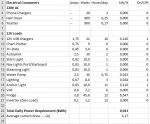
Here's an example power calculation taken from my Bav 36 with a 21W USB charger running 10 hours a day ...

1601393236303.png

My guess is your boat will be similar - the fridge is the monster (12h running assumes a 50% duty ratio on the compressor - it's "on" 24/7).

To get a reliable 0,913kWh ... you're looking at around 600W for this time of year in Portsmouth IMO.
 
Haha yes I have a fridge on the new boat (Sun Odyssey 36.2) the avatar is my old boat, a Vivacity 20 which didn't even have a heads on board :) I think mine will be very similar to your example, although I don't have a toaster on the new boat (did on the old one!)
 
Fitting solar charging to your boat to my mind must prioritize the location and mount for the solar panels. This will dictate the size so wattage of the panels. I think the actual cost of the panels somewhat less of a consideration. So go for the most you can fit. That will then reflect back to just how much use you can get from fridge and or lap top considering the season and weather. As for batteries I think the traditional engine start and service battery arrangement is still the best. The size of the service battery reflecting your needs in practice. So fit the biggest solar your can reasonably fit on the boat. Then fit and monitor the voltage of the service battery to determine when you need to either start engine and recharge, go to shore power or start a generator. You seem to want an estimate but in fact your real time experience will be what matters. ol'will
 
Thanks that's a useful calculator and definitely confirms solar isn't going to be sufficient on its own without some pretty big changes to the boat so it's either going to be more trips in to recharge or a small genny
Are you wedded to that laptop and if not, is there a specific task it must do?
I have two "laptops" one that has a 17inch monitor, a fan like a jet engine and a battery like a leaky sieve. And a chromebook that can run pretty much most things I really need (I believe some are even running windows these days, mine runs linux and then wine through that) - battery 10-12hrs. Charged from USB-C. ... may be cheaper to buy a lower power laptop than keep adding solar panels!
 
Are you wedded to that laptop and if not, is there a specific task it must do?
I have two "laptops" one that has a 17inch monitor, a fan like a jet engine and a battery like a leaky sieve. And a chromebook that can run pretty much most things I really need (I believe some are even running windows these days, mine runs linux and then wine through that) - battery 10-12hrs. Charged from USB-C. ... may be cheaper to buy a lower power laptop than keep adding solar panels!
Yes, it's my work laptop and the task it does is my job :ROFLMAO:

Contrary to popular belief Linux isn't better on battery than Windows, but yes I do have full freedom in my device and chose the Surface Laptop 3 as it's a really great device that's lightweight and efficient with a pen enabled touchscreen. Chromebooks will run almost none of the things I need for my job, but even so they don't actually have better battery life or smaller batteries (45Wh here and runs all day, also charged via USB-C if I choose to) otherwise I'd use my free account on a very large cloud to host a VM and connect remotely. This uses more local power, not less, due to the constant network traffic. Working locally is extremely power efficient these days, at least until I hit the go button. The problem here is keeping any device running for extended periods offshore, and changing device won't do that since all devices need charging. I could get a device with a bigger battery that lasts two days, but if that device uses twice the power to charge back up then nothing really changes, I still take the same power per day.
 
I built ... well specced, bought and installed ... a solar solution on my boat 2 years ago. This is the process I used and it worked very well for me.

First, work out what your actual requirements are ... mine were

I wanted to be generator and engine free at anchor for days on end under normal weather conditions - the goal.
I wanted to run the fridge 24/7 - this was the primary requirement after having the fridge destroy previous under-sized batteries.
I wanted to be able to survive 3 days at anchor (effectively little or no sunshine) without going below 50% battery capacity.
I only needed the system during my sailing season - May to September. Not full time live-aboard.
I wanted the system to be transparent, with the best monitoring I could find - this steered me towards Victron components.

First step was to understand all the electrical loads, list them all in a spreadsheet and where they were difficult to estimate - like a fridge - then spending €14 on a wattmeter was money well spent. I connected it in series with the device to be tested and used as normal for a few days. Then the daily energy usage can be worked out quite accurately.

From the daily energy measurements on my boat, I used approx. 0,75kWh every day. However, if sailing and using the autopilot, instruments etc. my energy usage can be around 1kWh ... so this needs to be taken into account too.

0,75kWh (a day at anchor) is 62Ah @ 12V ... so my 3 days without solar equates to 186Ah ... as that needs to be approx 50% of my battery capacity, my bank size came out at 370Ah. 2 x 185Ah Sealed Lead Acid batteries (C20).

Having decided on the battery bank size, I needed somewhere between 0,75kWh and 1kWh from the solar system to cover my daily needs.

Without building an arch on the transom, the bimini top was the only available large flat area on the boat - so that was where the solar was going to go. I read a lot about solar, positioning, efficiency, shading, etc. I did a whole load of calculations using NASA data, efficiency, but there is a much better calculator on the Victron Website which matches my 2 year solar yield experience almost exactly.

I took 1kWh as a ballpark and my sailing season is late April to end of September - location is Northern Croatia - the calculations said 300W would be enough. With 300W, the calculator shows 1kWh yield or more from end of April to end of September.

I bought 3 x 100W flexible solar panels and installed them on the bimini.

My measured yield from the 300W is usually between 0.8-1 kWh ... highest recorded is approx 1,6kWh. Importantly, the yield depends on the load, so if there is sunshine, but the batteries are full, and there is nothing currently running, then the system is effectively idle, providing only the float current - so the yield is lower than it could be - the system has a bit in reserve.

How do I know it has all worked?

I've done 2 seasons now with a fridge running 24/7 and the batteries are still healthy, still accepting charge and discharging as expected ... there have been no flat battery incidents and from a functional perspective it is working better than I had hoped. I haven't used my generator to charge the batteries at all.

I still did a lot of monitoring and calculations to determine what was actually going on - just to double check.

The battery monitor shows my overnight battery usage as -32Ah. Max and min battery voltages during the day are 12.6V min and 14.25V max ... so the voltages measured pretty much tie up with the SOC of a sealed lead acid battery bank ... I use approx 10% of my battery capacity overnight so the battery bank cycles between 90% and 100% under normal conditions. The lowest I have seen indicated is 87%. This is pretty healthy for the batteries.

Battery monitors can be deceptive if not synchronised regularly and if the correct parameters aren't used - so I checked voltages and charging currents to determine if the batteries really were being fully charged. I had to adjust some of the parameters in the battery monitor to stop it jumping to 100% too soon.

My experience is that the 300W array is perfectly adequate to cover energy use during daylight and simultaneously replace the previous nights usage - I'm on float consistently by around 12:00 - 13:00 each day ..... I can watch my MPPT charger go through Bulk, Absorption, Float every day .... it spends most of the afternoon cycling between Absorption and Float dependent on the activity of the various loads.

300W solar and 370Ah of batteries has worked very well for me - the boat is a typical AWB in the Med, with a daily energy requirement of around 0,75kWh, fridge is an air-cooled Danfoss operating all the time - lights are all LED, I charge multiple Tablets/Phones, have an LED anchor light.

Perhaps this experience will be of use to others.
 
I had to be a little creative in placement, but have managed to find room for 3x40W panels on my 23 footer. None of them are free of shadow the whole day, but not a bad compromise without modifying the boat in any significant way. Even so, an average of 100Wh is the best I can expect in a U.K. December.
 
Top