
Engineers vice

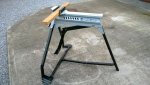
I have a "Elu Superjaws" ... brilliant bit of kit. Built all sorts of things from sheds and cupboards to houses with those, woudl not be without them.
$_86.JPG

I have 4", 6" and 8" Record vices on various benches .. and a small 4" vice I can clamp into the "Superjaws" when needed.
 
I have a "Elu Superjaws" ... brilliant bit of kit. Built all sorts of things from sheds and cupboards to houses with those, woudl not be without them.

View attachment 75895

I have 4", 6" and 8" Record vices on various benches .. and a small 4" vice I can clamp into the "Superjaws" when needed.

Interesting. I have been thinking of buying a similar thing (a Triton Superjaws XXL) to take to the boat instead of my B&D Workmate on the grounds that it would be easier to find room for it in the car. The Workmate takes up a lot of space.
 
One advantage of the workmate is that you can stand on it. I bought it when I built my last house nearly 40 yrs ago. Clever bit of design wouldn't be without it. I like the way it can hold tapered objects and pipes too.
Interesting. I have been thinking of buying a similar thing (a Triton Superjaws XXL) to take to the boat instead of my B&D Workmate on the grounds that it would be easier to find room for it in the car. The Workmate takes up a lot of space.
 
The vice needs to go right on the edge of the bench so that vertical pieces can pass down to the floor. The fixed rear jaw needs to be in line with the edge of the worktop face.This gives extra support to long pieces in the vice & helps support the vice from moving if something is pulling down & outwards.
A worktop of plain chipboard will always flex if not supported and at some time you may want to rivet something. Perhaps bend a piece if steel.
You do not describe the construction of the bench so one has to assume ( & we all know the definition of assumption)
I would suggest edging the underside of the chipboard along its full length with a piece of 100*50 or 75 * 50 screwed & glued & also fixed to the uprights of the worktop
Then bolt through that
This spreads the load better than just thickening the local area & stops that awful vibration one gets when hammering on the vice or drilling something at an angle
 
I've already published a screenshot of my 'bench'. Here's another one, two sections high. The chipboard is supported along all sides by a rigid angle section and the vice will be fitted on the left-hand corner as you suggest. Further edging won't be provided but I will reinforce the bench top with some marine ply which is 12mm but I may double it up. (The ply is a remnant from a previous job). My main problem ATM is finding my 12mm drill bits(no suggestions for storage systems please). I'll use large washers under the nuts as well.
The vice needs to go right on the edge of the bench so that vertical pieces can pass down to the floor. The fixed rear jaw needs to be in line with the edge of the worktop face.This gives extra support to long pieces in the vice & helps support the vice from moving if something is pulling down & outwards.
A worktop of plain chipboard will always flex if not supported and at some time you may want to rivet something. Perhaps bend a piece if steel.
You do not describe the construction of the bench so one has to assume ( & we all know the definition of assumption)
I would suggest edging the underside of the chipboard along its full length with a piece of 100*50 or 75 * 50 screwed & glued & also fixed to the uprights of the worktop
Then bolt through that
This spreads the load better than just thickening the local area & stops that awful vibration one gets when hammering on the vice or drilling something at an angle
 
https://photos.app.goo.gl/Lk6kgViRpXWSUsse9 QUOTE=ghostlymoron;6700683]I've already published a screenshot of my 'bench'. Here's another one, two sections high. The chipboard is supported along all sides by a rigid angle section and the vice will be fitted on the left-hand corner as you suggest. Further edging won't be provided but I will reinforce the bench top with some marine ply which is 12mm but I may double it up. (The ply is a remnant from a previous job). My main problem ATM is finding my 12mm drill bits(no suggestions for storage systems please). I'll use large washers under the nuts as well.[/QUOTE]
 
Interesting. I have been thinking of buying a similar thing (a Triton Superjaws XXL) to take to the boat instead of my B&D Workmate on the grounds that it would be easier to find room for it in the car. The Workmate takes up a lot of space.

I've had both, the jaws are a significant improvement over a workmate, of which I have had several. They are foot operated/knee release, so you don't need another set of hands to clamp stuff, and have significantly more holding power.

Get an older Elu or DeWalt set, with the bracing between the legs, you will not be disappointed. One of the best tools I ever bought.
 
I've had both, the jaws are a significant improvement over a workmate, of which I have had several. They are foot operated/knee release, so you don't need another set of hands to clamp stuff, and have significantly more holding power.

Get an older Elu or DeWalt set, with the bracing between the legs, you will not be disappointed. One of the best tools I ever bought.

Thanks for your advice.
 
I've now fitted the beast and it's a formidable piece of kit. Much stronger than my bench. On cleaning it up I was able to read the makers name etc. It's a Parkinson model F No 6 Perfect Vise. Apparently Mr Parkinson invented the QR vice in 1884. Mine's not that old about 1940s I'd say. It belonged to my mates dad who obviously gave it a serious amount of Welly. The design was later taken up by Record and other manufacturers. Parkinson's are no longer in business. They were based in Shipley near Bradford where I was a student.
 
Interesting. I have been thinking of buying a similar thing (a Triton Superjaws XXL) to take to the boat instead of my B&D Workmate on the grounds that it would be easier to find room for it in the car. The Workmate takes up a lot of space.
I've had both, the jaws are a significant improvement over a workmate, of which I have had several. They are foot operated/knee release, so you don't need another set of hands to clamp stuff, and have significantly more holding power.

Get an older Elu or DeWalt set, with the bracing between the legs, you will not be disappointed. One of the best tools I ever bought.
I wasn't able to get the models you suggested but I bought the Triton Superjaws XXL at a special offer price.

It is very useful and I like the quick clamp/unclamp using the pedal. The working height is greater than that of the Workmate which is a good feature if you're tall as it helps reduce backache, although it is so bloody heavy you're likely to get backache lifting it around!
 
I saw a useful tip on youtube recently for those who don't have soft jaws for holding timber and other delicate stuff. Make a pair of jaws out of some solid timber - hard or soft, depending on what you'll be doing with them and drill one side of each to take 2 or 3 little button magnets. The magnets will hold the jaws in place as you tighten up and the timber won't damage your work
 
I saw a useful tip on youtube recently for those who don't have soft jaws for holding timber and other delicate stuff. Make a pair of jaws out of some solid timber - hard or soft, depending on what you'll be doing with them and drill one side of each to take 2 or 3 little button magnets. The magnets will hold the jaws in place as you tighten up and the timber won't damage your work

Good tip :encouragement:
 
Top