Engine question

thealoi

Member
Joined
18 Nov 2010
Messages
25
Visit site
I am no expert on diesel engines, despite atttending an RYA course. I have a problem with my Volvo MD2030, which relates to sea water getting into the cylinder head. My engineers tell me that this is because the height difference between the exhaust and outlet is too little, despite using a Vetus water trap, anti-syphon valve etc...

What I don't understand is why the sea water is injected into the exhaust? On a car, this doesn't happen, but the exhaust is of course made of steel. Is it a temperature thing? Would the engine work if the sea water was ejected separately from the exhaust gases?

Any experts out there, please advise.
 
It is an answer to two exhaust questions
1 it allows a flexible rubber hose to be used by cooling the exhaust with the water
2 it provides a degree of silencing

Yes you could have separate exhaust and water systems and many installations do but combined is usually the most convenient

You would normally have to either cool or insulate the exhaust in any case

As an aside I would suggest that any course that did not explore exhaust systems was not fit for purpose
 
Last edited:
You can have a dry exhaust, yes. However, you have to build the whole thing out of steel (preferably stainless or it will quickly rust away), you have to carefully mount and lag it with glass cloth to prevent it burning any nearby wood or GRP inside your boat, and you have to have it exit well above the waterline and yet not blow exhaust fumes in your face. This means it's not really practical to fit such an exhaust in the bowels of the average boat, it really has to be designed in, often as a vertical funnel running to above head height. Easy enough to incorporate on fishing boats and "trawler style" motor cruisers but not most sailing boats. Dry exhausts are also often very noisy.

By comparison, a lukewarm rubber hose is a lot more civilised inside a boat!

Pete
 
And to add to prv's post, modern yacht engine practice is to have flexible mountings for quietness. Dry exhausts cannot be fitted easily where there is a lot of movement. Wound metal hose that is used for exhaust pipes has limited flexibility and will break quite frequently, releasing hazardous fumes into the boat.

Is the OP aware of the exhaust risers for Volvo engines? These are intended to prevent the problem that he seems to be having.
 
I have a problem with my Volvo MD2030, which relates to sea water getting into the cylinder head. My engineers tell me that this is because the height difference between the exhaust and outlet is too little, despite using a Vetus water trap, anti-syphon valve etc...

Then your 'engineers', if they were any good (or even had a passing familiarity with yacht engines), should have suggested a high-rise exhaust bend, as per Vyv's post. To be honest it beggars belief that they wouldn't do so.
 
And to add to prv's post, modern yacht engine practice is to have flexible mountings for quietness. Dry exhausts cannot be fitted easily where there is a lot of movement. Wound metal hose that is used for exhaust pipes has limited flexibility and will break quite frequently, releasing hazardous fumes into the boat.

Is the OP aware of the exhaust risers for Volvo engines? These are intended to prevent the problem that he seems to be having.
Every car we have had since grandpa's Model T has had flexible engine mounts, as does my BMW. They all had metal exhausts so does the trawler yacht at the end of our pontoon so I'm afraid I don't see your point.
 
Every car we have had since grandpa's Model T has had flexible engine mounts, as does my BMW. They all had metal exhausts so does the trawler yacht at the end of our pontoon so I'm afraid I don't see your point.

There's flexible and then there is flexible. My Bukh had theoretically flexible mounts that were not far removed from rigid, whereas my Yanmar shakes like a mad thing. If you look beneath your car you will find that the exhaust pipe hangs on flexible mounts that that match those of the engine, which are considerably less flexible than those on modern yacht engines. Many cars used to have vibration dampers between the cylinder head and a bulkhead to limit movement. It is done somewhat more cleverly today but I think if you compare the force needed to displace your car engine with that of your boat you will notice a considerable difference. I used to help look after a rescue boat that had a metal exhaust - I used to braze it back together regularly after the engine movement caused it to fracture.

I suggest you try displacing your car engine
 
I have a problem with my Volvo MD2030, which relates to sea water getting into the cylinder head. My engineers tell me that this is because the height difference between the exhaust and outlet is too little, despite using a Vetus water trap, anti-syphon valve etc...

I'm no engineer (and I'd welcome any corrections), but having been researching related issues -

In addition to the water trap and anti-syphon valve, you need the exhaust to rise well above the water line (min 300mm or 350mm according to Vetus and other sources) between the water trap and the exhaust through-hull outlet. I think this is probably what your engineers mean.

The purpose of this rise well above sea level is to stop waves or swell pushing (sea)water backwards up the system into the engine. To achieve this rise either the flexible exhaust pipe must go up above this level (often in a loop because of space) or a 'swan neck' fitting is installed just before the hull outlet.

The purpose of the water trap is (largely) to hold below engine level all the water between the engine and the highest point of the exhaust run when it falls back down when the engine is stopped.

The purpose of the anti-syphon valve is to stop the engine cooling water continuing to flow into that area when the engine is stopped.

It is intersting to note that you don't need any of the above when the engine is running - it's only to protect it when it's stopped. However, while the engine is running you would want some silencing. The water trap does this as a side effect to its main, protective purpose, and you may or may not also have an additional silencer.

There is a useful diagram in the Vetus on-line catalogue, page 72. I'm not sure if this link will work, but try http://viewer.zmags.com/publication/d43ec278#/d43ec278/72
 
Last edited:
In addition to the water trap and anti-syphon valve, you need the exhaust to rise well above the water line (min 300mm or 350mm according to Vetus and other sources) between the water trap and the exhaust through-hull outlet. I think this is probably what the engineers mean.

I have no problem with what you have written but no, that is not what I mean. It seems the OP's problem is a common one, the solution to which is to add a riser between the cylinder head and the manifold, raising the latter by about 3 inches. There is one shown in the drawing at the bottom of this page, it's the cube separated by two gaskets. http://coxengineering.sharepoint.com/Pages/Calorifier.aspx
 
Many thanks for everyone's input. What is fascinating, is that you have covered the topic very thoroughly.

Mine was the first vessel of its type to be fitted with Volvo engines (in South Africa), and the engineers think that they miscalculated the amount of seawater which would be left in the pipes when the engine was switched off. The water trap has a 5 litre capacity, half of which is on the engine side, and half on the exhaust side. i.e. it can only accept about 2.5 litres of water flowing back. I do have a high rise exhaust bend which meets the criteria set out by Vetus, but I get the impression that this is not the primary problem. Whilst a dry exhaust would work, it seems these are best planned from the outset, and not retrofitted to a yacht.

The best solution seems to be to fit a 17 litre capacity water trap, complete with rubber flap valve, which should stop any sea water getting into the exhaust manifold. Am now waiting patiently for Vetus to send it direct from Holland, which will take at least 3 days here in Sardinia.

Once again, many thanks for everyone's very helpful comments.
 
We had two times water on the pistons. Our engine ( Perkins 4108 M ) works well below the waterline and the freeboard of the boat is not high enough to make a vertical swan neck. We have a water trap but if sailing for many hours over the port side, the exhaust who is then under water ( Low freeboard ) will lead water into the engine. The air trapped into the engine and water trap will prevent water from entering if the tack is not to long but eventually small leaks in the engine will allow water to enter.
Freeboard is just 2 feet and if heeled is zero. ( Scary sailing if new to the boat )
What I did is creating a horizontal swan neck. The thick exhaust hose goes from the water trap all the way to the starboard deck-hull underside, then takes a turn along the hull to the other side, then to the exhaust opening.
Now, sailing heeled, the water should go up to the high side, so a swans neck is created.
The hose is very long, guess 7 yards, bad for the efficiency of the engine, but we have horsepower in excess and it makes the exhaust extra silent.
No more water on the pistons since installing the horizontal ( dead ) swans neck.
 
The water trap has a 5 litre capacity, half of which is on the engine side, and half on the exhaust side. i.e. it can only accept about 2.5 litres of water flowing back.

Unless you have an unusual installation, with a siphon break very little of the water falling into the trap comes from the engine side of the trap. If say, 50mm hose and 0.5m to injection point, that's just under one litre if it was completely full, which it wouldn't be. Add a negligible amount for the much narrower outflow side of the break, and you're still talking of maybe 1.2litres. As I'm sure you discovered, Vetus suggest calculating on the basis of the exhaust contents being 25% water, with a 2 times margin of safety, giving 50% as the working factor.

Incidentally, are you talking about the cylindrical water trap/muffler or some other sort? I'm pretty sure the cylindrical one can happily 'aggregate' the water falling into it from either direction. That said, and although you give no idea (I think) of the size of your engine, I quite agree that a larger water trap is no bad thing.
 
thealoi;4346184...... My engineers tell me that this is because the height difference between the exhaust and outlet is too little said:
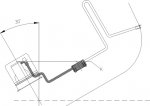
It could also be that the waterlock is not "inline" with the engine. We have had this problem on our genny installation. If the waterlock is slightly offset then on one tack it won't take much heal before the outlet of the waterlock is at the same height as the exhaust outlets of the engine.

See this diagram from Fischer Panda - 1000mm offset from the engine and at an angle of 30 degrees water will enter the engine:

heal 30 deg.jpg
 
Many thanks for everyone's input. What is fascinating, is that you have covered the topic very thoroughly.

Mine was the first vessel of its type to be fitted with Volvo engines (in South Africa), and the engineers think that they miscalculated the amount of seawater which would be left in the pipes when the engine was switched off. The water trap has a 5 litre capacity, half of which is on the engine side, and half on the exhaust side. i.e. it can only accept about 2.5 litres of water flowing back. I do have a high rise exhaust bend which meets the criteria set out by Vetus, but I get the impression that this is not the primary problem. Whilst a dry exhaust would work, it seems these are best planned from the outset, and not retrofitted to a yacht.

The best solution seems to be to fit a 17 litre capacity water trap, complete with rubber flap valve, which should stop any sea water getting into the exhaust manifold. Am now waiting patiently for Vetus to send it direct from Holland, which will take at least 3 days here in Sardinia.

Once again, many thanks for everyone's very helpful comments.
Not sure that type is necessary, and suspect it will not fit your exhaust without modification as it is for pipes 60mm and above and I think yours is 50mm. The normal 5 litre trap is usually big enough unless you have an exceptionally long hose run between the trap and the swan neck. The required capacity is determined by the volume of water likely in that section. If you look at the Vetus catalogue on the page that shows the one you are getting you will see a 7.5 litre LSS50A which should be more than adequate, or the WLOCKL50s at 10.5 litres. You don't say whether you have a swan neck in your system, but you may find using a Vetus Gooseneck (as they call it) is well worth it if you have room.
 
By way of a PS, don't bother with Vetus' clumsy pipe volume calculator. It's easier to use something like this: http://www.handymath.com/cgi-bin/cylinder.cgi
As I mentioned above, Vetus reckon a max of 25 per cent of the pipe volume (from exhaust to top of gooseneck) is water, times 2 for safety, so the max volume of water the trap needs to handle is half the pipe's internal volume. That's all assuming the system is well designed with appropriate falls, etc.
 
There's flexible and then there is flexible. My Bukh had theoretically flexible mounts that were not far removed from rigid, whereas my Yanmar shakes like a mad thing. If you look beneath your car you will find that the exhaust pipe hangs on flexible mounts that that match those of the engine, which are considerably less flexible than those on modern yacht engines. Many cars used to have vibration dampers between the cylinder head and a bulkhead to limit movement. It is done somewhat more cleverly today but I think if you compare the force needed to displace your car engine with that of your boat you will notice a considerable difference. I used to help look after a rescue boat that had a metal exhaust - I used to braze it back together regularly after the engine movement caused it to fracture.

I suggest you try displacing your car engine

Howay 'n teach yer grandma, etc!
M
 
And to add to prv's post, modern yacht engine practice is to have flexible mountings for quietness. Dry exhausts cannot be fitted easily where there is a lot of movement. Wound metal hose that is used for exhaust pipes has limited flexibility and will break quite frequently, releasing hazardous fumes into the boat.

Is the OP aware of the exhaust risers for Volvo engines? These are intended to prevent the problem that he seems to be having.

Unfortunately it seems these engines are installed poorly with insufficient fall from the engine to the Vetus trap. I have seen a couple in our marina and no end of folk have reported this problem here leading at least to rusty exhaust valves and seats giving loss of compression and in some cases total seizure.

The answer is to fit a high rise exhaust elbow as used by Beta who identified this problem on some installations years ago! This is an extra and maybe Volvo now make one???
 
The answer is to fit a high rise exhaust elbow as used by Beta who identified this problem on some installations years ago! This is an extra and maybe Volvo now make one???
See post #10. The OP already has a high rise manifold. The problem seems to be water coming back down the exhaust because of a long run or ineffective swan neck meaning the trap does not have sufficient capacity, not insufficient fall from the engine.
 
See post #10. The OP already has a high rise manifold. The problem seems to be water coming back down the exhaust because of a long run or ineffective swan neck meaning the trap does not have sufficient capacity, not insufficient fall from the engine.

Maybe a photo of his high rise....If the water is being injected before the top of the rise then I suppose we can expect some water to fall back to the exhaust valves every time the engine is stopped! Maybe it is not a kosher part.

There is a picture of the Beta one here....Water injected after the bend.


http://www.betamarinenc.com/index.php/repower-centre/exhaust-design
 
"Vibration dampers to bulkhead in cars"? Tell me of one. What is "displacing of a car engine" never heard the term in a lifetime of living with the garage business.

You know, it's odd. A day or so (#16) ago that whole quote was so self-evident that you called to mind grannies sucking eggs.

Now (#20) you've lifted the very same quote and you're baffled by it.

Puzzling.
 
Last edited:
Top