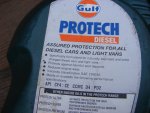
engine oil - modern equivalent of CD standard

Hardly a con. The point is not that sophisticated oils might do harm but that they are a waste.
Don't think that is correct. Synthetics require the higher internal temperatures of a performance engine to mobilise their long molecular chains.

If you visit France you can buy CD oil in Norauto branches and possibly other motor factor chains.
 
Don't think that is correct. Synthetics require the higher internal temperatures of a performance engine to mobilise their long molecular chains.

.....s.
Synthetics often have lower cold viscosity. Performance engines often run very cool (in the sense of oil temp vs coolant temp), because they spend a great deal of their time running at a small fraction of their rated power.

Yes you can buy CD oil, but IMHO it's worth considering not just the viscosity and minimumTBN, but also the quality of the additives like detergents which makes me think it's worth paying a little extra for a 'good' brand of oil.

Be wary of oils intended for really old engines, where there is no proper filter, these work on the basis of the crud forming a sludge in the sump, instead of being carried to the filter by detergent in the oil. A lot of 50s and 60s British motorbikes don't have proper filters, so people sometimes sell detergent-free oils for these.
 
Indeed. As I said above "there is no scientific evidence for that hypothesis, only anecdotal tales".

If you can find a synthetic oil with the correct viscosity then, cost aside, in my experience it's going to be better for your engine than the equivalent mineral grade. :)

Richard

I think that by the direction of the conversation, he was suggesting using an oil that is to good, to hitech, can be detrimental to the engine. So a lower quality mineral oil was better. At that time Morris made a 10/40 API CD oil for marine use which he recommended and I used for many years until Morris dropped it. I did campaign Morris trying to get them to restart production, on the basis that the sailboat auxiliary engine market was much greater than the canal boat market which they still supply with their API CC grade oil.
 
Don't think that is correct. Synthetics require the higher internal temperatures of a performance engine to mobilise their long molecular chains.

The chains in synthetic oil are not necessarily longer, although they can be, but they are of a much more consistent length than in mineral oil. However, they do not need to be "mobilised" as they provide a film of lubricant around metal components and are the carrier for the additives. Of course, all oils get thinner as they get hotter but synthetics do this in a more controlled and predictable manner than minerals so, provided that you start off with a synthetic oil with the correct hot and cold viscosity range, then the more tightly controlled behaviour could never be regarded as a disadvantage.

Richard
 
Last edited:
I think that by the direction of the conversation, he was suggesting using an oil that is to good, to hitech, can be detrimental to the engine. So a lower quality mineral oil was better.

Yes, I understand that .... but such views are entirely anecdotal and there has never been any supporting scientific evidence. My personal experience suggests that the exact opposite view is the correct one and my training as a polymer chemist does not give me any grounds for suspecting that my empirical understanding is incorrect.

Richard
 
Because the specification for CD calls for a TBN of 4. The reasons are explained on my website, as you know.

On TBN, your website says:

‘The TBN of a synthetic lubricant intended for a turbo-charged engine running for extended periods at the top of its rev range might be 12 – 15. Conversely, the TBN of a lubricant designed for cool-running, low power duties such as yacht auxiliary engines will be about 3-4.’

‘TBN of API CD is 4, of API CE it is 10.5 and for API CF it is 16. API CF-4 was introduced for use with fuels having lower sulphur content, its TBN being reduced accordingly to about 8.’

and it concludes ‘First and foremost, as far as possible use the grade of oil that the engine manufacturer recommends. In many cases this will be API CD ... Otherwise, use a quality oil to API CF-4, which is the official replacement for API CD.’

Following that advice I used carefully to seek out CD, but more recent experience is that major suppliers (e.g. Halfords) supply only CF as an oil for older diesels - I do not recall encountering CF-4 as such and on-line searches for it tend to throw up CF oils as compatible with it.

Apologies if I have missed any previous post, but can you advise of oils/suppliers of CF-4 specifically?
 
A little research reveals that CF-4 became obsolete because the test used to qualify it is no longer available. (the Mack T-6 test measuring piston ring wear, viscosity change and oil consumption.) It would appear that API CF is the alternative, although I preferred CF-4 for its lower TBN. I note that API has declared obsolete every grade up to and including CG-4, which does not mean that they are no longer made.
 
A little research reveals that CF-4 became obsolete because the test used to qualify it is no longer available. (the Mack T-6 test measuring piston ring wear, viscosity change and oil consumption.) It would appear that API CF is the alternative, although I preferred CF-4 for its lower TBN. I note that API has declared obsolete every grade up to and including CG-4, which does not mean that they are no longer made.

Thanks, CF it will continue to be then.
 
Yes, I understand that .... but such views are entirely anecdotal and there has never been any supporting scientific evidence. My personal experience suggests that the exact opposite view is the correct one and my training as a polymer chemist does not give me any grounds for suspecting that my empirical understanding is incorrect.

Richard

Well Ok, you carry on what you are doing, but if I still owned a boat I would be far more interested in taking advice from someone who has seen more glazed bore wrecked engines than most people have even changed their engine oil or someones academic advice, I would go with the advice of the bloke with a spanner in his hand.
 
Well Ok, you carry on what you are doing, but if I still owned a boat I would be far more interested in taking advice from someone who has seen more glazed bore wrecked engines than most people have even changed their engine oil or someones academic advice, I would go with the advice of the bloke with a spanner in his hand.

I most certainly will. :)

As for that bloke with a spanner in his hand ... I reckon that I've taken a car to a garage for work to be done about 15 times in the last 40 years and only because it was a requirement for the warranty. On probably 50% of those occasions I've received some or all of my money back when I've inspected the car at the garage and pointed out the cock-ups that the "professional" spanner man has made. :ambivalence:

Richard
 
Costco sell exactly what you need for a marine diesel in 20 ltr plastic drums. ie non synthetic mineral oil. Having sold my boat I have a full one at home.
A rare example of the case where most expensive is definitely not best. In fact expensive synthetic oil can wreck your engine.
 
Last edited:
A little research reveals that CF-4 became obsolete because the test used to qualify it is no longer available. (the Mack T-6 test measuring piston ring wear, viscosity change and oil consumption.) It would appear that API CF is the alternative, although I preferred CF-4 for its lower TBN. I note that API has declared obsolete every grade up to and including CG-4, which does not mean that they are no longer made.
.

I've 40 1ltr packs to sell @_£2 each cf4 spec pick up fylde coast lancs.

DSCF9178.jpg
 
On TBN, your website says:

‘The TBN of a synthetic lubricant intended for a turbo-charged engine running for extended periods at the top of its rev range might be 12 – 15. Conversely, the TBN of a lubricant designed for cool-running, low power duties such as yacht auxiliary engines will be about 3-4.’

‘TBN of API CD is 4, of API CE it is 10.5 and for API CF it is 16. API CF-4 was introduced for use with fuels having lower sulphur content, its TBN being reduced accordingly to about 8.’

and it concludes ‘First and foremost, as far as possible use the grade of oil that the engine manufacturer recommends. In many cases this will be API CD ... Otherwise, use a quality oil to API CF-4, which is the official replacement for API CD.’

Following that advice I used carefully to seek out CD, but more recent experience is that major suppliers (e.g. Halfords) supply only CF as an oil for older diesels - I do not recall encountering CF-4 as such and on-line searches for it tend to throw up CF oils as compatible with it.

Apologies if I have missed any previous post, but can you advise of oils/suppliers of CF-4 specifically?


i did post that an API CD oil is available here:

https://www.opieoils.co.uk/p-6504-motul-inboard-tech-15w-50-4t-boat-engine-oil.aspx

Very wise using an oil intended for the engine.
 
i did post that an API CD oil is available here:

https://www.opieoils.co.uk/p-6504-motul-inboard-tech-15w-50-4t-boat-engine-oil.aspx

Very wise using an oil intended for the engine.

Thanks. Yes, I saw that link at your #30. I have steered clear of synthetics, which have tended to have the later API specifications anyway. But I saw Vyv Cox’s response at #36 to your question, saying that synthetic was not necessarily a problem and that it might be an answer to those seeking a low TBN CD oil. But I also saw that he could not find any more information about it.

BTW As far as I can see – but I might be wrong, and would welcome clarification from Vyv or somebody else - API grades have not specified TBN. If that is so, have TBN ranges been attributed to the API grades on the basis of their other characteristics?
 
Top