engine oil foaming and burning

chal

Well-Known Member
Joined
13 Jul 2010
Messages
581
Location
Valentia Island, Kerry
Visit site
This is actually a question about an auxilliary yacht engine but since it is purely engine-related this seems like the right forum:

I'm restoring a classic yacht on a tight budget and it has a 37 year old Albin AD21 diesel engine. When I bought the boat we sailed her for about 7 hours with the engine running the whole time without apparent problem (once we actually got the thing running). Since then I've done some basic servicing including replacing badly corroded high pressure fuel lines, cleaning fuel system, new oil and air filters, and having the starter motor serviced. The engine now starts easily and seemed to run well, though up till now that has only been for 15 mins or so ata a time in a marina.

When I replaced the oil filter I also did an oil change and I noticed that the oil was quite emulsified (I think!) - it was a sort of milky coffee colour and quite thick; there was also some water in the bottom of the sump. I'm guessing the water is getting in via the water pump and that the seals probably need replacing, and doing so is on my (very long) to-do list.

I think the oil in the engine at the time was just basic mineral oil for a car engine as there was a part-used container of it on board. I have read that this is not really suitable for such an old engine and used a fairly expensive oil specifically for classic engines. It's SAE 30 (not multigrade) and it says on the company's website that it has enhanced anti-foam properties.

Yesterday I had to move the boat to a new mooring several miles away and motored up there. I checked the oil before leaving and found it had already turned milky coffee after just the few runs in the marina, but there wasn't much I could do about it and it hadn't caused any problem before so I set off. After maybe 30 mins a LOT of smoke started coming out of the exhaust. The engine seemed to be running fine and not particularly hot though some smoke was coming out round about the crankshaft at the front of the engine (it protrudes through the engine block to allow hand crank starting). We had no choice but to carry on and we got there ok leaving an embarrassing trail of air pollution behind us, By the time we arrived oil was actually foaming out of the filler cap on the rocker cover so I presume it was getting into the cylinders via the valves and that's why there was so much smoke.

So, sorry for the long intro but I thought that might help with answers to my questions:

Why is the oil turning to cappuccino so quickly? Is that simply down to water getting past the pump drive-shaft into the engine?

And why the incredible amount of foaming and burning this time but not on the much longer first voyage: was I in fact better of with the cheap basic modern oil?

One last bit of background: the last owner showed me the dipstick and proudly told me that the oil stayed so clean that you could hardly see it but I later found that it was really because it was pretty much completely empty. I topped up a bit before the 7 hour trip but maybe there was no apparent problem because there just wasn't enough oil there to foam up high enough.
 
Head Gasket or cracked cylinder liner. Cooling water getting in under pressure. Sounds far too much for a weep past seals in the water pump.
 
Hi - thanks for the reply. Just clutching at straws since dealing with either of those sounds like a very big job: when I changed the oil there was only a little water in the bottom of the sump. Does this mean there is a possibility that it could still be the water pump seals (and it is probably many years since they have been changed)? Or can you tell from my description of the symptoms that there must be more water getting in than that so it has to be something more major?

Also, why did it take about 30 mins to start smoke burning? Did it just take that long for the water level to rise high enough?
 
Water in the oil is bad, don't use it (much) and don't leave the water in the engine long. I would move fixing it up your priority list. I wouldn't think it would be a complicated thing to strip and as long as parts are available a rebuild shouldn't be difficult.
 
I used to run an AD21 in my Albin 25. I did quite a lot of work on the engine and received a lot of excellent advice from John Stanton who was an expert on these engines and imported spares for them. Unfortunately John has been retired for several years.

John advised me to change the seals on the water pump quite frequently as it is easy for water to leak into the engine oil. I suspect that this is the main problem with your engine.

If you have the matching Albin gearbox it shares lubrication with the engine is is essential to use a straight SAE 30 oil and not multigrade. There is an oil passage in the middle of the crankshaft at the rear of the engine and this supplies oil under pressure to the gearbox. There is a drain from the bottom of the gearbox leading back into the engine's sump. These gearboxes used very heavy coil springs wound around shafts as clutches. Apparently multigrade is too good a lubricant and can cause the clutches to slip.

Although I sold our Albin about eight years ago I scanned the documentation and you can find the AD-21 engine handbook at http://www.albina.seagers.org.uk/page64.html if you need it.
 
Thanks Dave - in fact, it was John Stanton who fitted the engine to the boat (many years ago) and I think it was from a sort of vestigial website of his that I learned the info about not using the multigrade oil. I do have the matching Albin gearbox and I have the manual, though thanks for the link.

I know you haven't even seen the engine but do you think it is worth trying the water pump seal? I know parts are available from Fors Marin but they are quite expensive and there must come a time when it's just throwing good money after bad and it would be better to take out a loan and have something more modern fitted in place of the Albin.
 
The symptoms that you describe do sound like water getting into the oil somewhere. Changing the seals in the pump is probably cheaper and easier than investigating the cylinder head gasket.

I cannot remember whether there is anywhere for water to escape between the pump and its connection to the camshaft. If so, is there any evidence of water there? That would help to confirm whether the pump seal is your problem.

If you do change the seals it is quite simple but there is a circlip on the shaft that needs to be released which I did not spot the first time around.
 
You seem to be clutching at straws looking for a cheap fix so I will throw you a life line but you will need to keep your fingers crossed !

Have you done anything to the exhaust pipes or knocked a gooseneck down ?

Old boats can have engines below the water line and I have known (generator) to have the same symptoms you describe.
As the engine cooled it sucked water into the sump via the exhaust outlet.

Overfilled sump could then direct oil/water into your pots to cause excessive smoke.

Its a long shot but if you have tampered with exhausts worth a try, good luck !
 
It sounds to me that the engine is already terminal. To run an engine with such emulsified oil is a disaster, with effectively no lubrication. It will be close to siezing, and I expect that the big and small ends and cam bearings will be heavily scored, requiring a regrind and renewal, and cylinders scored.

It sounds to me a little late to be looking for the water entry. You will find this when you remove the engine for the rebuild.

Sorry to be the bearer of bad tidings.
 
It sounds to me that the engine is already terminal. To run an engine with such emulsified oil is a disaster, with effectively no lubrication. It will be close to siezing, and I expect that the big and small ends and cam bearings will be heavily scored, requiring a regrind and renewal, and cylinders scored.

It sounds to me a little late to be looking for the water entry. You will find this when you remove the engine for the rebuild.

Sorry to be the bearer of bad tidings.

Also a good clue in the smoke snorting out of the front crank seal.
 
I have an Albin Ad-2 very similar to the 21, but a little older. The engine was entirely rebuilt (January 2012) The engine start with a few cranks of the handle which is something I could not do before the rebuild.

The problem is that I found water in the oil pan. Using a product called Kolor Kut which turns bright red in any H20. Although I noticed it doesn't work so well with emulcified oil which has water in it. Upon running the oil began to froth, emulcify.

My mechanic, the guy who rebuilt the engine, is in agreement; he beleives the water is coming from the water pump. He says the pump should be taken apart and rebuilt, and possibly the bearing replaced. I am taking it apart this evening, and will keep you updated. He did mention that this task might be a little over my head.
 
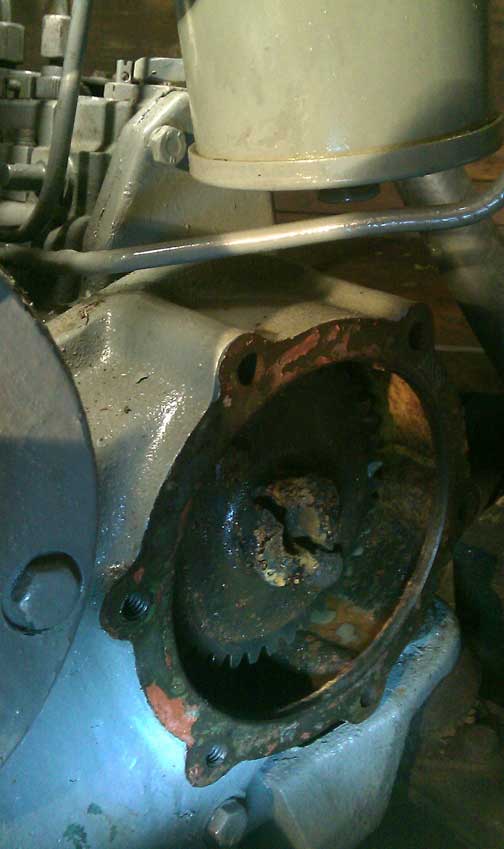
Here is a picture of the engine with the water pump removed taken last night. There is clear water behind the pump so the seal has to be faulty. There would be no other way for the clear water to get into this part of the engine. I hope you can locate the problem this easily. Otherwise the cooling chambers of the block will need to be tested for pressure leaks.

albin_pump_leak.jpg
 
One of the problems I have with all this is that although spares are readily available from Fors Marin they are incredibly expensive. Obviously I would not know exactly what was needed till I took the pump off but, for example, a couple of washers and a new impeller costs about GBP50 and a new pump is available for GBP900!! That's counting 10 Krone to the pound and I think it's a bit more favourable than that now but with postage and currency conversion charges it will end up being even more.

That makes the price of a pump about a third of the cost of a replacement engine.

It would be much cheaper and easier to just use a separate external 12v water pump. I don't know how practicable that would be, it's not something I've ever considered before.
 
try running the engine alongside using a shore hose pipe as a water supply, just to confirm it is the water pump, with the pumps impeller removed and plumbing disconnected.

it is quite possible to use an electric pump, I used a deck wash pump to cool a vetus generator when its pump drive snails wore out. the real problem is being certain to shutoff the water first on stopping, and equally starting the engine before the water supply is established.


A pulley driven pump would perhaps be better,if you establish the existing pump is the problem.

also check for water ingress via the exhaust water injection point if fitted.

something is very wrong for the water volumes in the sump you are experiencing. As others have suggested, cylinder cracks, corrosion through block or head. So the shore hose pipe will save wasting money on a replacement pump if it is a serious problem.
 
I have an AD-21 as well and it also has milkshake oil. I am about to tear it apart. Isolating the water pump as the issue or not the issue should be my first step. I suspected this seal as is bad, but to be fair my engine has overheated MANY times and the emulsification / excessive oil problem just started after a recent overheat. I was able to save the engine though, no excessive smoking, no serious blow by that I can tell. @ Original Poster, I suspect that engine is toast! I am going to seal off the engine coolant passages and pressure test the heat exchanger reservoir cap to see if I still have leakage. If yes, that tells me either the exhaust manifold is rusted through, (although it is dry inside when looking in from the outlet) or the head gasket / block / cylinder head are cracked or corroded through.
 
I pressure leak tested the AD-21 Seakamp heat exchanger reservoir cap to 7psi last night, and today it was still at 3.5 psi. This was with the water pump isolated. I rearranged the setup and pressure tested the system with the water pump connected, and this time I could sea bubbles coming out of the raw water side, which means the seal was leaking between the fresh water and the raw water sides of the water pump. I immediately ordered two electric water pumps, 12v dc, 3.5gpm, 45 psi max, which I think is maybe too strong, they were $50 US.
 
Pretty sure you'd be best to have the engine looked at by a pro. Sounds to me like the only sensible solution to ensure any sort of long term reliability would be a rebuild.

Snorting smoke/fumes/steam/whatever out of the crank seals is a really bad sign.
You should not have left the berth. There could no be all sorts of problems. It is possible that with a lack of lubrication there may be crankshaft and other bearing problems. When there is a lot of water in the sump that is what initially lubricates the engine on start up and by the time the oil comes through the damage might be done. You need a Pela pump or similar to drain the contents of the sump and after a flush out with oil refill and fix the water pump seals. There should be provision on the water pump to protect the engine from seal leakage such as a weep hole on the bottom of pump shaft housing . Is the correct seal fitted and the correct way round. Maybe with new seals and fresh oil it will run like this.

 
Top