Engine mount studs (M16) - What to use? Anything special?

dankilb

Well-Known Member
Joined
23 Jan 2008
Messages
1,538
Visit site
Just received four smart new engine mounts from the helpful folks at AV Industrial (who I think manufacture themselves and advised on the right model for our Beta 50):
SM1609.jpg

Question is, what do I stud them with (M16)? Is regular (mild) threaded rod okay? Do I need HT/8.8? And I'm assuming (hoping?!) stainless not required/worth it?

TIA
 
I would advise against using studs, they are the devils work for engine mounts, IMO.

Better to bolt the engine feet to the mounts, and set the alignment using shims between the mounts and engine bearers. This is the best method.
 
Question is, what do I stud them with (M16)? Is regular (mild) threaded rod okay? Do I need HT/8.8? And I'm assuming (hoping?!) stainless not required/worth it?

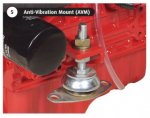
This may or may not be relevant in your case, but some height adjuster pins use a smaller diameter and thread for the part that screws into to mount/foot compared to the upper part where the nuts sit.
This is the case with the feet for my 20hp Beta 722, which use M12 and M16 respectively.
 
I would advise against using studs, they are the devils work for engine mounts, IMO.

Better to bolt the engine feet to the mounts, and set the alignment using shims between the mounts and engine bearers. This is the best method.
Ah, you beauty! ? Much prefer the sound of that myself...

I think the use of studs, with nothing sealing under the nuts, plus various unaddressed leaks under previous ownership, were what did for the last ones after 9 years/300 (yes, really!) hours.

8.8 shold be fine - bolts as opposed to machine screws.
and I was hoping for 8.8 recommendation, as that was my gut (if ill-informed/inexperienced) instinct also.

Many thanks, both.

And would galvanised make sense also? E.g.: M16 Hex Setscrews Grade 8.8 DIN 933 Hot Dipped Galvanised
If so... I'm liking the look of the prices too ?
 
This may or may not be relevant in your case, but some height adjuster pins use a smaller diameter and thread for the part that screws into to mount/foot compared to the upper part where the nuts sit.
This is the case with the feet for my 20hp Beta 722, which use M12 and M16 respectively.
Aaaaah...! Okay. You're quite right there, now I think about our existing installation also. They do require some sort of 'pin' (as they call it) - or basically a stud, lock-nutted in place, then bolted either side of the actual engine mount.

It looks like there wouldn't be clearance to directly bolt (machine screw) without quite a lot of shimming, in order to clear the adjacent horizontal of the engine mount/bracket, as per Beta's ever helpful Installation Manual (which I momentarily forgot to turn to as an obvious first reference earlier!):
Beta_p19.JPG
Beta_p20.JPG
I suppose I could source a machined collar/standoff, having ascertained the correct height with washers/shims first. I don't particularly see the point of the 'height adjuster' stud... (more to follow on that!).

This way I could still use machine screws(/bolts) and set the height, correctly, once and forever. I can drill out the Beta engine mount/bracket holes to M16 if required.

Or am I missing something? Might I need that adjustment for some reason later (as the mounts settle perhaps?). I'd be happy to run for a few dozen hours on sensible shimming/washers, before committing to a 'fixed' height (which, after all, can always be modified again later).

One issue now is that the feet/mounts are already on reasonably hefty (maybe 20mm) iroko blocks acting as shims. The holes in them won't line up with the new mounts anyway, so rather than swiss-cheese them they'll be replaced anyway. I'm thinking with DIY alloy spacers of some sort, with wood being in such short/costly supply.
 
Should have asked them,they more than likely supply the studs.
Quite right - found them: Height Adjusters Marine Mounts: AV Mounts Online

But the prices do seem very steep for what they are/do (and AV are usually reasonably priced IMO). I guess by the time you've faffed around with sourcing or machining an alternative, it mightn't be worth the while all in... But I reckon something simpler out of M16 HDG stud could do the same job.

And I am loathe to fundamentally change a bit of Beta's installation advice. I've always found their tech instructions/support to be spot on so far.

Hmmm. ? Maybe need to think this through. They won't be needed/fitted while the weather holds and there's a barrier coat needing painting, anyway!
 
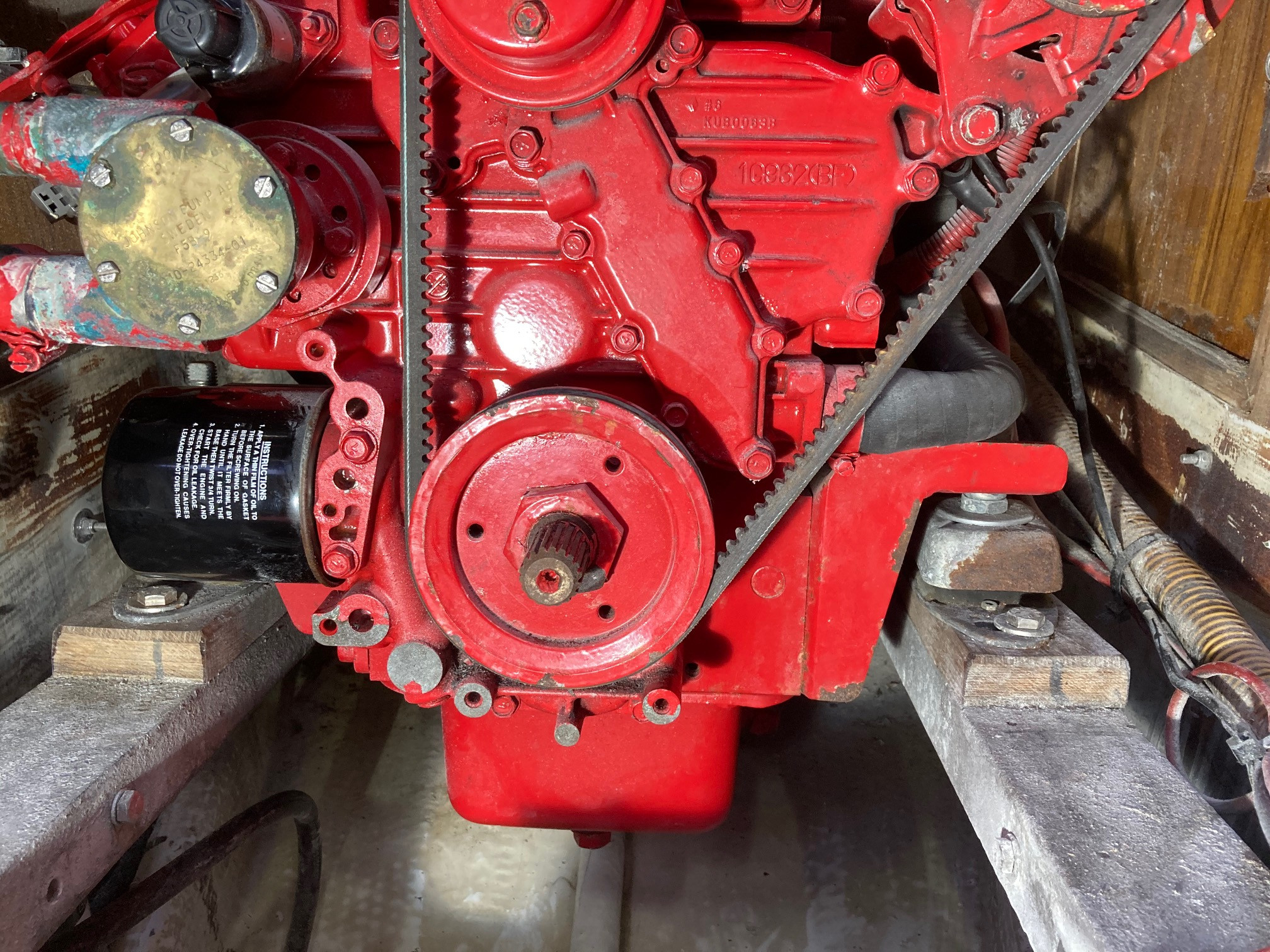
Bingo! Thanks to the magic of image hosting for a previous post (IIRC to help another member with installation options), I've found the best actual pic I have:
IMG-4767.jpg

Looks like Beta's brackets are plenty flat underneath not to foul any bolt-and-spacer options, after all (unlike the example in the Manual - where the oil filter's on the 'wrong' side, after all! ? - and which we know covers multiple models/configs).

And judging by what you can see from the imperfect angle of the pic, that mount looks close to bottomed-out on the bolt and a single washer as it is. So, again, doesn't look like bolt/spacer is off the cards.
 
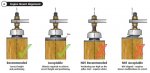
Suspect you are making this all too complicated. You need the adjustable studs se here for what complete engine mounts look like asap-supplies.com/engine-and-gearbox-components/flexible-engine-mounts I am surprised they were not supplied, although by ordering just the mounts there is perhaps an assumption that you are just replacing mounts and re-using the old studs!. The diagrams in your post#7 are showing you the way to attach the mounts to the beds so that you end up with the feet roughly in the middle of the stud when the engine is lined up. You need individual adjustment on each corner, plus sideways movement front and back (through the slots in the base) to get thee engine properly aligned with the shaft. If you have done your sums right setting the level of the beds correctly in relation to the prop shaft centre should be easy without messing a bout with shims.

On both the installations I have done from scratch (that is rebuilding the beds to suit the new engine), I did all the alignment before I drilled the beds for the hold down coach screws. Not the only way of doing it, but worked for me.

PS just buy the proper studs you have found rather than messing about to try and save a few pennies on less than £30!
 
Ah, you beauty! ? Much prefer the sound of that myself...

I think the use of studs, with nothing sealing under the nuts, plus various unaddressed leaks under previous ownership, were what did for the last ones after 9 years/300 (yes, really!) hours.


and I was hoping for 8.8 recommendation, as that was my gut (if ill-informed/inexperienced) instinct also.

Many thanks, both.

And would galvanised make sense also? E.g.: M16 Hex Setscrews Grade 8.8 DIN 933 Hot Dipped Galvanised
If so... I'm liking the look of the prices too ?


Plated bolts would be better, you can usually find those in 8.8. Avoid stainless steel for this application due to fretting and shear loading failure potential.

I'll go on record again advising against studs. There are proper jacking arrangement used on some larger engines, but studs and nuts are about the worst possible option for engine mounts, especially if you have the option to do something better. The mount makers hate them, the engine manufacturers only provide them on the smaller engines due to commercial pressure - it means the OEM's don't need such fine tolerances on the beds making the engines quick to install and adjust. I know VP specifies a maximum height for the foot above the mount for the D1 & D2 series as excessive height leads to some very undesirable consequences. I worked for manufacturers and distributors for many years, so have a first-hand view on this.
 
Plated bolts would be better, you can usually find those in 8.8.
Yup, makes sense, that's usually what I'd look for if sourcing bolts for a vehicle, say...

I'll go on record again advising against studs.
I'm still inclined to agree, too. I now think I could easily through-bolt the Beta mounts to the feet with minimal dramas and just a washer or two for fine/later adjustment. I make up all the required height below the feet, the old fashioned way (with permanent spacers/shims).

PS just buy the proper studs you have found rather than messing about to try and save a few pennies on less than £30!
I do get where T.'s coming from, of course. But I wonder whether I can't actually improve on the 'proper' adjustable ones - and the previous, somewhat scrappy, installation - at the same time? The total cost of aluminium stock to make new spacers and all fasteners would be less than the adjustable studs alone (and are they even 8.8 plated?).

The studs on my Beta mounts were M16 Fine, ie 1.5mm pitch, not the more commonly available 2mm pitch.

Adjustment studs are often metric fine
Helpful, will ask AV what the new ones are. Nothing M16 readily to hand at home, regardless of pitch, to test (and that's probably much to the First Mate's great relief)!
 
I do get where T.'s coming from, of course. But I wonder whether I can't actually improve on the 'proper' adjustable ones - and the previous, somewhat scrappy, installation - at the same time? The total cost of aluminium stock to make new spacers and all fasteners would be less than the adjustable studs alone (and are they even 8.8 plated?).
Sorry, but I really don't see what you are trying to improve. Studs are the standard way of mounting this size engine and almost universally used by engine manufacturers. my first re-engine was replacing a Stuart Turner with a Yanmar 1GM. The ST was adjusted with shims cut out of roofing lead - what a PITA. The method I described earlier was a doddle. I built a jig using a 1" broom stick for a dummy shaft down the stern tube and Ply sections to represent the mounting brackets to scale. Built up the hardwood beds to the right height and angle. Dropped the engine in connected to the shaft, lined it all up and bored the pilot holes for the fastening on the mounts to the beds. Replaced that with a Nanni which a different bracket heights and spacing so dropped the engine in, connected it up with temporary spacers to get the bed height right, lifted the engine and fitted full length spacers to the beds and dropped the engine back in, drilling for the hold down fastening as before.

If you get the mounts at the right height as in your earlier diagram you have enough for fine adjustment. Lock it all up and it is idiot proof. What are you hoping to achieve over and above that with your complicated spacers and shims?
 
Don’t get me wrong, I agree with the sentiment of not needing to make things more complicated or re-invent the wheel for no good reason.

What are you hoping to achieve over and above that with your complicated spacers and shims?
Almost to the contrary - I don’t see it as necessarily being over/above nor more complicated:

The spacers I’ll likely need to make anyway. Easy enough. And aluminium stock is cheap and easy to work DIY (80mm wide bar seems a decent option).

If I’m lucky and I can get it close, a few washers should be all the shims required.

Then drop a bolt (hex machine screw) in.

In contrast, it looks like 1 stud, three nuts, and 5 washers on the standard setup. Add to that, the example in Beta’s figure ‘5’ (#7) does seem to have been set at a height with what looks a perilous gap. Why allow that extra space for flex/stress/vibration? Threads are of course known to add weakness too. And the steel grade/coating isn’t specified.

I agree with Moodysailor on this. Why not bolt direct to the foot (or with minimal shimming), if you can? Surely that offers the optimum interface between the load and the rubber mount itself?
 
I should add - as important context - this’d be my first opportunity at machining some aluminium or this size and (for me) relative complexity. It’s also a chance to test a new pillar drill!

Get these height of the spacer blocks - which, to clarify, I plan to replace the iroko/wood blocks with - and very little shimming should be needed.
 
Sorry, still can't see what you are hoping to achieve. There is nothing wrong with the standard studs that needs "fixing". £7 a mount for something that works with no effort seems a no brainer to me. Seems like you really want to make things though! Give the pillar drill something to do. they are very useful for cutting bungs for woodwork as well.
 
How do you get equal loading on 4 feet? You can on 3 feet but how on 4?
Not sure I follow on the loading - although doubt it’ll ever be equal. All I know is each mount is spec’d to 150kg and the engine wet should be <300kg. In discussion with the manufacturer of the mounts, they suggested this was an appropriate balance between too ‘hard’ and too weak!
 
Top