Engine hours

I was only trying to be helpful and you are welcome to believe what you want but I am not making this up and I've seen it myself. If you are happy getting new drives when you need no problem.

Good luck with a recon unit, why do you think they would only be £2K.

I don't think anyone is saying you're making stuff up but there are thousands of boats out there running on ancient drives. They're not all sat rotting away in barns!
 
Just curious, if properly serviced would the reasonable life of an engine be any different if it was coupled to a shaft rather than an outdrive?
 
Just curious, if properly serviced would the reasonable life of an engine be any different if it was coupled to a shaft rather than an outdrive?

If I understand your Q correctly "proper serviced" and all that entails ---then ans no difference to the engine life .
The engine does not know what's its connected to ,shaft , out drive ,IPS pod etc ,and I can not see how any these influence it's life per se .

How ever in the real world out drive set ups are in smaller boats whereby access can be problematic which may ,stress MAY make a deviation from "proper service " .-what ever that means ?
Also part of the maintenance budget needs to be shared with the drive or drives if replaced -timing wise not easy to predict when a big spend on the drives is coming .

Nit picking one could say in an outdrive Vp set up salt water sits in the riser ,nearer the turbo than say in a mid engined shaft install -so in theory - turbo and any open valves when stationary I guess are more prone to corossion .

You might get more blocked /restricted cooling water issues even with "proper service " with an outdrive compared to
Bog standard through the hull scoup+ stainer of a shaft set up
Overheating accelerates diesel engine demise ,in a cumulative way .

So rarther than 50-50 Equal. Maybe 49-51 or 48-52 tops In favour if inboard shaft
 
Last edited:
Many thanks for that. I was just curious whether an outdrive coupled to an engine would add a greater or lesser load (stress) compared to conventional shaft drive.

Incidentally, on the subject of engine hours, I met up with a Dutch owner of a boat identical to mine back in 2014. His 350hp Yanmar 6LY engines had just clocked up 3,500 hours with no issues, just regular servicing. He was just coming up to retirement and was planning on using the boat more. God knows what hours he's on now :).
 
His 350hp Yanmar 6LY engines had just clocked up 3,500 hours with no issues, just regular servicing
Am I right in guessing that this chap used his boat mostly at slow speed?
We keep using hours as a measure of engine wear, but fuel burn is actually much better.
And depending on the boat and its usage, for any given hours, one engine can have easily drunk three times or more, compared to another identical one.
 
Am I right in guessing that this chap used his boat mostly at slow speed?

To be honest I didn't think to ask, but I take your point. Hours in isolation can be a misleading indicator of engine wear.

I don't have fuel burn figures but currently my cumulative log reading is some 6,000nm and 1,120 hours which equates to an average 5.36 knots :)
 
Last edited:
Am I right in guessing that this chap used his boat mostly at slow speed?
We keep using hours as a measure of engine wear, but fuel burn is actually much better.
And depending on the boat and its usage, for any given hours, one engine can have easily drunk three times or more, compared to another identical one.

In this example slow speed = low fuel burn ,so we are back to hours
It all depends if its a high hours planner , that's spent it's life on a river then fuel burn could be misleading .
Broom as illustrated can do both .

So waveys back of an envelope distance / hours is a good indication what type of use it's had thus far .
The anomaly is grater in fast planners spending a greater proportion of time @ D speed .
So we are back to sq 1 .Where Service History and condition ( boro-scope + other tests ) are the best way to split it IMHO.
So evaluating my boat for example
9 knots = 19 L /h. Per engine
High twenties low thirties = 90-110. l/h per engine .
Log shows 18000 Nm
Hours 750
Ave 24 knots. Age of machinery 13 years
So one can conclude its not spent a great deal of time @ D , speed over marina and anchorage manoeuvreing etc .
That may account along with a good SH why the engines are in ,and behave like thay are pretty good nic.

So it's really multi factorial ,which engine set turns out to be better in the Op.s original post .On the info provided you just can,t tell .
 
In this example slow speed = low fuel burn ,so we are back to hours
Hang on a minute, we aren't back to hours - exactly the opposite, I reckon.
With a diesel marine engine, you can do the following (real world example):
- run for one hour at 8 knots burning less than 10 lph. or
- run for one hour at 24 knots burning 60 lph
Now, in terms or wear and tear, 1000 hours on the latter engine are comparable to 6000 on the former.
Would you be equally happy to buy a boat with either of these engines, if they had the same hours (and AOTBE, in terms of maintenance etc., of course)?
 
Hang on a minute, we aren't back to hours - exactly the opposite, I reckon.
With a diesel marine engine, you can do the following (real world example):
- run for one hour at 8 knots burning less than 10 lph. or
- run for one hour at 24 knots burning 60 lph
Now, in terms or wear and tear, 1000 hours on the latter engine are comparable to 6000 on the former.
Would you be equally happy to buy a boat with either of these engines, if they had the same hours (and AOTBE, in terms of maintenance etc., of course)?

Agree
But the second sentence
"could be misleading " I would look at the NM ( from the plotter gps and log ) and work out average speed .Think Wavey has a good point in a planner ?
Then reconcile that with boat type ,are we talking canal , commercial , leisure D ,semi D or planer ? -hopefully the av speed kinda fits the engine /boat design .
Any how to split your "same hours " hypothetical example --- it's still down to condition etc
Or if they really are both that identical ,then under bid em -find out who's more desperate than t,other .

Any how the market in leisure boats seems hours fixated -hence the post !
I guess the private car motor market is fixated with mileage .
How ever the commercial markets in both sectors inc marine -agreed may move away from those .
Commercial marine may indeed lean away from hours towards fuel used .
CAT engines these days in leisure applications I understand fuel burned data is available .Does the leisure market recognise this -have not seen any data published in CAT engined leisure sales -eg older bigger Sunseekers or Sq 78 -they publish hours .
Where that data is not available then we ( the market ) are back to sq1 = hours .
All roads seem to lead to hours in the used leisure boat market AOTBE

To answer your Q I would go with the 24 knot one .if you do a "wavey " look at the log
They are planners with that fuel burn something like a VP powered 30-30odd fter -kad 42---300 or D4/D6 powered .
I would not be happy with a planner spending its life @8 knots ,in a river etc
If I have understood your Q correctly ??

(I know the fuel burn for 3-4 L vp and 12L MAN -it's not a D or SD or planer with a bigger engine the 60 L@24 kn tells me that )
 
Last edited:
If I understand your Q correctly "proper serviced" and all that entails ---then ans no difference to the engine life .
The engine does not know what's its connected to ,shaft , out drive ,IPS pod etc ,and I can not see how any these influence it's life per se .

How ever in the real world out drive set ups are in smaller boats whereby access can be problematic which may ,stress MAY make a deviation from "proper service " .-what ever that means ?
Also part of the maintenance budget needs to be shared with the drive or drives if replaced -timing wise not easy to predict when a big spend on the drives is coming .

Nit picking one could say in an outdrive Vp set up salt water sits in the riser ,nearer the turbo than say in a mid engined shaft install -so in theory - turbo and any open valves when stationary I guess are more prone to corossion .

You might get more blocked /restricted cooling water issues even with "proper service " with an outdrive compared to
Bog standard through the hull scoup+ stainer of a shaft set up
Overheating accelerates diesel engine demise ,in a cumulative way .

So rarther than 50-50 Equal. Maybe 49-51 or 48-52 tops In favour if inboard shaft

Boats with outdrives have better engine access compared to mid engined shaft drive boats. Usually considerably better access.
Therefore easier to carry out regular checks, easier to identify any faults , easier access to change filters . Servicing the engines is quick and easy so potentially less cost if paying labour for service.
.


You are quite correct about the potential for turbo corrosion issue but this doesn't impact on engine life - unless a turbo breaks up.

Outdrive service is something that just has to be factored in . It doesn't follow that the engine service is neglected .
.
 
I would not be happy with a planner spending its life @8 knots ,in a river etc
Why not? An engine doesn't know where it's installed.
The examples above were based on the Cat 3116 I've got in my old tub.
They spent their whole life at around half of their rated rpm (2800), and at lowish load, hence burning 10 lph each - if that.
The very same engines were mostly used in P boats (like Rafiki Azimut, for instance), where they are typically spinning well above 2000 rpm, and burning 50 to 60 lph.
AOTBE, which one would you expect to clock more hours before needing a rebuild?
...typing this while touching wood, with fingers crossed, etc.! :cool:

Otoh, I agree that hours are THE criteria in pleasure boats - and not only because it's the only parameter available with pre-electronic engines, but also because most folks are unaware of the fuel burn importance anyway.

Which was the reason for my post #46 in reply to Wawey, to start with.
If we were debating a 3,500 hours engine in a Nordhavn forum, most folks would think it's barely run in....
 
Boats with outdrives have better engine access compared to mid engined shaft drive boats. Usually considerably better access.
Mmm... That is a sweeping generalization, if I've ever seen one.
Aside from the fact that I have seen MANY engine bays in outdrive boats where the access is nowhere near the one in your pic, likewise I have seen proper engine rooms in mid engined shaft boats where the access is overall MUCH better than that.
 
Mmm... That is a sweeping generalization, if I've ever seen one.
Aside from the fact that I have seen MANY engine bays in outdrive boats where the access is nowhere near the one in your pic, likewise I have seen proper engine rooms in mid engined shaft boats where the access is overall MUCH better than that.
Generalisation perhaps . But I have seen engine bays in shaft drive boats (under 40 footers) that are within a very cramped space under the floor.
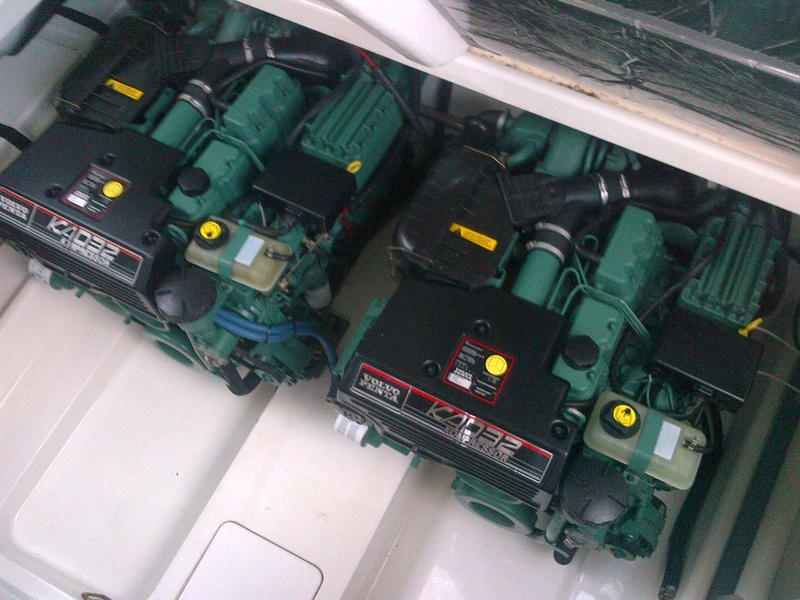
By the way the one in the pic is my engine bay on 33ft boat.
 
Why not? An engine doesn't know where it's installed.
The examples above were based on the Cat 3116 I've got in my old tub.
They spent their whole life at around half of their rated rpm (2800), and at lowish load, hence burning 10 lph each - if that.
The very same engines were mostly used in P boats (like Rafiki Azimut, for instance), where they are typically spinning well above 2000 rpm, and burning 50 to 60 lph.
AOTBE, which one would you expect to clock more hours before needing a rebuild?
...typing this while touching wood, with fingers crossed, etc.! :cool:
..
Wait a minute in post # 49 with the "AOTBE " is assumed the 9 knot vs 24 knot was in the same boat hull -why wouldn,t I?
Now you -agian if I understand the above correctly -are putting the same engine in two different hull s ?
Does your boat ,can it sit all day ,is it designed to cruise @ 24 kts
What are we comparing here Apples vs Apples or Apples Vs oranges ?

I am not advocating rebuilds are linked proportionally to hrs ,I,am a big fan of the "marine age " theory in a link posted somewhere above .
Nordhavens fit lower rated stuff -that's hp/L ---kinda waaaay lower than a fast planer - what are we comparing here ??
BTW - MAN agents via laptop can print off load factor deltas --- so they know what you been up to :)

Similarly modern Ferrari s @ service upload all this stuff to be storred @ Marenello central data facility - so they too
Well F dealers know what you been up to --- how often and for how long and which gear = speed! - over say 8000 rpm clutch wear % the whole shooting match -so picture this --- , you trundle up wanting p-ex -first thing they do -note down the chassis no ,on top of the steering wheel - then disappear ( while you have a coffee ) for 10-15 mins -tapping away .
That's an extremely mileage sensitive area Ferrari residues .
With boats it's depends on the application - but it's really hrs as a starting point in residues AOTBE -that's the way the market is fraid !
 
As Portofino says, hours are king even if that's perhaps not the best or only measure.

As a bit of an aside, Rolling Swiss, the Swiss Cruising Club Trader 42, has over 6000 hours on its Cummins QSB 5.9 380hp engines since approx. 2008. She is used practically every day in a long season and has travelled as far afield as Norway, Russia, West France and most places in between. She is still going strong and AFAIK hasn't needed any major rebuilds. She is obviously serviced absolutely to manufacturers recommendations, which, I suspect is more than many leisure motor boats. Nevertheless, a good example of engine life that can be achieved.
 
Generalisation perhaps . But I have seen engine bays in shaft drive boats (under 40 footers) that are within a very cramped space under the floor.
By the way the one in the pic is my engine bay on 33ft boat.
Yeh -but is that engine also used in outdrives --- same engine ?
Martyn there are outliners in most things that can be measured /recorded
We are talking access to E rooms in particular focusing on outdrive boats which by there v nature are generally less than 40 fr ish -we all also talking about the same engine -this refines shaft drive side down considerably .
I mean we are looking @ shaft stuff driven by VP kad series VP D4/6 stuff or others ,not many mercruiser shafts

null_zpsx3whkvhl.jpg

Represents difficult access increasing as we move right whereby the Yellow is outdrive and orange shaft .
Sure there's overlap at each end in the middle .
 
Boats with outdrives have better engine access compared to mid engined shaft drive boats. Usually considerably better access.
Therefore easier to carry out regular checks, easier to identify any faults , easier access to change filters . Servicing the engines is quick and easy so potentially less cost if paying labour for service.
.


You are quite correct about the potential for turbo corrosion issue but this doesn't impact on engine life - unless a turbo breaks up.

Outdrive service is something that just has to be factored in . It doesn't follow that the engine service is neglected .
.

You are into racing snake territory here -just difficult to see /check anything -nip in the bud
null_zpsufjkdoep.jpg
 
A boat that been kept at low speed/revs is probably a river boat and therefore a fresh water environment. As long as there are correct anodes it should age less, the exception would be the turbo which could gum up. There could also be glazing on the bores. But all in all I'd prefer it.
 
Yeh -but is that engine also used in outdrives --- same engine ?

We are talking access to E rooms in particular focusing on outdrive boats which by there v nature are generally less than 40 fr ish -we all also talking about the same engine -this refines shaft drive side down considerably .
I mean we are looking @ shaft stuff driven by VP kad series VP D4/6 stuff or others ,not many mercruiser shafts
My thinking is a comparison of boats up to 40 ft or so.
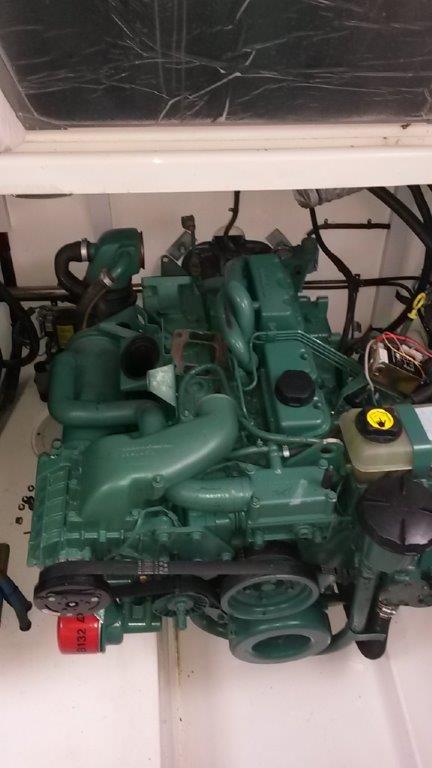
For the avoidance of doubt my boat is sterndrive . As the photo in my earlier post shows there is plenty of space to stand or even sit in front of the engines . The access down the sides and between the engines is adequate ,if a little cramped, but everything can be reached for inspection and service. Even some reasonable stipping down doesnt necessarily need any access to be created - eg turbocharger and intercooler removed as in this photograph

I also had a water pump seal leak which was quick and easy to remove, fit new seal and refit the pump - so quick there was no opportunity for a photograph.

The same boat as my own may be fitted with ad41's or kad43's which are six cylinder compared to my 4 cylinders so extend further forwards in the engine bay space. But access for service is still good . I think the similar good engine access is true in other Sealines and also other brands such as Fairline Targa sterndrive sports cruiser boats - not so sure about the more modern Fairlines.
kad32's like mine will not be in anything bigger than 33/34 ft I think.
About 36ft to 38ft starts to see shaft drive boats and in this sort of size for flybridge planing boats in particular these are pretty much all camped access. this is the very nature of trying to fit the engines into a boat of that size and substantially unavoidable in the boat builders fight to maximise accommodation space. In the 36 to 38ft range kamd42/43/44/300 are often used and the Yanmar six cylinder looks to be a similar size. Brooms , Sealine, Fairline , Jeanneau .. you name it. I think one forum member who recently said he can't even get to check his drive belts other than by feel .

I still say on the whole the engine access for regular checks and normal service with the engines at the stern and on sterndrives is better than a near equivalent mid engined shaft drive boat.
I also dont have to worry about getting oil on the chief officers upholstery or disrupt her viewing of the TV or preparing lunch as my engine bay is under the cockpit floor .

Having said all that my next boat if there is one may well have shaft drive . I am not necessarily wanting to promote sterndrive as being better or worse than shaft drive - just making my own observations based on my own experience which is no doubt less than others.

I consider engine life has to do with regular use and regular service - both of which are important.
Given due care I don't think the propulsion system is an important factor in engine life.

I guess pushing on towards 50 footers start to get a decent access and space around the engines.
 
Top