Engine fuel mystery

Hello Jason Are you suggesting that both new filters may have a washer problem??

Yes, but not the rubber ones, instead the copper ones behind each of the CAV fuel line "tails" you have fastened the fuel hoses onto. Each one has a flat copper washer. Couldn't tell from looking at them but took a guess and put the old ones and connectors back in and air leak solved. I suspect they were the wrong size or bad tollerance.

Should point out this was a brand new CAV filter like yours.

Pete
 
Last edited:
Caer Urfa;2199140 There are no visable signs of any leaks. [/QUOTE said:
I had a similar mystery problem on one of our recovery trucks many years ago. We'd replaced clips, washers, rubber pipe connectors etc etc but we still had the problem.
I finally cracked it in the hard shoulder of the M61. There was a bit of swarf partially obstructing the inlet pipe to the lift pump ( god knows where it had come from). The effect was to make the lift pump work harder than it should and the resulting greater than normal vacuum was causing the diesel to partially vapourise. So our problem wasn't air in the system, but fuel vapour. Bleeding it sorted it for a while, driving really slowly didn't cause a problem but normal driving did. I know you've just renewed everthing, but I wonder if you checked every pipe and cock for "bits" or just took it for granted that as it was new...?
That experience was one of many that now makes me assume nothing and check everything - new or not - when fitting it to ensure that it is "fit for use"

Hope you get to the bottom of it soon!
 
Like most boats the tanks are a pain in the A--- to get at due to access.
How would you recommend pressuring the system to find a leak?
PS: There are no visable signs of any leaks.
Thanks for your interest


From years of trying to find leaks in Proces Plant under vacuum, it's very hard. It is easy to see bubbles in soapy solution when you put the system under pressure though. It may not be an option for your problem, but finding a leak coming out is easier than finding air sucking in, which on the balance of probability seems to be a good bet for your problem.

Keeping an open mind helps, and when all else fails and you have excluded the improbable, it's the imposible that's the solution.
 
From years of trying to find leaks in Proces Plant under vacuum, it's very hard. It is easy to see bubbles in soapy solution when you put the system under pressure though. It may not be an option for your problem, but finding a leak coming out is easier than finding air sucking in, which on the balance of probability seems to be a good bet for your problem.
.

Fine, but how do I pressurise the system?
do I disconnect the main fuel line off the tank to the primary filter and pump air down it with a say 'cycle pump' and put washing up liquid over each joint?

Also to check the 'breather pipe' is clear do I disconnect the pipe off the side of the boat externaly and blow down it and listen for the bubbles??

I am now seeing possibilities on here but need to see more how to check it, it's always easy once you have done it!!

Thanks every one for your comments so far, to cure this problem will lift ten tons off my shoulders as the main problem is you do not know 'when and where' the engine is going to cut out next.
Mike
 
I may have missed this, but if you run the engine for x-1 hours (where x is the stopping point) will it run for x hours when re-started? And similarly, if you run it for x-1, then switch tanks, will it then run for x?

If there a slow build up of an airlock somewhere in the high pressure part system, I'd expect it to carryover to the next running period, rather than dissipate. If, OTOH, you get another x hours, then I'd suspect something on the low pressure side.
 
I may have missed this, but if you run the engine for x-1 hours (where x is the stopping point) will it run for x hours when re-started? And similarly, if you run it for x-1, then switch tanks, will it then run for x?

If there a slow build up of an airlock somewhere in the high pressure part system, I'd expect it to carryover to the next running period, rather than dissipate. If, OTOH, you get another x hours, then I'd suspect something on the low pressure side.

Hi Ken
The engine starts and stops no problem as many times as I like in between the say 8 hrs it runs, obviously the higher rpm I run it at the less hrs I get on the bases I think the higher throughput of diesel the more air it is sucking in??
It has stoped no matter at present which tank I run, however I am monitoring each tank and I am beginning to suspect the starboard tank system as it has now twice stopped when running from the starboard tank.
Thanks for you comments
 
Your leak, or leaks could be anywhere, but it's leaking somewhere!
Others have mentioned Jubilee clips (and they do look as if a smaller size would be better) and it is VERY common for people to get leaks at the filter bowls by doing the bolt up too tight and distorting the housing. Other than that I see that you have an elbow entering a tee piece at the top of your picture and lots of hose tails into female threads. These are all potential leaks. When screwing a male to male adaptor into a tee (for instance) it is NOT sufficient to just tighten it with a spanner, especially if it's a parallel thread. As a minimum you should have a copper washer under the head and ensure it bottoms out. Thread to thread and bottoming out will leak. Even taper to parallel and taper to taper can leak. These fittings are not really designed to be leak proof under vacuum and olive fittings are preferred. However I have solved this problem before by taking it off, cleaning it, and running a ring of plumbers solder around the thread. Not preferred again but it stops the boogers leaking! Don't use multicore though. plaster it in plumbers flux and use a good grade of plumbers solder. Multicore is really only good for electrical work. Hope this helps.
 
Hello Boatmike
Your comments are sound,actualy I was recommended rightly or wrongly and used 'Rocol oil seal' on any threaded joints, the jubilee clips were sent by ASAP to go with the 8mm inlet pipe and the 6.5 mm return pipeing.
I attach another view which may help you, I also hear your comments on the 90 deg bend fitting which also I had thought about
Note: this picture does not show the none return valve later fitted on the return from the engine to the secondry filter.Thanks so far for your constructive comments
Mike
DSCN1318_edited.jpg
 
....return from the engine to the secondry filter.

A few people asked about this earlier, and since nobody's picked up on it again:

I think it's this fact that's turning your drama into a crisis' (as they say). I know it complicates matters for switching tanks, but try running the return line back to the tank, rather than the secondary filter. That way, any air that does find its way into the system will be able to escape, rather than building up in the secondary filter until it stops the engine. If you put a piece of clear hose in temporarily, you'll be able to check on your progress on the leak front.

As others have said, your leak could be anywhere. I would start by drying off all the joints, then going round them again with a piece of that blue paper workshop towel looking for any signs of dampness. If that doesn't find anything, then pressurise the tank by mouth / dinghy pump on the tank vent and try again.

FWIW, I don't like the jubilee clips, either :D

Andy
 
A few people asked about this earlier, and since nobody's picked up on it again:

I think it's this fact that's turning your drama into a crisis' (as they say). I know it complicates matters for switching tanks, but try running the return line back to the tank, rather than the secondary filter. That way, any air that does find its way into the system will be able to escape, rather than building up in the secondary filter until it stops the engine. If you put a piece of clear hose in temporarily, you'll be able to check on your progress on the leak front.
Andy

Hi Andy
Thanks for that it's worth a try at least,BUT so I have it clear
Main fuel feed after primary filters/control valve to the pump is 8mm.

The one 6mm return comes out the block through a none return valve (shiny bit first picture)to a 'T' then it can divert to either tank, 'it does not' go into the secondry filter which it looks but passes behind it.

I think from memory (will check weekend) The other return goes from the block does go into the secondry filter, through the filter, then back to the pump, Are you suggesting by-passing the secondry filter and going straight back to the pump??

Checked also the clips supplied by ASAP for the 8mm & 6.5mm I/D rubber piping was
13-20mm are these not correct as they feel tight.
Thanks for your help so far
Below is picture of the ORIGINAL engine layout if it helps
CAERURFA001.jpg

Mike
 
Last edited:
In my opinion (I may be wrong) you seem to have a vast number of hose clips and rubber pipes in your fuel path.

I suspect that is where your leaks are coming from.

I have used solid copper pipes with olives for most of the piping. I chose the fittings on the top of the CVA filters to match the copper pipes. The flexible pipes have copper tube ends which are also sealed using olives when fitting. Most of the bit's came from ASAP.

Perhaps the first approach would be to see if you can double up on the hose clips wherever possible.

Cheers

Iain
 
Hi Ian
The none return valve was fitted as another elimination possibility,incase we were having problems with backflow, it is fitted on the 'fuel return' from the engine to the secondry filter

I would suggest this is your problem. I have had this too. This return should go to the fuel tank as it contains trapped air from slow suction leakage at the CAV flters . As the same ful is going round and round the volume of air builds up till the engine falters or stops.,


Try blanking of the spill line back into your filters etc and oead th spill fuel back to your fuel tank or suitable container and see if this works as then you will not be continuing t return air into your system as you are doing now.

The CAV filters should be under positive head and cannot be cleared of air using the lift pump.. You nee to pressurize the fuel taznk by blowing into it so that you can bleed the CAV's by using their own bleed screws.

I would be happier if your injector spill went back to th tank.

;)
 
...The one 6mm return comes out the block through a none return valve (shiny bit first picture)to a 'T' then it can divert to either tank, 'it does not' go into the secondry filter which it looks but passes behind it.

I think from memory (will check weekend) The other return goes from the block does go into the secondry filter, through the filter, then back to the pump, Are you suggesting by-passing the secondry filter and going straight back to the pump??

Just to check I understand: You have *two* return pipes from the engine. One goes back to a tank, the other is piped back into the secondary filter - am I OK so far?

I am suggesting that *all* leak-off / return lines go back to the tank as a temporary measure at least. (This is based on general principles, I don't know the ins and outs of this engine, but I'm assuming that it is a conventional mechanical injector pump and is to some extent at least self bleeding. The injector pump can purge itself of small amounts of air, which will find their way into the fuel return line. What you want to avoid is this air in the return line being reintroduced to the fuel supply along with a few more fresh bubbles, so you get an ever increasing amount of air trapped until one of the pumps calls foul and the engine stops.)

Checked also the clips supplied by ASAP for the 8mm & 6.5mm I/D rubber piping was 13-20mm are these not correct as they feel tight.

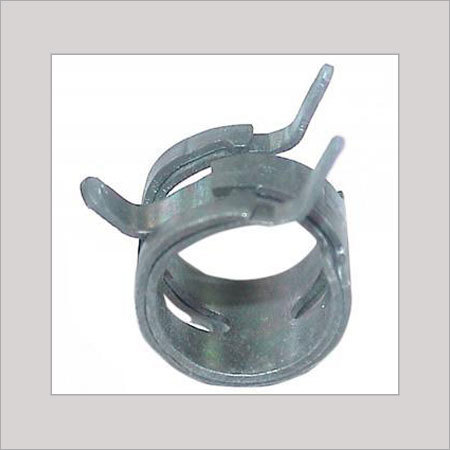
The problem with the clips (can we call them Jubilee (tm) style clips? ) is that the saddle under the screw is rigid, and formed to one particular radius. If this radius doesn't match the OD of what you're trying to clamp then you don't get even pressure, and particularly with smallish diameter Jubilee (tm) style clips at the bottom end of their size range you get no pressure at all on the pipe where the band meets the saddle, despite the screw being tight, and the hose feeling secure (do one right up and look at it end-on to see the effect). Ironically, the tighter you do them up, the worse this can be, even to the extent of puckering the hose up in this area and forcing it away from what you're trying to clamp it to (hopefully a proper hose barb).

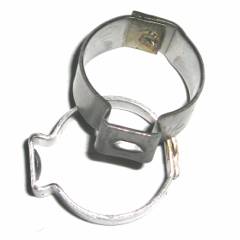
A solution is to replace the worm drive clips with ones that uses spring pressure or a screw to tighten a metal band or wire clip.

Like this:
4d24_1_bo.JPG


or
312.jpg


or
O-CLAMP.jpg


You should be able to get them as 'fuel hose clamps' in Halfords, or similar if you have to.

Andy

(Smilies removed, as they counted towards my allotted 4 pictures ?wtf? )

Edit: I started typing this before Bilgediver's post above ! Doh.
 
Last edited:
Whoops Bilgediver
Sorry just realised what I said.
The return pipe with the none return flow valve fitted goes from the block to the diverter 'T' and then into the selected tank.
The other return from the block (no return valve fitted) goes back to the secondary filter as discribed.
Does this change your thinking??
Thank you for you constructive comments
Regards
Mike
 
I can relate a similar story that still applies to my boat today. It was working perfectly but the decision was made to have it and the injectors serviced professionally. During the service the engineer noted that the fuel line (filter to engine) was not to the required spec (it was clear reinforced tube which was presumably OK at the point we built the boat) and replaced it with a straight piece of black regulation tube. We started to use the boat again and soon after started experiencing embarrassing engine failures. Obviously fuel since bleeding the engine got us going again. The engineer rebuilt the fuel system, still no luck. Eventually I replaced the fuel line with the clear reinforced again – with a large downward U bend at the end just before the engine. Problem largely solved. Now an air bubble we can see grows over several hours motoring and when deemed too large can be worked through the engine by flexing the U bend – no bleeding necessary. We just need to mitigate the risk of using, what is now, non-standard fuel line.
 
Whoops Bilgediver
Sorry just realised what I said.
The return pipe with the none return flow valve fitted goes from the block to the diverter 'T' and then into the selected tank.
The other return from the block (no return valve fitted) goes back to the secondary filter as discribed.
Mike


Although Volvo and other engine makers have insisted on certain models recirculating the spill fuel to restrictor nozzles and back int the low pressure fuel system it is not a good idea in an imperfect world.


CAV filters under negative had have a habit of drawig air which cannot be sen as the air sits in the top half of the filter ad invisible. Usually the engine can cope with minor leaks and a lot of the air finds its way to the spill system.

If the spill system dumps to a fuel tank then all iws well and the air is disposed of back at th tank however if the spill sytem dumps to the fuel pump suction as Volvo sometimes do then it is now remaining in the system and being added to by fresh leagage air and from time to time there will be enough air in the system to stop the engin by airlocking the fuel pump.

You can check this theory by disconnecting your spills from thereturn to filter an allowing tem to discharge to a tank or container. Then run the engine and see if it performs faultlessly,also if you feed the fuel to the bottom of a container and view it are you able to see air bubbles coming from the spill line.

The clips you have used are not the best for the job as at this size you need the correct clps which another poster has put up pics, or preferaly get the pipes crimped.

I pressurise m fuel tank by using a dinghy pump or by holding plastic hose in the tank filler with rag jammed around to improve the seal and then blowing down the hse or using a dinghy pump. This is the only way I can get fuel to flow out f the top bleed o the CAV. The CAV must be full with NO air.
 
Concur with bilgediver and the others who look at the leakoff system with suspicion.

The system cannot self bleed if the leakoff is being presented back into the system anywhere from the stack pipe to the inj pump inlet. The air will just go around and around until it builds up enough to stop the motor.

It has to be presented back to the tank OR a t piece fitted in the return line complete with a lengthy vertical hose going to a plenum chamber that is capable of being purged of any air build up.

That's if I understood correctly how your system is rigged.

I hesitate to knock your system, you look to have done a neat and tidy job, but as with the others, in my opinion, worm drive hose clips for small bore tubing on hose tails are the work of the devil. You would have been better with cable ties (and spreaders), or better still, crimp type clips.

A visit to somewhere like Dunlop Hiflex or Pirtek Hose would have got your hoses fitted with swaged fittings and suitable 1/2" BSP (IIRC) twin male connectors for a surprisingly small price.

Still, if the system could self bleed, you wouldn't have an issue.

We can all sit here and pontificate, yet the human calling to think "it'll be fine" is a strong one.
I am sure everyone on here (I have and I'm a qualified diesel engineer, tho been out of the game for 12 years now), have done something that they know is not the purest way, but have nevertheless incorporated it into their boat knowing that the chances are that it will not present any problems.
So don't sweat it. :)
 
Last edited:
I haven't read all the posts here so apologise if I am repeating previous wisdom.
Using rubber hose and hose clips in place of proper compression jointson fuel systems is very bad practice and I suspect that this is the problem although you say everything is tight. A neat installation is not necessarily a good one!
I have had CAV filter aglomerators on the suction side of my system for 26 years and have had no problems. So I doubt this is the problem. The only thing you have changed is the perfectly good copper tube and compression joint system, therefore you should be looking at the less suitable system you have installed.
 
Hi Gents
Many thanks for all your 'constructive comments'
I think I understand about the fuel return issue that if air is building up it has nowhere to escape, so my line of action will be:
Check the overflow air vents are clear.
Look at the return system in more detail in particular the feed return back to the secondry filter.
Check washers on Primary filters as suggested
Look at jubilee clips
It will be no good doing it 'all in one go' otherwise I will not know which improved the situation, BUT I have to bottom this problem!
The joys of having a boat!
Best Regards
Mike
 
I haven't read all the posts here so apologise if I am repeating previous wisdom.
Using rubber hose and hose clips in place of proper compression jointson fuel systems is very bad practice and I suspect that this is the problem although you say everything is tight. A neat installation is not necessarily a good one!
I have had CAV filter aglomerators on the suction side of my system for 26 years and have had no problems. So I doubt this is the problem. The only thing you have changed is the perfectly good copper tube and compression joint system, therefore you should be looking at the less suitable system you have installed.

Hello RFC
Just to confirm
The existing copper piping was 'microbore', which caused my first problem by clogging up with muck from the fuel tanks,(later both removed and cleaned)
It was the suggestion of a marine engineer that the microbore was very small for delivery fuel and why not go for 8mm main fuel feed and 6mm return,also both tanks were going through only one filter at that time, if that filter failed I was dead in the water, hence I set about designing the new system.
Then at that point I decided to ripe everything out and start again.
Like most problems to solve you can be 'to close' and sometimes 'miss the obvious' and the help on this post has given me plenty to think about which I will certainly be putting into action.
Thanks for your coments everything has helped to give me ideas.
Mike
 
Top