Encapsulated keel filling, need advice.

Turboviolet

New Member
Joined
10 Apr 2012
Messages
17
Location
Bristol
Visit site
Hi,

On the boat I'm currently repairing (restoring more like to be honest) encapsulated keels cracked because of the rusted ballast some time ago. Cement was taken out, cracks patched and a roofing lead scrap thrown in. The ballast was loose and the keels open from the top when I bought it.
I've taken all the ballast out, properly cleaned everything from the inside and now ready to encapsulate the ballast with the resin... hence the questions...

1: Is it better to melt the lead scrap and cast it into cupcake size pellets or shred it?
2: If it is better to shred it, then how to clean the lead of the rust (some steel pellets from the old ballast was mixed in and keels still leaking) and oxidation?
3: What resin to use? I did search the forum and people are suggesting the Poliester Cast Resin. Called MB Fiberglass and they suggested this one http://www.mbfg.co.uk/crystics-9293-casting-resin/crystics-9293-casting-resin-20kg.html Will it do the job? They said to do it in stages and not to mix more than 500ml of resin at once....

Any suggestions welcome. My wife don't really fancy me melting 900kg of lead on a stove in our kitchen :)
 
In an earlier thred someone collected, for scrap price, the lead weights from tyre fitters. Could also try a scrap yard for lead flashing. If melted in to blocks, then you would need less resin to encapsulate and keep the weight as low as possible.

For melting, why not use an open fire outdoors? Lead has a low melting point. Cheap and keeps fumes to a minimum.
 
If you want to do the best job ie lead as low as possible then you need to melt the lead and mold into the shape you need to drop into the keel. Lead can be melted fairly easily over a fire or gas ring but be very careful. If you heat up the stuff out of the keels the lead should melt first and be able to pour off the lead.
You need to get the shape of the place it will go perhaps by lining with polythene then pouring in plaster. getting it out will be the hard part. Once you have a plug mold then you can make a mold to take the lead. I have used GRP polyester resin and glass. It is immediately destroyed by the molten lead with much smoke but I was able to get a decent lead shape out of the mess. Make sure the slug of lead is going to fit easily into the keel. Then just drop it in with lots of polyester resin.
Alternatively you may be able to fashion a mold for the lead out of steel or ali approximating the shape you need.

Just to explain. I have a grp centre board with lead ballast on my little boat. I wanted more lead at the tip and was able to fit a bit more length in. I removed the CB and sat it upside down. With lots of wax etc I made a GRP mold of the tip of the CB. This was removed when hard and reattached about 40 cms away from the keel tip. I cut away some of the original GRP of the keel. I cut away a big hole in the now tip of the mold so lead could be poured in. I got about 15kg of lead into it.
Much smoke from burning GRP but when cold I peeled off the GRP mold to have a nice lead shaped keel tip. I laid glass and epoxy over that to form a tough tip. It still gets battered by inadvertent groundings but after 20 years or more the mod was a good idea.
Was it a good idea to use GRP for a lead mold? Well it certainly seems iffy but if thick enough I found it held the lead until it was cool. You might find high temp epoxy for the mold but i don't know if it would be worth it.
Of course you may think it OK to just drop bits of lead into the keel but you won't get as much in or as low.
DSC_1897.jpg (96.1 KB)
Here is the little boat getting a pull down test to measure righting moment. I think the added lead made a lot of difference to righting moment. olewill
 

Attachments

  • DSC_1897.jpg
    DSC_1897.jpg
    96.1 KB · Views: 11
Hi,

On the boat I'm currently repairing (restoring more like to be honest) encapsulated keels cracked because of the rusted ballast some time ago. Cement was taken out, cracks patched and a roofing lead scrap thrown in. The ballast was loose and the keels open from the top when I bought it.
I've taken all the ballast out, properly cleaned everything from the inside and now ready to encapsulate the ballast with the resin... hence the questions...

1: Is it better to melt the lead scrap and cast it into cupcake size pellets or shred it?
2: If it is better to shred it, then how to clean the lead of the rust (some steel pellets from the old ballast was mixed in and keels still leaking) and oxidation?
3: What resin to use? I did search the forum and people are suggesting the Poliester Cast Resin. Called MB Fiberglass and they suggested this one http://www.mbfg.co.uk/crystics-9293-casting-resin/crystics-9293-casting-resin-20kg.html Will it do the job? They said to do it in stages and not to mix more than 500ml of resin at once....

Any suggestions welcome. My wife don't really fancy me melting 900kg of lead on a stove in our kitchen :)

The ballast in the keels of may boat is composed of steel stampings, mixed with a little resin.. The space above it is filled with a two component expanding foam ( not the rubbish builders one component stuff) and the whole lot then glassed over .

This however is what can happen if the keels are damaged and water gets in ( this boat became within a hair,s breadth of being scrapped but someone took it on and repaired it)

DSCF1194.jpg
 
Making a mould is not an option in my case. I access that space via 4 holes in 4 different lockers. To open it up completely i would have to remove the whole wooden interior apart from a forecabin. And all I got left before the boat goes back into water is 5 weekends :(
So the main question remains - to cast lead into pellets or clean it somehow and shred it.
Shredding sounds like good option for me. Lead scrap I got is an old roofing material with thickness of no more than 2mm. If I cut it in pieces of ~ 60mm x 4mm x 2mm, then pour and suppress it into keel with low viscosity casting resin on top. Let it settle then foam and fiberglass over.
 
If you are careful you can melt the lead outdoors in the garden then pour it a little at a time into a bucket of water you will end up with a lot of small pear shaped droplets. Just exercise a modicum of care and thought when melting and pouring the lead. Also lead fumes are dangerous so don't stand over the pot breathing in whilst it's melting.
 
Pouring hot lead into water sounds a bit dangerous... On other hand clean and small lead pellets are probably the best to fill in with resin.

Regarding the repair, it was done 8 years ago and all 8 years boat was in the water. So should be alright. When I stripped everything down to fiberglass I found a fiberglass patch on both sides where it was cracked. Now the outside is done. Everything filled, sanded, primed, antifouled... looks like new.
 
Tar looks like ideal material as it stays soft and will seal any possible leaks. But I can't find any information how it works with GRP over time. It may affect the resin. And another silly thing - I couldn't find where to buy it. Go to the nearest travellers site, maybe...? ;)
 
Pouring hot lead into water sounds a bit dangerous... On other hand clean and small lead pellets are probably the best to fill in with resin.

Regarding the repair, it was done 8 years ago and all 8 years boat was in the water. So should be alright. When I stripped everything down to fiberglass I found a fiberglass patch on both sides where it was cracked. Now the outside is done. Everything filled, sanded, primed, antifouled... looks like new.


Not that dangerous do it in small quantities, pour slowly from about a meter hight higher if possible into as large a volume of water that you can manage, wear a full face visor welding mask or safety specks, gloves and away you go. Done it for a friend when we put over a tonne of additional lead into his steel keels.
 
From a 1.5 meters high step ladder into a bucket full of water...
Where to get BBQ coal this time of a year?

If you have a water butt that would be better and use a propane fed gas ring sheltered by a shield of bricks the crucible can be just a steel ladle it doesn't need to be anything special. As Parzi indicated you would be creating a form of shot tower. It works:encouragement:
 
I would prefer to smelt over a gas flame for greater control - outdoors for safety. if you cast into a channel and then chop into lengths roughly equal to the width, either with a guillotine or cold chisel, it should be quite quick and easy. Of course, it would be better to have no sharp edges to promote overall wetting with the resin, but moulding spheres slows everything down and dribbling into water, the way shot used to be made, involves handling difficulties and personal risks.

Worth mentioning that lead flashing is almost pure lead as are modern wheel weights, whereas old wheelweights were lead/antimony alloy to harden them. An unencapsulated lead keel is hardened with antimony, to make it harder, but it doesn't offer any real benefits in an encapsulated keel.

Rob.
 
If you are mixing resin to refill a moulded GRP keel you need a slow-setting resin mix with very little accelerator and enough but not too much catalyst. Using standard pre-accelerated laminating resin if there are any larger patches/gloops of resin it can get very hot going off, just possibly hot enough to catch fire from the exothermic heat of the reaction.
 
20170304_143528.jpg

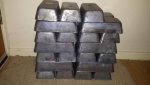
340kg processed out of 816kg project weight. Minus 2x90kg iron cast shoes.... Less than 300kg left to melt. Out of which approx. 100kg still to source somewhere :(
 
I've just about got all the lead I need for ballast and have melted down most of it into blocks of about 15 kg each. (17 in. X 4 in. X ½ - 2 in.)

I find it very east to cut with my hand circular saw so I shouldn't have too much trouble fitting it precisely into the bilge.

I am in two minds as to what to hold it in place with. I already have a twenty gallon drum of bitumen but I like the idea of polyester resin as it would make the keel more solid when on the hard. Does anyone have an opinion on the preferred material?

The designer says "Ballast plus trim 7,840 lb / 3,556 kg". What weight should I allow for trim? Maybe 250 kg? I presume that should only be set in place once I have the anchor chain in the locker and full water and fuel tanks?
 
Top