Encapsulated Keel Damp Patches - How bad can this be?

Kurphy

New Member
Joined
6 Jul 2020
Messages
10
Visit site
Hi,

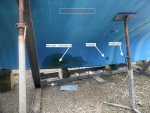
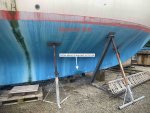
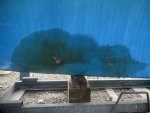
I'm trying to work figure out what to do here. My big old boat with encapsulated keel has had bilge water in it for quite some time. Year of manufacture 1979 and is ver thick fibreglass. There are now patches on the side of the keel that smell like the bilge... could it be that the bilge water has seeped down here and come out through the glass? Whatever is going on in there has opened up the paint in the worst spot. The big patch on the port side has two smaller patches on the same line heading aft. On the starboard side, there is a smaller patch on the opposite side. Online research has given me the wobbles but lots written about keel bolts and so on but no keel bolts here. Anyone had this before on a long keeled boat? If so, how serious is it, and what was the fix?
 

Attachments

  • IMG_5168.jpeg
    IMG_5168.jpeg
    638.3 KB · Views: 150
  • IMG_9067.jpeg
    IMG_9067.jpeg
    942.1 KB · Views: 150
  • IMG_9717.jpg
    IMG_9717.jpg
    937.8 KB · Views: 138
Should have mentioned the boat has been out of the water for over 2 years. Also diesel leaked into the bilge and the stains on the keel smell like diesel.
 
Keel bolts are irrelevant to encapsulated keels. As PeteK says, knowing what make/model the boat is will help.

Do you know whether your keel ballast is lead or (more likely) steel or iron? Is it a solid lump(s) of metal or (more likely) metal punchings set in resin?

As you are probably aware from your reading, the problem, if it is steel or iron and water gets to it, is that it will rust and expand. That is certainly not necessarily terminal (and from your pictures I guess it's not in your case), but in severe cases it can be. Ingress of water can be the result of either absent or incomplete sealing of the ballast surface inside the boat, or from damaged GRP on the outside of the keel (including, especially, underneath the keel).

Can you see any bulges in the external surfaces of the keel (including that in the bilge), or is it all smooth and the correct shape?

Assuming no, or only minor bulging, I'd suggest you need to drill holes in, or remove patches of, GRP in the appropriate places to drain all the water out. Then laminate over the top of the ballast to absolutely prevent any further water getting in that way. (This will be challenging to do properly because the existing surface will be contaminated by oil and diesel, etc.) Make good any previous damage to the keel's GRP, and properly fill the holes and/or patches made to drain it. I'm sure others can provide more detailed guidance on such repairs.
 
Ahoy. Thank you so much for your replies. We don't know the make model of the boat. We know the hull/deck was was built by Robert Ives in Christchurch to a Colin Archer design. We don't know who did the interior or laid the ballast in, this could have been also done by Robert Ives.
 
Keel bolts are irrelevant to encapsulated keels. As PeteK says, knowing what make/model the boat is will help.

Do you know whether your keel ballast is lead or (more likely) steel or iron? Is it a solid lump(s) of metal or (more likely) metal punchings set in resin?

As you are probably aware from your reading, the problem, if it is steel or iron and water gets to it, is that it will rust and expand. That is certainly not necessarily terminal (and from your pictures I guess it's not in your case), but in severe cases it can be. Ingress of water can be the result of either absent or incomplete sealing of the ballast surface inside the boat, or from damaged GRP on the outside of the keel (including, especially, underneath the keel).

Can you see any bulges in the external surfaces of the keel (including that in the bilge), or is it all smooth and the correct shape?

Assuming no, or only minor bulging, I'd suggest you need to drill holes in, or remove patches of, GRP in the appropriate places to drain all the water out. Then laminate over the top of the ballast to absolutely prevent any further water getting in that way. (This will be challenging to do properly because the existing surface will be contaminated by oil and diesel, etc.) Make good any previous damage to the keel's GRP, and properly fill the holes and/or patches made to drain it. I'm sure others can provide more detailed guidance on such repairs.
Great answer thank you. There's no bulging and there is no sign of rust coming through.
 
Should have mentioned the boat has been out of the water for over 2 years. Also diesel leaked into the bilge and the stains on the keel smell like diesel.
I reckon the "damp" patches probably are due to diesel

If they are some water splashed on them wont wet the surface


Get someone who works in a lab to make you some water detection paper** which will determine if its water or not

** see Preparing and using cobalt chloride indicator papers
 
Last edited:
It looks like there is something connected to the bottom of the hull, indicated by the straight line that can be seen in the pictures. Look at the starboard side damp patch, you can see the line running through it. Remove the paint along this line and see if a shoe has been bolted or screwed on. My encapsulated keel has a noticeable radius at the bottom turn, yours is a lot sharper than mine. Your hull profile and age of hull may mean that a shallow keel was added in line with traditional construction methods being replicated in GRP, just a guess.
 
Last edited by a moderator:
The only slightly useful comment that I can make is that if any water was able to gain access to the ballast, it's better if the ballast is lead, and not iron. Easily checked using a magnet. As has already been said, it's more likely to be diesel, and the penetrating power of diesel is legendary.
 
You might try talking with Oiltechnics, who specialise in removing hydrocarbon (inc diesel) spills. They have a range of fluids which "eat" diesel and it might be that you could add some to the bilges and the water/cleaner mix will migrate following the diesel stain.

Oiltechnics will be able to advise you on the compatibility of their products and GRP layups and resin.
 
I think at the very least you need to strip all antifouling and other paint from and around the damp patches so you can see what's going on. I'm wondering if some water in a deep sump froze over a winter and in expanding, caused a crack.
 
I think at the very least you need to strip all antifouling and other paint from and around the damp patches so you can see what's going on. I'm wondering if some water in a deep sump froze over a winter and in expanding, caused a crack.
+1 You also need to check the bottom of the keel; there could be wear there that has penetrated the GRP. If the ballast is steel punchings, that could be bad but not fatal news.
 
As said above, I'd drill two or three 10mm holes low down and angled up at 45 degrees or so to encourage water to drain out.
If it drains then I'd hole cut a hole of around 50mm dia about 3 or 4" above the bottom of the keel right in the middle of your damp patch.
Taper in the hole from the outside in.
Then flush and flush again using a strong detergent like bilgex and then fresh water until you're happy you've got rid of most of the diesel and then get it dry.
A mirror or shiny ss sheet or something to reflect the sun onto the area will help.
Then when dry, epoxy laminate the hole,
fill and fair,
couple of coats of epoxy primer,
tie coat,
antifoul.

If it didn't drain we're into a different approach.....
 
This is awesome help guys thank you. We’ve only just acquired the boat and the keel issue was really worrying us.

This is what I’m going to do:
1. Seal up leaky deck fittings (this is where the rain water was coming in, sealant lost its seal ) and find and fix diesel/oil leaks in engine.
2. Thoroughly clean bilge.
3. Remove paint from patches.
4. drill holes and drain whatever is in there.
5. Check for damage under keel and identify what the foot is if there is one.
6. hit bilge with acetone and flush any moisture out through drilled holes. Making sure boat is well ventilated.
7. fix any cracks in the keel
8. If rusty ballast treat with anti rust treatment.
9. Reseal bilge with resin if needed and paint.

Does this sound like a logical approach?

Found some more info on the boat.
Hull moulded by Robert Ives Christchurch in 1977. Rest of the work done by Cox Marine (Golden globe race builder) in 1979. Model is a CA40 Colin Archer pilot cutter design only a handful made most of her sisters hips are in Norway. Displacement 18t length 40 beam 13.

We’re just starting this project and this is the first post I’ve made on this forum and I can see how valuable this place is going to be. I have a busy few months ahead of me and I’m glad to have your help at hand. Hopefully can give back somewhere when I find a thread I can contribute to.
 
I am less than happy about the acetone. Yes it will dissolve diesel but will thin it and make it more able to creep if there are voids in the ballast area.

Perhaps see what results from the drilling , first ? Then ask Oiltechnics if you have diesel in the keel..
 
This bloke has plans for the original Colin Archer designs. While it is not your design, he suggests that ballast keels were fitted and this may have been replicated in the GRP design.

ColinArcherPlans

Ballast Keel.
Ballast keel is an issue. These designs have originally different keel solutions.
Some have a lead keel. Lead is now quite expensive so alternatives may be considered.
Traditionally the boats had cast iron ballast-keels. This is not everywhere available, or can be expensive.
Some have steel box filled with a steel/concrete mix. This is a cheaper keel and gives good strength as it goes under the whole length of the wood keel.

Before drilling holes, if the keel can be removed, perhaps the bolting inside and the join is what is leaking, or it is encapsulated ballast (cast) that has moved or swelled, repair work here will cure the problem. Of course the crap has to be removed and cleaned up as well and maybe drilling is teh only way. Have you looked into the bilge, what do you see, is it flat topped at a shallower depth, or does is it profiled to a V shape. I would have a good search, if water tanks are fitted in the space, lift out and look under. I would also try and contact owners in Norway and seek advice.
 
This is awesome help guys thank you. We’ve only just acquired the boat and the keel issue was really worrying us.

This is what I’m going to do:
1. Seal up leaky deck fittings (this is where the rain water was coming in, sealant lost its seal ) and find and fix diesel/oil leaks in engine.
2. Thoroughly clean bilge.
3. Remove paint from patches.
4. drill holes and drain whatever is in there.
5. Check for damage under keel and identify what the foot is if there is one.
6. hit bilge with acetone and flush any moisture out through drilled holes. Making sure boat is well ventilated.
7. fix any cracks in the keel
8. If rusty ballast treat with anti rust treatment.
9. Reseal bilge with resin if needed and paint.

Does this sound like a logical approach?

Found some more info on the boat.
Hull moulded by Robert Ives Christchurch in 1977. Rest of the work done by Cox Marine (Golden globe race builder) in 1979. Model is a CA40 Colin Archer pilot cutter design only a handful made most of her sisters hips are in Norway. Displacement 18t length 40 beam 13.

We’re just starting this project and this is the first post I’ve made on this forum and I can see how valuable this place is going to be. I have a busy few months ahead of me and I’m glad to have your help at hand. Hopefully can give back somewhere when I find a thread I can contribute to.
If you don't mind me asking what was the final analysis of thia problem. Thanks.
 
Top